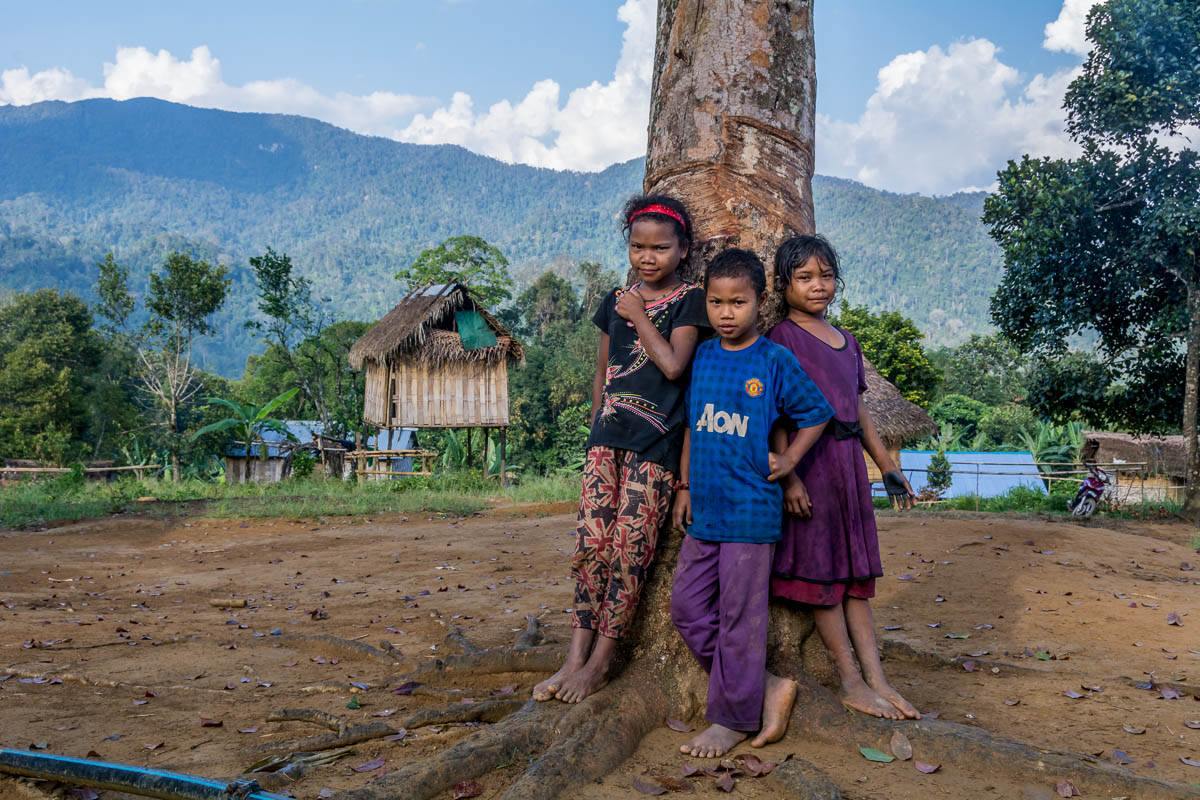
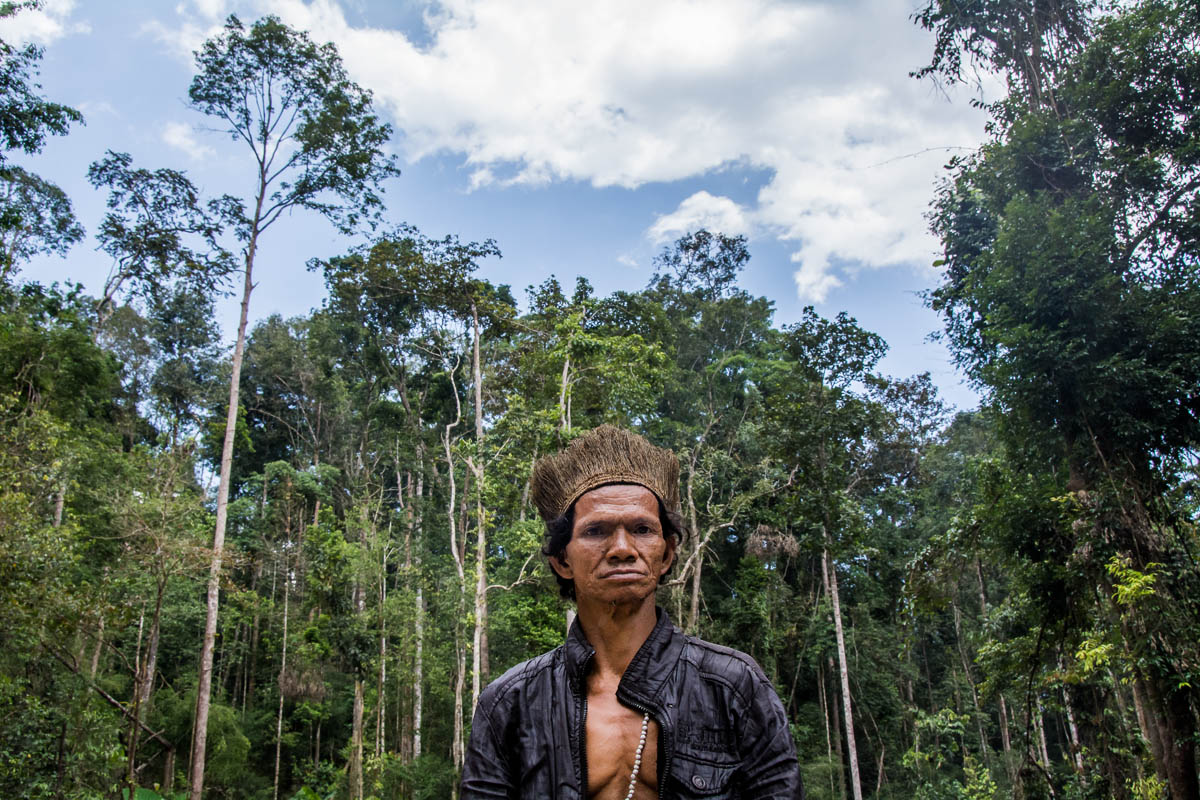
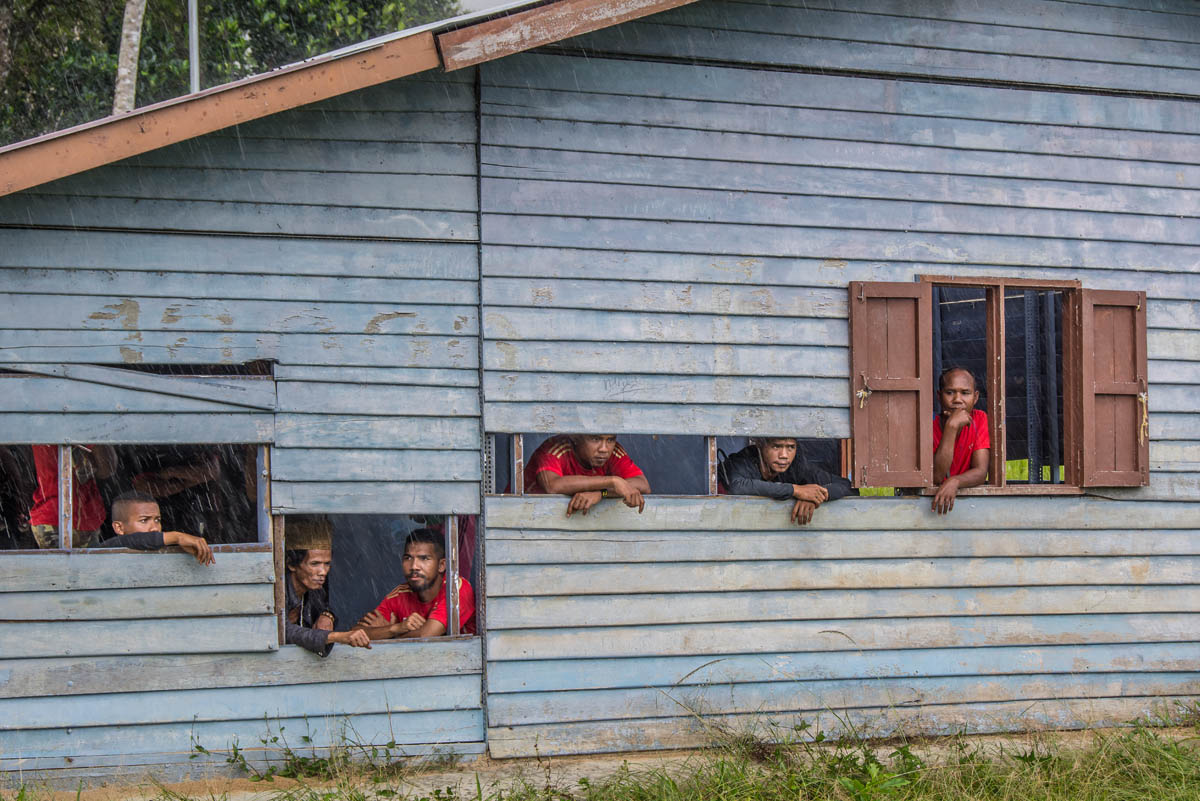
Siberut Island_17


Kornelius lights a paraffin lamp in the traditional Uma clan house in Dorogot hamlet, an isolated community in Siberut’s swamp forest. Electricity has yet to reach Dorogot, but is already being rolled out in neighbouring villages Rogdog and Madobag as part of a Biomass generation scheme.

Head of the clan, an elderly Mentawai ‘Sekerei’ shaman sits on the porth of his uma clan house in Dorogot hamlet.

A Mentawai woman bathes her baby in a traditional Uma clan house in Dorogot hamlet. Siberut Island, part of the Mentawai archipelago in western Indonesia, is recognized as a U.N. Biosphere Reserve due to its outstanding cultural and ecological value.

Skulls of hunted monkeys, hornbill and pigs hang from the rafters in an Uma clan house in Dorogot hamlet. Many Mentawai people still follow an old animist belief system of which this decoration is a part.

Toikot is a traditional shaman healer with his animals inside his traditional Uma house. Siberut Island, part of the Mentawai archipelago in western Indonesia, is recognized as a U.N. Biosphere Reserve due to its outstanding cultural and ecological value.

Toikot (right) is a traditional shaman healer here speaking to his Grandson inside his traditional Uma house. Siberut Island, part of the Mentawai archipelago in western Indonesia, is recognized as a U.N. Biosphere Reserve due to its outstanding cultural and ecological value.


This forested, hilly area slopes down to the coast along the Telaga River, through ancient mangrove forest. But since the 1980s, it has been increasingly opened up by government-sanctioned development projects; more recently, in 2013, mangrove clearance has resumed for the commercial farming of shrimp (also referred to as prawns). This resurgence has brought the company Sunlight Inno Seafood Company Sdn Bhd, which is supported by the government, into conflict with local communities that depend on the mangroves for their livelihoods.
In response to mangrove clearance, six indigenous Orang Asli communities in the district have come together to form the “Group of Six” (G6) collective Pitas action committee. It aims to save around 1,000 acres of the remaining mangroves and get this area legally designated under their Native Customary Rights (NCR).
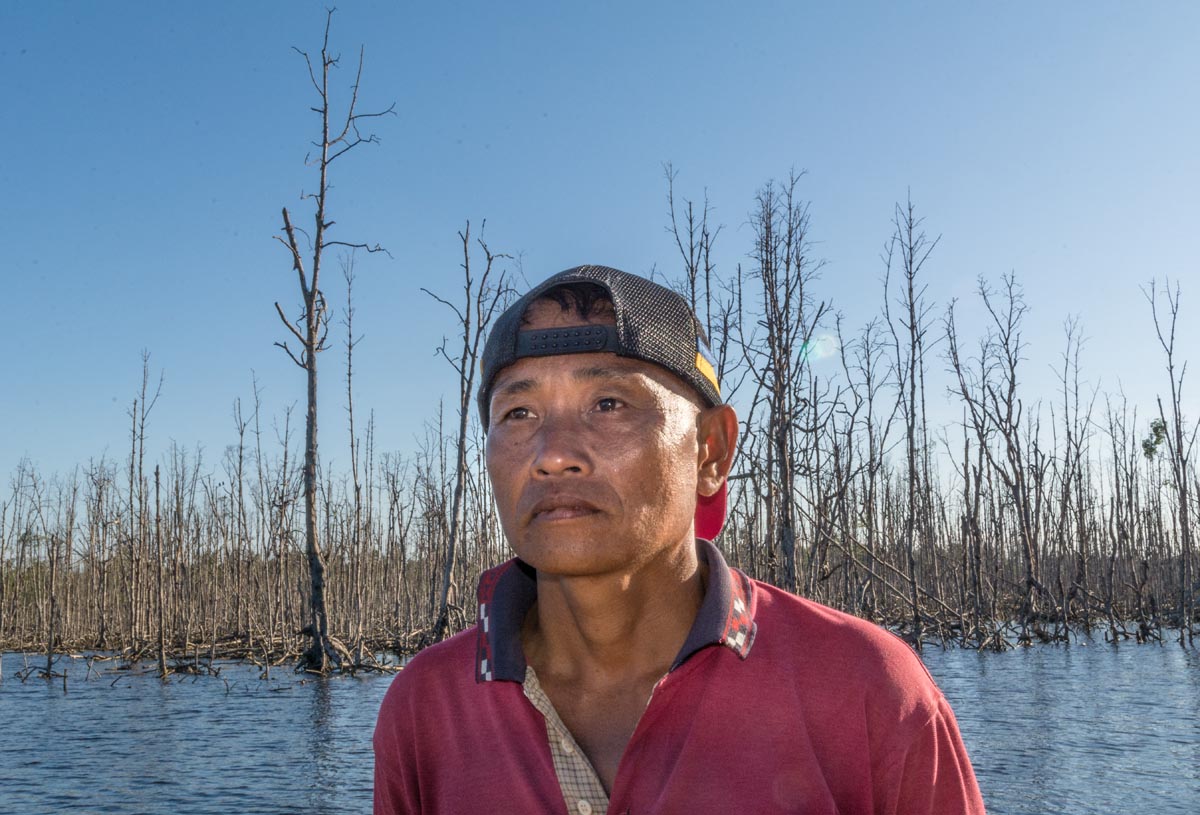
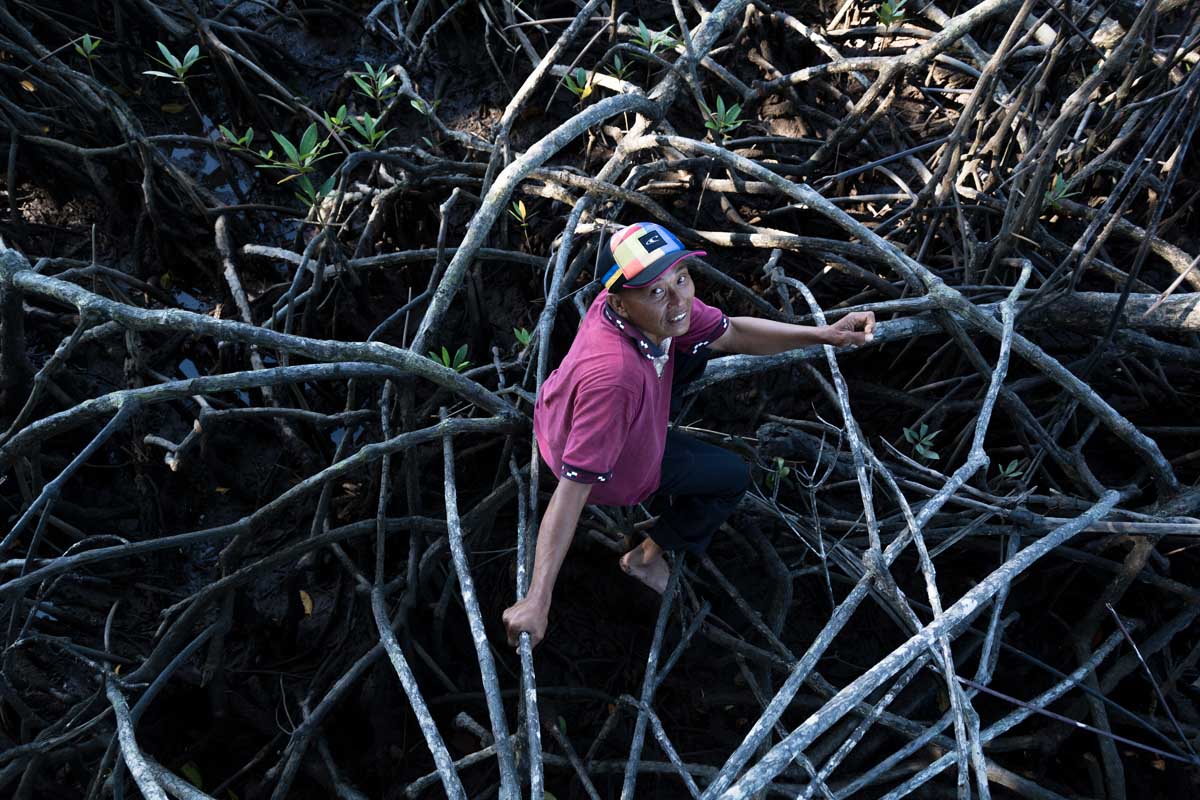
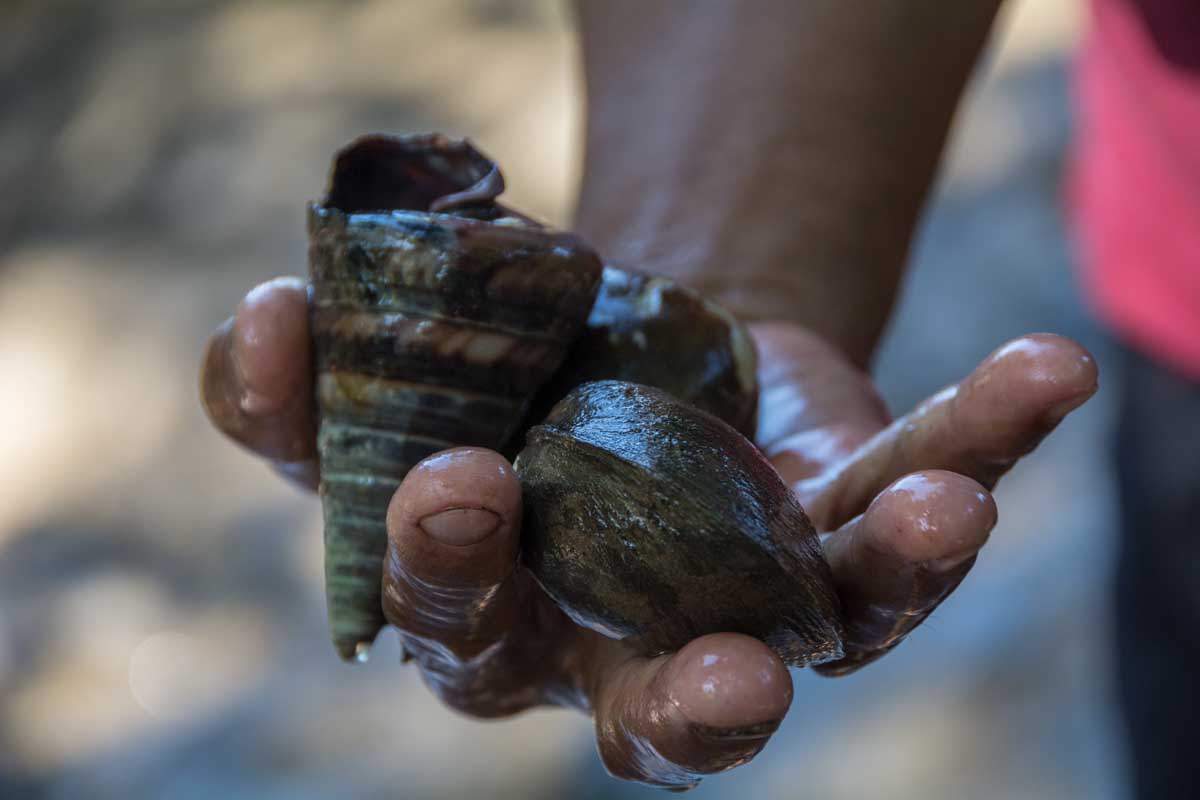
Farmer and fisherman Mastupang Bin Somoi, 52, from Kampung Sungai Eloi, is founder and Chairman of the G6 collective. In his gardens he grows vegetables, rice and a few rubber and oil palm trees. He shows me a handful of large shellfish he has gathered from the muddy riverbed at the nearby boat landing. He says the villagers in the area depend on a mix of farming, fishing and collecting non-timber forest products from the mangrove forest for their livelihoods.
“They used to be quite friendly, they were not scared of humans, but now after their habitat’s been destroyed they’ll keep their distance,” Somoi says as he watches two proboscis monkeys (Nasalis larvatus) bound through the trees. As the boat he’s on proceeds along a channel through the mangroves, a two-meter (6.5-foot) estuarine crocodile (Crocodylus porosus) slides from the bank into the water. These mangrove forests are home to a wide diversity of vulnerable species, some of them listed under the Convention on International Trade in Endangered Species of Wild Fauna and Flora (CITES).
“This sign says, ‘no encroachment’,” says Somoi, pointing to a sign tied to a tree. The signs have been placed by the communities to demarcate the perimeter of the mangrove forest claimed under their NCR. Around 2,300 acres have already been cleared under the project and this is set to expand next into an additional 1,000 acres, pending the outcome of an Environmental Impact Assessment (EIA) started in 2015.
Further along, Somoi points out a burial site he says is sacred to the communities. Soon the dense mangrove forest opens into a clearing of stark devastation with dead mangrove roots bleached silver by the tropical sun and the dark peat earth beneath torn into grooves by heavy equipment. Most of the forest has already been cleared and the communities are desperate to retain the remainder on which they depend for resources, as well as the other ecosystem services it provides.
The shrimp farms cut out of the mangrove forests are secured with two-meter-high solid metal fences backed with coils of razor wire to keep people out. One plot visited by Mongabay was an area about 400 meters (1,300 feet) across containing artificial ponds in which water was being circulated with turbine pumps; a handful of workers was on-site.
Lanash Thanda, president of the NGO Sabah Environmental Protection Association (SEPA), described how the project was originally initiated by the Sabah Forest Development Authority (SAFODA) as part of the 2010 Malaysian Economic Transformation Programme to bring economic development to the poverty stricken area. “There is no water connection so people save rainwater from their roofs and when that is gone have to pay for deliveries,” Thanda said. She explained that levels of poverty in Pitas are high compared with most of Sabah. However, according to Thanda, the project has floundered due to mismanagement and a lack of processing, storage and transportation infrastructure. “Look at their office – it’s new. That’s the prawn farm company. When I came in November it wasn’t there,” said Thanda, explaining how the project is proceeding despite initial deficiencies. “The Sunlight company was supposed to open a plant in Pitas to process prawns and provide 3,000 jobs, but nothing is happening,” Thanda told Mongabay. She said local people are dismayed that foreign workers have been brought in, and that few of the jobs originally promised have materialized. Sunlight Inno Seafood Company Sdn Bhd did not respond to requests for comment.
The boat stops at a large stand of dead mangrove trees. The communities suspect they were poisoned because at the same time the trees died, “all the fish died” in the area, Thanda said. This area of mangroves was frequently used by local communities, and its destruction galvanized members from the G6 collective into action. In June 2015 they confronted workers clearing the area with heavy equipment.
“We spoke to the other G6 communities. Thirty-seven members came down. We posted a notice and painted the hitachis [digging equipment],” Somoi said. “In the notice we explained that we are giving you [the equipment operators] 24 hours notice to vacate this area, because this is our NCR [Native Customary Rights] area. If you do not leave after this we will not be responsible for actions taken against you from the communities. Then we left.” According to Thanda, thirty staff from the G6 communities working in the shrimp farms were sacked within the following month. She suspects that this was punitive retaliation by the shrimp company for protesting further clearance.
The equipment was subsequently removed and the Environmental Protection Department responded that an EIA would now be conducted on the area to assess whether clearance should proceed. But despite beginning in 2015, the EIA is still pending. The G6 collective has since been active in denouncing the conduct of the EIA process and the project in general. Meanwhile, according to SEPA, in December 2015 the State Cabinet approved clearance of a further 3,000 hectares of mangrove forest in the region.
On April 27, 2017, a delegation from the G6 collective travelled to the state capital Kota Kinabalu to deliver a letter to Chief Minister Datuk Seri Musa Aman, requesting that he intervene to stop the mangrove clearance. The Borneo Post reported that the letter requested the First Minister “to intervene and protect the land in their villages from alleged encroachment by the owners of a prawn farming project there.” The Chief Minister has yet to respond to their request.
Clearance of the forest is nothing new to the communities. Bihahon Rumindon, 67, from Kampong Boluuh village (which is a member of the G6 collective), has been fighting for recognition of his land title for years. He says that while he was awarded the land by the Sabah Forestry Development Authority (SAFODA) in 1971, SAFODA did not follow though on the allocation commitment and instead used it for a local acacia plantation project now managed by Acacia Forest Industries Sdn Bhd (AFI). The company is currently structured as a 50:50 joint venture between SAFODA and the Hijauan Bengkoka Plantations Sdn Bhd (HASB) company and supported by SAFODA.
According to AFI literature, HASB is: “a Sabah based company the ultimate shareholders of which are two international timber funds. Tropical Asia Forest Fund (TAFF) is the majority shareholder managed by New Forests.”
Requests for comment sent to AFI were unanswered by press time.
Rumindon explained that his people, the Rungus indigenous people, were originally nomadic. He and his neighbors agreed to settle on the land offered to them by SAFODA. He said the department offered 18 acres of land per family if they agreed to give up their nomadic tradition, settle there and clear the forest to cultivate crops. “There was a survey conducted and stones put in the ground in 1974,” Rumindon explained, thumbing through a thick folder of correspondence with government officials.
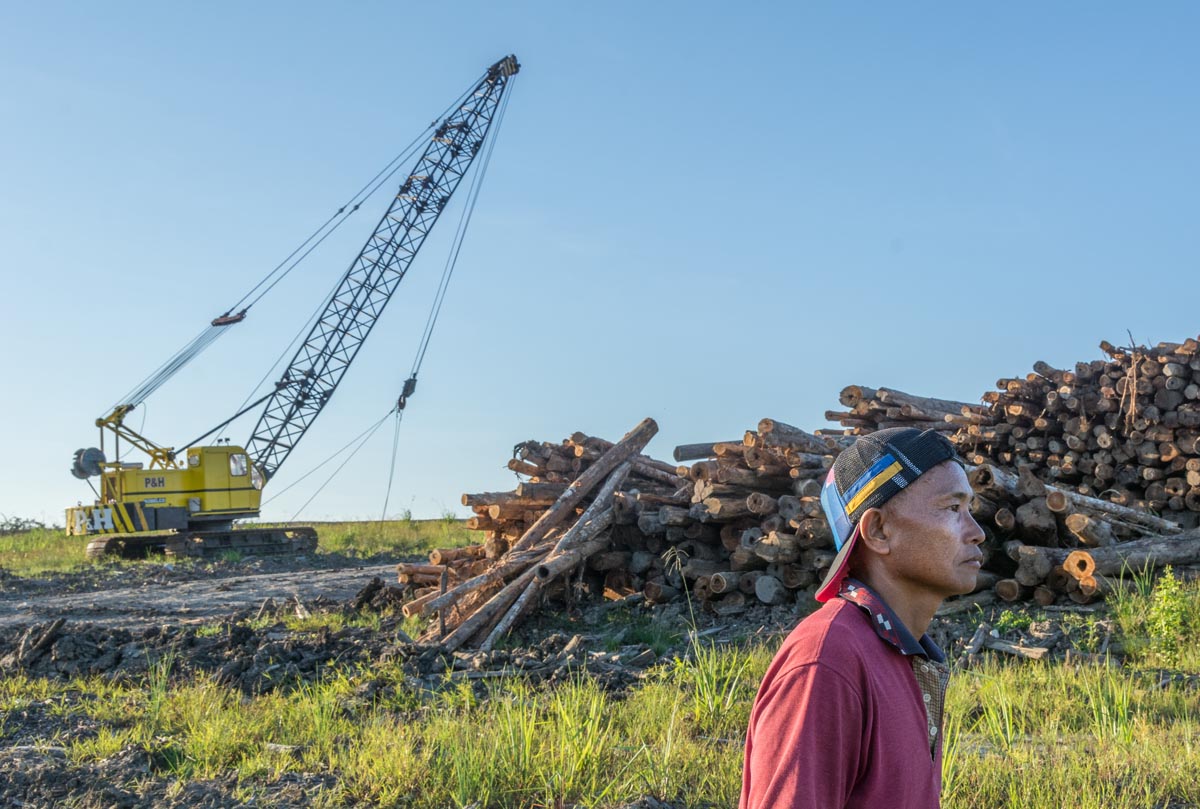
According to Rumindon, in the late 1970s the community agreed to requests from the original acacia company, Hijuan Planters, to rent the land, because the company said it would clear it. Mongabay visited AFI’s loading dock where cranes load vast piles of acacia logs onto barges destined for pulp and paper mills. “SAFODA says we are encroachers” said Rumindon, who despite his age is still struggling for a just outcome and says it was SAFODA that leased it to the company. Rumindon says the land was never returned. AFI, which took over operations more recently, retains occupation of the plantation area still under operation, and their claim appears to be supported by SAFODA.
“It took seven years to get hold of the [paper] plan,” Rumindon explained, unrolling a large detailed plan of community land from the land department. It appears to conflict with an earlier plan that clearly shows the plots allocated to community families. “SAFODA began designing reforestation and settlement projects in Bengkoka in early 1979,” reads a translated version of SAFODA’s website. “Acacia mangium cultivation was started in 1981. This project is the only large-scale institutional farm dedicated to commercial purposes.” The site does not mention an earlier land agreement, and requests for comment sent by Mongabay to several senior SAFODA staff went unanswered.
In its charter, translated from Malay to English, SAFODA says it is committed to: “Restoring and maintaining an environmentally friendly balance including flora and fauna through forestry activities.”
Rapid clearance of natural eco-systems for development projects in Sabah is an ongoing issue of concern to conservationists, and the situation in Pitas is no exception. As forest is razed for development, already-threatened species may be placed at greater risk. Meanwhile, local communities may face the loss of the many valuable ecosystem services mangrove forests provide, such as fishing, foraging and water catchment.
So far, local indigenous groups say their appeals for official recognition of their rights over these lands have largely been ignored. Critics say government development plans remain firmly in favor of supporting big businesses, despite damaging environmental consequences.
by Rod Harbinson on 13 September 2017.
Originally published by Mongabay Series: Global Forest Reporting Network
The first lesson we are taught in the Participatory Video training by NGO InsightShare taking place last October in Oxford, UK, is that mistakes are great! This is reassuring to many attending the week-long seminar, as making and screening a video to an audience can be, even for an experienced film-maker, a daunting task. Perhaps this approach is to put people unfamiliar with sophisticated technical equipment at ease.
We learn that for people in distant developing countries, often with little or no access to electricity, there are real challenges to overcome to get to grips with the Participatory Video process. Yet despite the challenges, among those involved in a growing global network of practitioners, there is a shared experience that participatory video, or ‘PV’ in short, generates remarkable results.
InsightShare is a key organisation at the forefront of pioneering and developing this methodology. PV first evolved in Canada in the late 1960s. Don Snowden was an early pioneer who developed the PV methodology at a small fishing community on Fogo Island in Newfoundland. InsightShare has been actively building the skills of communities worldwide since it began in the late nineties. Since then it has accrued a deep body of knowledge used to refine the effectiveness of its teaching.
The workshop curriculum is developed by drawing on years of accumulated hands-on experience in the field. Workshops are practically orientated with participants encouraged to learn by doing. At the end of the process the participants can showcase a tangible outcome of their efforts – their own video.
Although a simple concept at its core, implementing the PV process in the field can be fraught with difficulties. This is especially so as many of the communities with which InsightShare works are poor, often exploited and at the margins of society. Many have difficult issues to confront which can sometimes include tensions within the community itself or conflicts with powerful external actors such as corporations or governments.
Simply put, PV is a way of teaching people to make their own videos using video cameras and editing equipment. Used to support communities in developing countries, it has been gaining credence for some years as a way of providing them with a vehicle to identify and amplify their collective voice.
Many of those who have experienced the workshop-led process say they have found the experience empowering because it provides a way in which they can express themselves, their culture and opinions, without interference from outsiders who often promote their own agendas.
“They are open to it. So it’s another way of building community… that for them is really new, as a way of addressing their issues, their problems, their situations, or just showing what is beautiful within their territory. So I think they realise that this approach is different.” explained Thor Edmundo Morales. He has been an Associate with InsightShare since 2015, facilitating trainings in his native Mexico and more recently Liberia and Kenya in Africa.
The practical dimension of PV is to provide communities with the skills and equipment to produce their own videos about the lives of their community, their neighbours, relatives and each other. Then the process enables them to use these videos in ways that they find useful – however they decide that might be.
A typical film screening premiere will first entail showing the films to the community itself, so that everyone involved can identify with the results and share in the collective experience. Often this leads to discussion and self-reflection which can deepen understanding of important issues within the community.
“I think communities see themselves within the mirror which is the screen. Seeing themselves in the video, they start spotting new problems, issues, concerns or things they like, that they haven’t seen before.” explained Thor.
Many of InsightShare’s projects are with Indigenous People, often living in remote regions, and frequently with little access to services that we take for granted such as electricity. So it is something of a paradox that the PV methodology is quite heavily laden with high-tech equipment requiring an electricity power supply.
This issue throws up a bundle of technical and teaching issues which the PV methodology needs to overcome and address in order to be successfully adopted. People living in marginal circumstances are often dependent on subsistence livelihoods, making the most of the local environment to provide through forest foraging, agriculture, fishing or animal husbandry. Often participants will not have come into contact with modern equipment such as video cameras and computers in their day to day lives, and these will be unfamiliar to them.
The introductory process involves a series of exercises to help participants get acquainted with the concepts and equipment. Thor explained how he found workshop participants in Africa initially fearful of the technology, but this soon changed: “When they first saw the computer they were really afraid to use it and then after about two hours they were like, oh this is so easy,” he said.
“In Mexico many people we work with, particularly amongst the Yaqui, they had never touched a camera or computer before.” explained Thor. The Yaqui indigenous people live in the Sonora desert region in Northern Mexico. They have faced violence and intimidation as companies construct a gas pipeline across their territory, infringing their rights and threatening the fragile environment.
Anabela Jeka Carlon Flores, an indigenous Yaqui lawyer, is fighting the pipeline with her community of Loma De Bacun. In April 2016, Anabela’s community won a legal ruling requiring suspension of pipeline construction across Yaqui territory. However, the companies behind the pipeline: SEMPRA and INOVA, have ignored the court ruling and continued building.
Undeterred Anabela continued campaigning for justice, but in December 2016 she was kidnapped along with her husband and once released fled fearing for her life.
Anabela attended an InsightShare workshop with other members of her community in 2015 and soon came to appreciate the benefits: “The main benefits are that people are really thinking about their land, their culture, they are questioning. Before you cannot really see that they question big projects.” said Anabela, at a safe location some distance away from her home community, shortly after her kidnap ordeal. Soon she plans to overcome the threats she has received and return home.
Different communities around the world find PV useful for different reasons explains Thor: “The Yaqui use the cameras to record interviews, to show as proof to the Inter-American Commission on Human Rights, for the struggle they were having. They gathered a lot of interviews and sent them as evidence to sustain their case,” he said.
While InsightShare refrains from getting directly involved in community struggles, it does equip communities with the tools and skills to be able to put forward their perspectives and opinions, sometimes to policy-makers or companies that are disrupting their lives. This is in keeping with the now widely established view that effective development must recognise power relationships and equip people with the skills to be able to participate in the discussions and decision-making processes that effect them.
The Maasai people of Kenya and Tanzania in East Africa are nomadic pastoralists who regularly move with their herds of goats and cattle. After independence it was agreed that the Maasai would move from their lands to allow the creation of the Serengeti game reserve. They were given new lands in the Ngorongoro region, which is now hotly contested by different stakeholder’s including the government, conservationists, investors, the tourism industry and the Maasai people themselves.
The Maasai say that in recent years their community rights to use the land have been increasingly eroded and ignored. Along with big game animals The Maasai became a familiar part of the safari tour, regularly appearing in safari promotional literature and media coverage.
“The image and the name of the Maasai is used to sell everything from the safari tour to I don’t know – hand soap. Just everything. It is a very heavily exploited image. One that is not in the control of the Maasai people themselves.” said InsightShare facilitator Gareth Benest, who has held PV workshops with the Maasai.
“Everyone was distressed and emotional. We discussed how the Maasai brand is worth an estimate US$10 million annually but the community gains no benefit. This was one of the most difficult sessions I have ever had with the group.” said Gareth.
It is not only ongoing voyeurism of the Maasai and exploitation of their image. Since colonial times a romanticized view of their lives has been constructed by outsiders projecting their own view of the Maasai upon them, which may be completely inaccurate. It may also gloss over pressing issues.
Gareth explained how at their first workshop the Maasai participants were excited to be able to tell their own story: “They said that we’ve had journalists come and go. We’ve had film crews, we’ve had photographers come and go, and we’ve seen how other people tell our story, and now it’s time for us to tell our own story.”
“PV is a particularly interesting and exciting tool in enabling a community that has never benefited from being able to represent themselves in the world, to start to take control of their own image, albeit in a small way to begin with.” Gareth explained.
Sometimes the burning issues for a community have less to do with pressures from outside and more to do with contested issues within the community itself such as changing attitudes towards cultural traditions. Alternatively, it is common for powerful actors seeking to exploit communities, to use divide and rule tactics (such as bribes, intimidation and offers of work), to create conflict within communities, so weakening their opposition.
“I was given an award, a distinguished human right defender” said Samwel Nangiria of NGO-Net in April 2017. He was awarded the Rural Human Rights Defender of the Year by NGO the Tanzania Human Rights Coalition. “Human rights have no borders and its protection calls for global community. It was really emotional. The Olosho video was screened to show the voices of the people… I mean I had to shed tears of hope and happiness. There will be a big community reception party in Loliondo… It’s a victory for the entire community.” said Samwel.
Samwel is from Loliondo in the Tanzanian state of Arusha and has been involved in PV since the first workshop was held in 2015. He said that PV has improved, “Unity among communities, and in particular the clans within Loliondo.” He said, “the video has restored trust” and bridged the breakdown in communication between segments of the community and clans, “that was rampant before.” Samwel explained.
“Three of them have had over a year of arrests, of beatings, Samwel was tortured.” Gareth said, explaining that the impact of the video has caused the government to review its approach. “Previously the government thought, well all we have to do is silence the troublemakers, get rid of these individuals and we’ll be able to implement our own plans for the land. When the video came out there was a realisation that even if they do silence those people, they can’t stop the community’s voice from being heard. The government changed its whole approach because of this. It no longer saw force as an option.” Gareth explained.
Samwel relayed how his community found the PV process provided a way to amplify their concerns and ensured that they were heard, even in political decision-making circles: “The Olosho video was taken by many politicians at the last general elections (in 2015) as a starting point for our community based land rights campaign.”
“Recently, the video was re-screened before the government mission that was in the district trying to strike a balance between wildlife and people in the Loliondo Areas. The mission was seeking for the community position with regards to wildlife conservation and investment in the village lands.” said Samwel.
A finished video product is usually, though not always, a significant outcome of the PV process. However, Gareth is keen to stress that their model of PV is not driven by video outputs. Sometimes there are situations in which members of the group consider that releasing their film could attract adverse attention, exacerbate community divisions or provoke repression from external forces.
The most important result of the experience is not necessarily the final video, but more the learning and experiences shared by community members as they go through the production process.
Assessing the precise impact of the PV process is arguably impossible as it is not just about counting the number of finished videos produced. However the growing body of monitoring and evaluation learning that InsightShare has gathered, demonstrates the effectiveness of the methodology, and this has proved attractive to donors, ever keen to show that their money has real and tangible outcomes.
Once the workshop is finished and it is time for InsightShare’s facilitators to move on, the question arises as to what happens in future. InsightShare is always keen to leave behind the hardware (camera, sound equipment and laptop) to enable communities to continue making videos in their own time and for their own needs.
Samwel explained that PV has had a “high multiplying effect.” and he is working to train others in the community to pass on the skills: “We would like to advance the capacity-building of the group (‘Oltoilo-le-Maa’, meaning ‘Voice of the Maasai’) to establish a simple and functioning community media hub.” he said.
“The videos we created in Mexico, I took them to Kenya and Liberia and we showed them.” Said Thor, explaining the benefits of sharing and reflecting on PV work, no matter where in the world it has been produced. Thor explains the wider strategy being pursued for networking groups together: “InsightShare is trying to make a network where people trained by InsightShare actually meet each other…Put people together so they can interact.” he said. This network of regional hubs is now taking shape to share experiences of PV worldwide.
As the workshop wraps up in Oxford the group forms a circle and reflects on the six day training. Everyone shares how the intensive learning experience has both touched and challenged them in different ways. On one thing everyone agrees – the PV process involves much more than simply making a video.

Learn more about PV on the InsightShare website.
By Rod Harbinson


Mongabay joined them on a convoy deep into the rainforests of northern Malaysia’s Kelantan State to supply provisions to anti-logging campaigns, traveling by night to evade detection by State Forestry Department police. Here, the Temiar indigenous peoples are resisting deforestation by setting up road blockade camps in local forest reserves. By March 2017, three blockade camps had reportedly been torn down by forestry police, but the Temiar vowed to set up more.
The terrain was mountainous and the dirt logging trail had been regularly pounded by the heavy monsoon rains, making progress treacherous. The convoy passed Orang Asli villages along the road, punctuated with log piles and bulldozers at the trackside.
“If we see any of the big guys [elephants], turn off your engine and lights and wait for them to pass,” Karin Lee of PEKA (Preservation of Natural Heritage Organization) announced over the radio to the convoy.
“We brought cooking oil, rice, milk for the children, all the dry stuff for their basic everyday use,” said Sabrina Syed (full name: Puan Sri Shariffa Sabrina Syed Akil), president of PEKA. The convey of three four-wheel-drive vehicles loaded with food supplies, arrived at the isolated community of Kampong Tambaga in Pos Gob district in Kelantan State at 4 a.m., after an arduous ten-hour journey.
“We have no choice but to come in at night,” Syed said. “Of course if they see us, they have the right to arrest us,” A successful entrepreneur with an eco-resort and restaurant, Syed established PEKA in 2010.
In November 2016, the State Forestry Department stopped issuing permits to enter the forest reserve areas where the Orang Asli live, reportedly in response to the blockades. However, the forest is still subject to licenses that authorize private companies to log the forest.
“It’s not that we don’t want to ask for a permit, but they have frozen the permit at the moment because they do not want us giving any support to the Orang Asli,” Syed said.
Jules Ong, a film director and cameraman said he had already been arrested in January for filming a blockade being demolished by forestry officials.
“The sentence is three years and 15,000 Malaysian Ringit just for entering a jungle,” said Ong during an interview in March 2017. He thinks he will find out next month whether he will be charged. Despite this, he still decided to join the supply convoy into the forest reserve without a permit.
Section 47(1) of Malaysia’s National Forestry Enactment (NFE) prohibits entering a forest reserve without a valid permit.
“You can apply for a permit [at] the Gua Musang Forestry office,” Encik Razali Bin Abdu Raman from the Kelantan State Forestry Department said during a March 23 interview. He was unclear, however, on whether the freeze on permits was still in place. The Gua Musang Forestry Department office confirmed that a permit was required to enter the forest reserve, but refused to clarify whether it would issue one to enter the area where the blockades had taken place. Although the Orang Asli – which translates to “original people” and refers collectively to the indigenous groups of West Malaysia – have been living a subsistence livelihood for millennia, community members say their high level of dependence on food gathered from the forest has made them vulnerable to the impacts of logging.
“The logging companies keep on coming to the area. We want to stop that. This land has belonged to us for hundreds of years, since our ancestors,” said Yussuman Bin Andor, a Temiar man from the village of Kampong Pos Gob.
“We plan to do the blockades again to protect the waterfalls, the river, the medicinal plants,” Bin Andor said. “The fish in the river are all finished, we don’t have fish anymore. So we have to stop the logging however we can.” He explained that the river has silted up due to soil erosion from nearby logging. He said the variety and amount of plants gathered for use in cooking and healing has also declined, leading to concern about the impacts of logging on their region.
The main reason for bringing in the food supplies, Syed explained, is to sustain the communities while they are spending time on their logging blockades.
“They have to spend a lot of time on the blockade so they don’t have time to look for food,” she said.
The headman of Tambaga convened a meeting the morning after our arrival on March 12 to welcome the guests and thank them for the food supplies. Then, more than forty men assembled from the surrounding Temiar communities to discuss their next steps together with their lawyer Siti Kasim and PEKA’s Sabrina Syed.
“We will be mounting another blockade in the coming weeks,” announced Temiar activist Mustafa Along after the discussions, which included a debate on whether or not forming human chains would make future blockades more effective.
They agreed that they would keep the blockades peaceful despite what they described as heavy-handed tactics from the Forestry Department. Singaporean English language Asian cable television news agency Channel NewsAsia (CNA) reported the Forestry Department used chainsaws to cut down their manned barricades in January, allegedly leaving one man seriously injured.
“Blowpipes are not for fun, not for display, they are used for a certain reason. If we use blowpipes it is to kill,” said the elected headman elder known as the “Panghulu.” He reminded those assembled that the presence of poison dart blowpipes at the blockades was unacceptable as tribal protocol stipulates they are reserved only for killing. The Orang Asli live in permanent forest reserves administered and policed by the State Forestry Department. According to CNA’s investigation, 90 percent of reserves are licensed out to logging companies.
Syed says that the Forestry Department profits handsomely from the logging business.
“When they give out the licenses they get money immediately,” she said.
Experts say that logging, though not a new part of the economy in Kelantan, has taken a new turn in recent years. “Selective logging [of big trees] is being replaced by clear-cutting for plantations,” said Shamila Ariffin, research officer with Friends of the Earth Malaysia.
According to Forestry Department numbers, Kelantan had 867,866 hectares of forest in 2008 and is the state with the third-largest forested area in peninsular Malaysia. However clearance for conversion to timber plantations has skyrocketed from 14,819 hectares in 2008 to 166,291 hectares in 2014, for a total of 151,472 hectares converted over this period, and still continuing.
Tree cover loss — which signifies both deforestation and tree plantation harvesting/clearing activity – has increased in Kelantan in recent years. Satellite data from the University of Maryland show nearly a third of the state experienced tree cover loss from 2001 through 2015, with 2014 showing the highest loss numbers over that period. Intact forest landscapes – areas of original land cover large and undisturbed enough to retain their native biodiversity levels – are relegated to Kelantan’s southern and western peripheries.
Areas targeted by logging companies include remaining intact forest landscapes (IFLs), with satellite imagery from Planet Labs captured April 2017 showing a large network of logging roads infiltrating a now-degraded IFL. Activist and indigenous groups are setting up blockades in the region to stymie further logging activities.
“What the authorities are doing now is they are clear-cutting the forest to plant rubber trees and it affects the water catchment area,” Syed said, explaining how heavy erosion after logging has caused siltation in rivers. “Once the water catchment is affected, the rivers are affected, and the fish in the rivers, so everything is affected like a domino effect.”
Those working with the Orang Asli say there is little official recognition of their rights. In a report, the NGO Friends of the Earth Malaysia states “in Peninsular Malaysia forestry resources are stipulated to be the absolute property of the state, while Orang Asli communities are burdened with numerous legal restrictions and impediments in their efforts to manage their ancestral forests.”
Siti Zabedah Kasim is a lawyer with the Malaysian Bar Council. She has dedicated herself to legally representing the rights of the Orang Asli for several years and is a frequent visitor to their communities.
“I‘ve decided to choose the Orang Asli area because I feel they are still under-represented and they need empowerment, they need more help,” Kasim said in an interview. She added that it is a painstaking task because “the court case will take so long,” by which time the loggers may have concluded operations and moved on.
According to Kasim, Orang Asli claims of land rights and ownership to their communal forest are routinely ignored by the State Forest Department.
“The Forest Department seem to think that the Orang Asli here are only ‘tenants at will,’ meaning they are not the occupier or the land-owners,” she said. “They keep saying that these people are merely squatters, have no rights basically. So because of that, the Forestry Department seem to think they can do whatever they like by taking the land or log around their ancestral land, without thinking how it will affect the community.”
The Malaysian governance structure provides state governments with the highest level of control over decisions relating to land use.
“It’s a problem when even the Human Rights Commission set up by the government…came up with a report with 16 recommendations [that] are still not done,” Kasim said, adding that the federal government does have a responsibility for the rights of the Orang Asli but have been reluctant to get involved.
“The federal government can actually do something because the Orang Asli welfare comes under the federal government,” she said. “The six million dollar question that we lawyers keep asking is why? Why is it not being taken seriously by the government, the federal or the state government?”
On January 17, 2017, Kasim won a high court judgement against logging company Jejarang Wagasan, which had taken the Temiar to court for blockading their logging operations.
“We established that the Orang Asli are actually in possession [of the land], not the loggers,” said Kasim, adding, “the court agreed with us.”
However, local resident Yussuman Bin Andor alleges the Forestry Department defied the judgement and ordered guards to break down three blockades, arresting 16 indigenous Temiar people in the process.
“On that day they just ambushed and destroyed everything,” Bin Andor said.
Mongabay made several requests for comment from officials at Kelantan and Gua Musang Forest Departments, but those requests were denied or went unanswered.
“They [the logging company] actually now have appealed…so we are just waiting for the date for them to appeal. So it’s still ongoing,” Kasim said.
Kasim added that she regularly receives threats for her outspoken work, but that she intends to continue: “They don’t like that I’m an outspoken woman. I receive a lot of threats, even death threats,” she said.
Sabrina Syed and her colleagues from PEKA departed a day early in one vehicle to make the long journey out of the forest. But they did not make it out.
“We have to get out now!” Siti Kasim shouted as we were woken in the community longhouse at 1 a.m. Syed had been arrested along with two colleagues and their driver, and their vehicle impounded. With no telephone signal, a Temiar scout had made the arduous journey through the night on his motorbike to alert us that the same temporary Forestry Department checkpoint that had caught them was still in place.
Attempting a longer route that would have bypassed the checkpoint, our way out was halted by a landslide. Instead we waited in the forest until Temiar scouts could check the situation. We finally got word in the small hours of the night that the checkpoint had been left unmanned and at 6.30 a.m. we finally emerged from the forest.
Syed and her companions were arrested at the roadblock, then escorted in a vehicle convoy to the town of Gua Musang. On the advice of her lawyer, Syed insisted on going to the police station rather than the Forest Department office. After a night in the police station, Syed and her companions were able to leave on bail terms. Mongabay spoke to her immediately after her release.
“You are trespassing on a Forest Reserve so you have to come with us,” Syed said, relaying what the Forestry Department guard had told her at the moment of their arrest. She said they were escorted out of the forest by three vehicles.
“Our lawyer recommended we go to the police station instead of the Forestry Department,” she said, and once there they filed a police report. She said that when they had finished, they attempted to leave the police station but were blocked by Forestry Department guards.
“They started getting rowdy. They pushed our hands behind our backs,” she said, adding that they retreated back into the police station.
“This Forestry Department is furious at us for opening this can of worms, the corruption and so on,” Syed said.
The Forestry Department did not respond to attempts made by Mongabay to confirm the events.
“We are all on verbal bail and have to return here April 14,” said Karin Lee of PEKA.
On April 23, Malaysia’s High Court ruled that 9,300 hectares of Gua Musang forest legally belongs to the Orang Asli – including 1,000 hectares the Forest Department had slated for clearing.
However, Lee said that the Forest Department is still threatening to destroy any new blockades.
“They [the Forestry Department] also ‘advise’ the community to not further set up any [more] blockades,” Lee said, adding that the department provided a warning that “if they continue with [a] blockade, the [Forestry Department] will NOT hesitate to demolish it under the forestry act.”
Syed, who was also arrested in December 2016 for making comments about deforestation, which the Sultan of Johor Baru regarded as insulting, vows to continue.
“They expect me to stop doing all this or what?”
GUA MUSANG, Malaysia – In their fight for the rights of peninsular Malaysia’s native people, the Orang Asli, an alliance of women are making waves in the country’s highly conservative society as they support the efforts of communities and activists trying to stop logging of the region’s forests. The women represent a variety of fields and organizations and are speaking out and even risking arrest in their struggle for the forests and the communities that depend on them.
Mongabay joined them on a convoy deep into the rainforests of northern Malaysia’s Kelantan State to supply provisions to anti-logging campaigns, traveling by night to evade detection by State Forestry Department police. Here, the Temiar indigenous peoples are resisting deforestation by setting up road blockade camps in local forest reserves. By March 2017, three blockade camps had reportedly been torn down by forestry police, but the Temiar vowed to set up more.
The terrain was mountainous and the dirt logging trail had been regularly pounded by the heavy monsoon rains, making progress treacherous. The convoy passed Orang Asli villages along the road, punctuated with log piles and bulldozers at the trackside.
“If we see any of the big guys [elephants], turn off your engine and lights and wait for them to pass,” Karin Lee of PEKA (Preservation of Natural Heritage Organization) announced over the radio to the convoy.
“We brought cooking oil, rice, milk for the children, all the dry stuff for their basic everyday use,” said Sabrina Syed (full name: Puan Sri Shariffa Sabrina Syed Akil), president of PEKA. The convey of three four-wheel-drive vehicles loaded with food supplies, arrived at the isolated community of Kampong Tambaga in Pos Gob district in Kelantan State at 4 a.m., after an arduous ten-hour journey.
“We have no choice but to come in at night,” Syed said. “Of course if they see us, they have the right to arrest us,” A successful entrepreneur with an eco-resort and restaurant, Syed established PEKA in 2010.
No permit, no entrance into the forest
In November 2016, the State Forestry Department stopped issuing permits to enter the forest reserve areas where the Orang Asli live, reportedly in response to the blockades. However, the forest is still subject to licenses that authorize private companies to log the forest.
“It’s not that we don’t want to ask for a permit, but they have frozen the permit at the moment because they do not want us giving any support to the Orang Asli,” Syed said.
Jules Ong, a film director and cameraman said he had already been arrested in January for filming a blockade being demolished by forestry officials.
“The sentence is three years and 15,000 Malaysian Ringit just for entering a jungle,” said Ong during an interview in March 2017. He thinks he will find out next month whether he will be charged. Despite this, he still decided to join the supply convoy into the forest reserve without a permit.
Section 47(1) of Malaysia’s National Forestry Enactment (NFE) prohibits entering a forest reserve without a valid permit.
“You can apply for a permit [at] the Gua Musang Forestry office,” Encik Razali Bin Abdu Raman from the Kelantan State Forestry Department said during a March 23 interview. He was unclear, however, on whether the freeze on permits was still in place. The Gua Musang Forestry Department office confirmed that a permit was required to enter the forest reserve, but refused to clarify whether it would issue one to enter the area where the blockades had taken place. Although the Orang Asli – which translates to “original people” and refers collectively to the indigenous groups of West Malaysia – have been living a subsistence livelihood for millennia, community members say their high level of dependence on food gathered from the forest has made them vulnerable to the impacts of logging.
“The logging companies keep on coming to the area. We want to stop that. This land has belonged to us for hundreds of years, since our ancestors,” said Yussuman Bin Andor, a Temiar man from the village of Kampong Pos Gob.
“We plan to do the blockades again to protect the waterfalls, the river, the medicinal plants,” Bin Andor said. “The fish in the river are all finished, we don’t have fish anymore. So we have to stop the logging however we can.” He explained that the river has silted up due to soil erosion from nearby logging. He said the variety and amount of plants gathered for use in cooking and healing has also declined, leading to concern about the impacts of logging on their region.
The main reason for bringing in the food supplies, Syed explained, is to sustain the communities while they are spending time on their logging blockades.
“They have to spend a lot of time on the blockade so they don’t have time to look for food,” she said.
‘We will be mounting another blockade’
The headman of Tambaga convened a meeting the morning after our arrival on March 12 to welcome the guests and thank them for the food supplies. Then, more than forty men assembled from the surrounding Temiar communities to discuss their next steps together with their lawyer Siti Kasim and PEKA’s Sabrina Syed.
“We will be mounting another blockade in the coming weeks,” announced Temiar activist Mustafa Along after the discussions, which included a debate on whether or not forming human chains would make future blockades more effective.
They agreed that they would keep the blockades peaceful despite what they described as heavy-handed tactics from the Forestry Department. Singaporean English language Asian cable television news agency Channel NewsAsia (CNA) reported the Forestry Department used chainsaws to cut down their manned barricades in January, allegedly leaving one man seriously injured.
“Blowpipes are not for fun, not for display, they are used for a certain reason. If we use blowpipes it is to kill,” said the elected headman elder known as the “Panghulu.” He reminded those assembled that the presence of poison dart blowpipes at the blockades was unacceptable as tribal protocol stipulates they are reserved only for killing. The Orang Asli live in permanent forest reserves administered and policed by the State Forestry Department. According to CNA’s investigation, 90 percent of reserves are licensed out to logging companies.
Syed says that the Forestry Department profits handsomely from the logging business.
“When they give out the licenses they get money immediately,” she said.
Experts say that logging, though not a new part of the economy in Kelantan, has taken a new turn in recent years. “Selective logging [of big trees] is being replaced by clear-cutting for plantations,” said Shamila Ariffin, research officer with Friends of the Earth Malaysia.
According to Forestry Department numbers, Kelantan had 867,866 hectares of forest in 2008 and is the state with the third-largest forested area in peninsular Malaysia. However clearance for conversion to timber plantations has skyrocketed from 14,819 hectares in 2008 to 166,291 hectares in 2014, for a total of 151,472 hectares converted over this period, and still continuing.
Tree cover loss — which signifies both deforestation and tree plantation harvesting/clearing activity – has increased in Kelantan in recent years. Satellite data from the University of Maryland show nearly a third of the state experienced tree cover loss from 2001 through 2015, with 2014 showing the highest loss numbers over that period. Intact forest landscapes – areas of original land cover large and undisturbed enough to retain their native biodiversity levels – are relegated to Kelantan’s southern and western peripheries.
Areas targeted by logging companies include remaining intact forest landscapes (IFLs), with satellite imagery from Planet Labs captured April 2017 showing a large network of logging roads infiltrating a now-degraded IFL. Activist and indigenous groups are setting up blockades in the region to stymie further logging activities.
“What the authorities are doing now is they are clear-cutting the forest to plant rubber trees and it affects the water catchment area,” Syed said, explaining how heavy erosion after logging has caused siltation in rivers. “Once the water catchment is affected, the rivers are affected, and the fish in the rivers, so everything is affected like a domino effect.”
Those working with the Orang Asli say there is little official recognition of their rights. In a report, the NGO Friends of the Earth Malaysia states “in Peninsular Malaysia forestry resources are stipulated to be the absolute property of the state, while Orang Asli communities are burdened with numerous legal restrictions and impediments in their efforts to manage their ancestral forests.”
Taking the conflict to the courts
Siti Zabedah Kasim is a lawyer with the Malaysian Bar Council. She has dedicated herself to legally representing the rights of the Orang Asli for several years and is a frequent visitor to their communities.
“I‘ve decided to choose the Orang Asli area because I feel they are still under-represented and they need empowerment, they need more help,” Kasim said in an interview. She added that it is a painstaking task because “the court case will take so long,” by which time the loggers may have concluded operations and moved on.
According to Kasim, Orang Asli claims of land rights and ownership to their communal forest are routinely ignored by the State Forest Department.
“The Forest Department seem to think that the Orang Asli here are only ‘tenants at will,’ meaning they are not the occupier or the land-owners,” she said. “They keep saying that these people are merely squatters, have no rights basically. So because of that, the Forestry Department seem to think they can do whatever they like by taking the land or log around their ancestral land, without thinking how it will affect the community.”
The Malaysian governance structure provides state governments with the highest level of control over decisions relating to land use.
“It’s a problem when even the Human Rights Commission set up by the government…came up with a report with 16 recommendations [that] are still not done,” Kasim said, adding that the federal government does have a responsibility for the rights of the Orang Asli but have been reluctant to get involved.
“The federal government can actually do something because the Orang Asli welfare comes under the federal government,” she said. “The six million dollar question that we lawyers keep asking is why? Why is it not being taken seriously by the government, the federal or the state government?”
On January 17, 2017, Kasim won a high court judgement against logging company Jejarang Wagasan, which had taken the Temiar to court for blockading their logging operations.
“We established that the Orang Asli are actually in possession [of the land], not the loggers,” said Kasim, adding, “the court agreed with us.”
However, local resident Yussuman Bin Andor alleges the Forestry Department defied the judgement and ordered guards to break down three blockades, arresting 16 indigenous Temiar people in the process.
“On that day they just ambushed and destroyed everything,” Bin Andor said.
Mongabay made several requests for comment from officials at Kelantan and Gua Musang Forest Departments, but those requests were denied or went unanswered.
“They [the logging company] actually now have appealed…so we are just waiting for the date for them to appeal. So it’s still ongoing,” Kasim said.
Kasim added that she regularly receives threats for her outspoken work, but that she intends to continue: “They don’t like that I’m an outspoken woman. I receive a lot of threats, even death threats,” she said.
Arrested, again
Sabrina Syed and her colleagues from PEKA departed a day early in one vehicle to make the long journey out of the forest. But they did not make it out.
“We have to get out now!” Siti Kasim shouted as we were woken in the community longhouse at 1 a.m. Syed had been arrested along with two colleagues and their driver, and their vehicle impounded. With no telephone signal, a Temiar scout had made the arduous journey through the night on his motorbike to alert us that the same temporary Forestry Department checkpoint that had caught them was still in place.
Attempting a longer route that would have bypassed the checkpoint, our way out was halted by a landslide. Instead we waited in the forest until Temiar scouts could check the situation. We finally got word in the small hours of the night that the checkpoint had been left unmanned and at 6.30 a.m. we finally emerged from the forest.
Syed and her companions were arrested at the roadblock, then escorted in a vehicle convoy to the town of Gua Musang. On the advice of her lawyer, Syed insisted on going to the police station rather than the Forest Department office. After a night in the police station, Syed and her companions were able to leave on bail terms. Mongabay spoke to her immediately after her release.
“You are trespassing on a Forest Reserve so you have to come with us,” Syed said, relaying what the Forestry Department guard had told her at the moment of their arrest. She said they were escorted out of the forest by three vehicles.
“Our lawyer recommended we go to the police station instead of the Forestry Department,” she said, and once there they filed a police report. She said that when they had finished, they attempted to leave the police station but were blocked by Forestry Department guards.
“They started getting rowdy. They pushed our hands behind our backs,” she said, adding that they retreated back into the police station.
“This Forestry Department is furious at us for opening this can of worms, the corruption and so on,” Syed said.
The Forestry Department did not respond to attempts made by Mongabay to confirm the events.
“We are all on verbal bail and have to return here April 14,” said Karin Lee of PEKA.
On April 23, Malaysia’s High Court ruled that 9,300 hectares of Gua Musang forest legally belongs to the Orang Asli – including 1,000 hectares the Forest Department had slated for clearing.
However, Lee said that the Forest Department is still threatening to destroy any new blockades.
“They [the Forestry Department] also ‘advise’ the community to not further set up any [more] blockades,” Lee said, adding that the department provided a warning that “if they continue with [a] blockade, the [Forestry Department] will NOT hesitate to demolish it under the forestry act.”
Syed, who was also arrested in December 2016 for making comments about deforestation, which the Sultan of Johor Baru regarded as insulting, vows to continue.
“They expect me to stop doing all this or what?”
Published on Mongabay.com