Carrying water carriers made from thick elephant bamboo, this woman walks home through the forest from the water source spring.
Bamboo fencing lines rice fields. The Karen practice Swidden agriculture. The forested hills of Eastern Burma roll away into the distance.
As one ventures further east from the high Himalayas where the elevation declines, vegetation takes a foothold making farming once again viable. This arc of hills and mountains spanning the countries of mainland Southeast Asia, has attracted migrants from a colourful array of ethnic backgrounds. Historically living with a high degree of autonomy, they have until recently managed to skirt the edges of lowland centres of power.
With this unit of the Karen National Liberation Army guerrillas, armed with Kalashnikov’s and old carbine rifles, we marched along mountain ridges into the interior of the self-declared nation of ‘Kawtoolei’ comprising the extent of Karen held territory. It had taken me some while to gain permission for this journey from leader of Karen forces, General Bo Mya, who presided over the jungle base of Manerplaw, on the Thai-Burmese border.
Having at the outset passed through the Burmese army’s frontline on a speeding long-tail boat, we had taken to mountain paths and spent long days walking the hilltop ridges from one village to the next.
This was 1991 and already the Karen ethnic group had been in armed conflict with the Burmese government since Burma’s 1947 independence from its British colonists. One of our Unit expressed the bitterness shared widely across the Karen nation, that promises made by the British colonial administration, had not been honoured by subsequent Burmese government’s.
As we passed Karen farmers on the trail they regularly provided reports of the whereabouts of the Burmese soldiers, who tended to stick to the valley roads and rivers. All the villages were receptive to our arrival, providing food and supplies, always without a request for payment. This ethnic war effort was pulling together in a fight to evade capture and pursue self-determination.
The Karen are not alone in their efforts and still today ethnic groups on Burma’s mountainous periphery such as the Kachin, continue their armed struggle with the distant central government for control over their land, culture and livelihood. Now that democratic elections have to some extent been respected, the dreaded ‘Tatmadaw’ Burmese army no longer takes orders from the military junta generals, but from a democratically elected government led by Aung Sung Suu Kyi, known as the ‘Lady’ who for years led the people’s struggle for democracy.
Karen men manually saw planks in a saw pit in Eastern Burma.
Further afield, spanning regional borders across mainland Southeast Asia, a similar story of struggle for contested landscapes is continuing to play out, while the infrastructure of modern development makes inroads into the fabric of the hitherto largely natural landscapes.
In his 2009 book ‘The Art of Not Being Governed – an anarchist history of upland Southeast Asia’, James C. Scott, a Professor at Yale University in the United States, challenged modern notions of statehood in the region. Overturning conventional wisdom, he argued that for millennia the upland peoples had been playing a cat and mouse game with lowland states and concentrations of power.
Scott describes the huge area of uplands about the size of Europe that spans the continent: “One of the largest remaining nonstate spaces in the world, if not the largest, is that vast expanse of uplands, variously termed the Southeast Asian massif and, more recently, Zomia.”
He argues that elevation of the topography is a key factor determining the reach of lowland states. And to some extent this remains the case despite the growing penetration of surfaced roads and communications infrastructure into the uplands. For the jungle base of Manerplaw, it was the purchase of military planes from the Chinese and the arial bombing that followed in the mid 1990’s that finally forced its residents to scatter. Not that it spelled the end of Karen resistance – far from it.
“Everything we know about the hill Karen – their historical fear of slavery, their self-image as an orphaned and persecuted people – suggests that their social structure and swiddening were designed to keep them at a safe distance from captivity.” Says Scott about this ethnic group.
Pulling apart and debunking historical assumptions applied to the hill people, Scott rewrites the history books in their favour. As he is keen to point out, with a strong oral tradition and little or no written language of their own, hill-tribes have often been misunderstood. All too often outside observers: rulers, colonialists and more recently development workers, have written histories of them, in mostly negative terms.
Carrying water carriers made from thick elephant bamboo, this woman walks home through the forest from the water source spring.
Scott however views this lack of written language as a pragmatic choice contributing to a complex strategy, which has enabled socially fluid hill populations to evade the imposition of bureaucracy by lowland administrators.
Historically a defining feature common to lowland centres of power in the region is irrigated rice cultivation: “virtually all the pre-modern state cores in Southeast Asia are to be found in ecological settings that were favourable to irrigated rice cultivation.” Says Scott.
Irrigated rice had various characteristics that rulers still favour. Scott explains how grain is relatively easy to transport as it has a “high value, per unit weight and volume, and can be stored for relatively long periods.” More importantly for state governments it is relatively easy to measure the area in cultivation, and to estimate or weigh harvested volumes. If required it is easy for state armies to appropriate grain in storage. All these characteristics make it an easy staple to tax.
The people of the uplands like the Karen traditionally use shifting ‘Swidden’ systems for their rice cultivation, which depends on rainfall in contrast to the irrigated lowland rice paddy systems. Scott explains how the “shape –shifting,” propensity of the hill people to move their settlements at a moment’s notice, has regularly confounded centres of power, be they lowland governments or colonial administrators.
Historically at least this favoured agricultural method of shifting-cultivation is often attributed as a key reason for their nomadic tendency to move-on. Convention views assume that once forested land cleared for cultivation has become depleted of nutrients and exhausted, the community is forced to move on to find fresh land.
Logging trucks ford the Salween river border between Burma and Thailand at the Thai border village of Mae Sam Laeb.
This however is an oversimplification. If shifting cultivation, or ‘swiddening’ is done in rotation, leaving fallow fields to regenerate in-between burning, the system can be sustainable. Population pressure in recent years has in some areas caused the rotations to reduce in length, leading to shorter fallows and hence reducing the time available for fields to regenerate. Such prolonged rotations are often singled-out as the cause of deforestation in the hills, despite myriad other pressures.
Scott however cites many other economic, social, political and religious reasons for communities to move, and analyses their motivations through the lens of freedom from slavery and oppression. He explains at length that the reasons underlying their selection of shifting agriculture are as much about evading political control as they are about efficiently producing food. A concept he terms, “escape-agriculture.”
A Karen boy plays in a mountain stream in the hills of Eastern Burma.
“State rulers find it well nigh impossible to install an effective sovereignty over people who are constantly in motion, who have no permanent pattern of organisation, no permanent address, whose leadership is ephemeral, whose subsistence patterns are pliable and fugitive…” Scott explains.
“The technique is seen by lowland officials, including those in charge of development programmes in the hills, as both primitive and environmentally destructive.” Scott says, and highlighting the stigma attributed to swiddening by dominant ruling cultures continues: “By extension, those who farm this way are also coded as backward. The implicit assumption is that, given the skills and opportunity, they would abandon this technique and take to permanent settlement and fixed field (preferably irrigated rice) farming.”
The “escape” advantages of swiddening involve, “poly-cropping, staggered maturities of crops, and an emphasis on root crops that can stay in the ground for some time until harvested. For the state or a raiding party, it represents an agricultural surplus and population that is difficult to assess, let alone sieze.”
Describing the hidden qualities of the humble potato at evading capture he says: “After they ripen they can be left in the ground for up to two years and dug up piecemeal as needed. There is thus no granary to plunder.”
The violence and oppression of the state from which hill people flee remains a very real issue. Though now the land available for migration has diminished while at the same time generally the power of the state has continued to increase.
Karen-Hilltribe-Thailand-Burma-Myanmar_12
Weaving traditional tribal pattern at home in a hilltop village in Eastern Burma.
Karen-Hilltribe-Thailand-Burma-Myanmar_20
A Karen hilltribe boy leans on a post in a hilltop Karen village in Eastern Burma.
Karen-Hilltribe-Thailand-Burma-Myanmar_11
A woman Karen National Liberation Army (KNLA) commander in Eastern Burma.
Karen-Hilltribe-Thailand-Burma-Myanmar_04
A Karen boy carries an ancient hunting rifle through the forest.
Karen-Hilltribe-Thailand-Burma-Myanmar_03
A Karen girl plays in the dirt in a hilltop Karen village in Burma.
Karen-Hilltribe-Thailand-Burma-Myanmar_13
A woman Karen National Liberation Army (KNLA) soldier on the parade ground at Manerplaw base camp in Eastern Burma.
Karen-Hilltribe-Thailand-Burma-Myanmar_22
This woman in a hill top mountain village in Eastern Burma is from the Karen tribe. She was said to be over a hundred years old.
Karen-Hilltribe-Thailand-Burma-Myanmar_15
Carrying a length of bamboo spliced to channel water, this Karen man inhabits a hill top village in Eastern Burma.
Karen-Hilltribe-Thailand-Burma-Myanmar_08
A Karen boy wears a headband of plastic waste, at a newly formed refugee camp North of Mae Sot in Thailand. He had fled fighting between Burmese and Karen troops along the border.
Karen-Hilltribe-Thailand-Burma-Myanmar_02
A Karen soldier climbs a hill through the forest carrying a pit saw.
Karen-Hilltribe-Thailand-Burma-Myanmar_06
A mother and child wearing traditional Karen dress in a hilltop Karen village in Eastern Burma.
Karen-Hilltribe-Thailand-Burma-Myanmar_01
A woman wearing traditional clothes from the Karen tribe, in the hills of Eastern Burma.
The Chong ethnic group from the Areng valley in the Southwest Cardamom mountains of Cambodia, still partly practice shifting cultivation in their valley, until recently isolated. The Areng river presents the lifeblood of the nine mile long valley, surrounded by steep hills of dense tropical rainforest.
Together with nature activists the Chong repelled a scheme to build a hydro-electric dam on their river which would have submerged the valley villages and farmlands. The struggle became a national rallying cry as the realisation dawned on Cambodians that this struggle was essentially about saving one of the last forested areas in the country. A country that until twenty years ago, had some of the most extensive tropical forests, remaining in the region.
Koh Kong province in Southwest Cambodia contains some of the most intact forests in Southeast Asia and is home to a plethora of rare species. The forests are under attack from multiple pressures bringing forest dwelling people into conflict with those exploiting the natural resources.
Prime Minister Hun Sen was installed to power by Vietnam forces and spent years trying to dislodge remnants of the retreating Khmer Rouge from their jungle hideouts. Including in the Cardamom mountains. He remains frank that no hiding place can be left for opposition to his increasingly unpopular regime. The corrupt kleptocratic elite under his leadership, is at the heart of the illegal logging and deforestation frenzy that has environmentally and socially ripped apart the country in recent decades.
Scott’s largely historical analysis still carries some relevance for our understanding of current struggles: “For early state elites, the periphery – seen frequently as the realm of “barbarian tribes” – was also a potential threat.” He says.
The awarding of over 200 hundred Economic Land Concessions (ELCs) each of at least 10 thousand hectares in size, has been deeply unpopular policy in a country where the majority of the population still lives off the land. Sold off to the highest bidder, often to powerful cronies within the elite and to international corporations, the land is explicitly designated for intensive industrial agriculture.
Demarcation of the ELCs has paid no regard to the existing inhabitants, nor the status of the land. National Park forests, Indigenous peoples communal forest areas, everything is up for grabs. The tragic story being played out is causing deep fissures in society as an estimated half a million farmers and forest dwelling people are forced either to stand and fight for their land or to move on.
Residents of Prek Smach commune, Kiri Sakor district building a road blockade to guard their village from threats by the Union Development Company. Botum Sakor national park, Koh Kong Province, Cambodia.
In the Areng valley the current road upgrading is being debated. In many senses it makes life easier, with regular transport to commercial centres for supplies now feasible for most of the year. Still the tropical rainy season has a major impact, washing away much of the seasonal road improvement building. In addition power cables are being erected alongside the road, causing encroachment into the forest. People raise concerns that such conveniences may also hold hidden threats to their forests as poachers arrive from outside, and an increased presence of state authorities threatens their relative autonomy.
Last year the Chong people, perhaps emboldened by their victory against the dam, embarked on the process of pursuing recognition for their indigenous rights (under the UN Declaration on the Rights of Indigenous Peoples, to which Cambodia is a signatory), with United Nations support. The Cambodian Government refuses to recognise the existence of ethnic groups, let alone the concept of Indigenous Rights.
Scott makes no claim that his analysis can be applied to today’s circumstances characterised as all pervasive: “At a time when the state seems pervasive and inescapable, it is easy to forget that for much of history, living within or outside the state – or in an intermediate zone, was a choice, one that might be revised as the circumstances warranted.”
The increasing penetration of state control over the land, is a crucial difference to Scott’s historical past where population density was low enough for hill peoples to move away from the reach of dominant state control and into largely uninhabited spaces where land for cultivation was plentiful.
However it would be wrong to suggest that this is a defining factor. For the Chong people, the experience of being galvanised into active struggle has led to a heightened level of self-empowerment. So as well as the land they are now pursuing recognition of their indigenous rights as a supplementary means of maintaining their traditional autonomy.
Likewise the growing numbers of young student activists in Cambodia who have campaigned in support of the Chong, are opening up new spaces of activism on the internet, which like their forefathers inhabiting land spaces, allows some agility to be able to act while evading the constant shadow of state oppression.
ZENIN THE TIME OF CORONAA photographic homage to Japanese Buddhism during the Coronavirus pandemicMonks planted this cedar tree a thousand years agoCleansing spring at the temple gate
Coronavirus, in short-measure, has changed the world completely. How can we make sense of this huge change in our lives? How can we cope, when our lives have been shaken-up and fears abound? Japanese Zen Buddhism offers a clear path to overcome fears and find courage, when all around us seems to be falling-apart. For thousands of years Buddhists have been meditating on the hardest challenges in life, such as sickness, grief and death.
The Zen Approach
This book offers a unique introduction to the Zen path through words, photos and Haiku poetry. More than a guidebook, it provides a space for contemplation about our current situation. It discusses the Zen approach to life, and applies it to both photography, and the emergence of the coronavirus pandemic.
Zen & Photography
A photobook with a narrative, the author shares his perspectives on the art of photography, and reflects on what the medium means in the Buddhist context. He explores Buddhist ideas found in photography, and how masters of the form have used Buddhist presence, to produce artworks which resonate widely. He explores his application of Buddhist practice to photography, and also explains how photography can diverge from a purely Buddhist way.
Zen Economics
The author reflects on our global situation as a human family, in the context of COVID-19. He asks whether the exploitative economic path, that collectively we have been on for some time, has contributed to the emergence of the pandemic. He applies Zen ideas to our economic trajectory which is eroding nature and wilderness at an alarming rate, to feed our ever growing consumption and automated lifestyles.
He pauses to consider the significance of the space that has emerged from the sudden halt in economic growth. Is it possible to draw an analogy between this global stillness, and the space of presence a person meditating can experience?
Zoonotics & Zen
Exploring evidence for the origin of the coronavirus, the author finds that while it probably originated in nature, it is important to understand, why it has crossed over into our species. Zen raises important questions about human interference in the natural world, which we need to address to re-align our relationship with nature.
In a time of global catastrophe we need to hold onto our sanity, but also map a path ahead. This path could deliver more of the same, or forge a better future direction.
Where Zen Buddhism evolved
The book is journey of contemplation of the ancient Zen path, trodden in a time of change. Through the lens of the photographer-author, we are taken on a visually and spiritually enriching journey, into the sacred mountains of Yamagata Prefecture in Japan, where Zen Buddhism evolved.
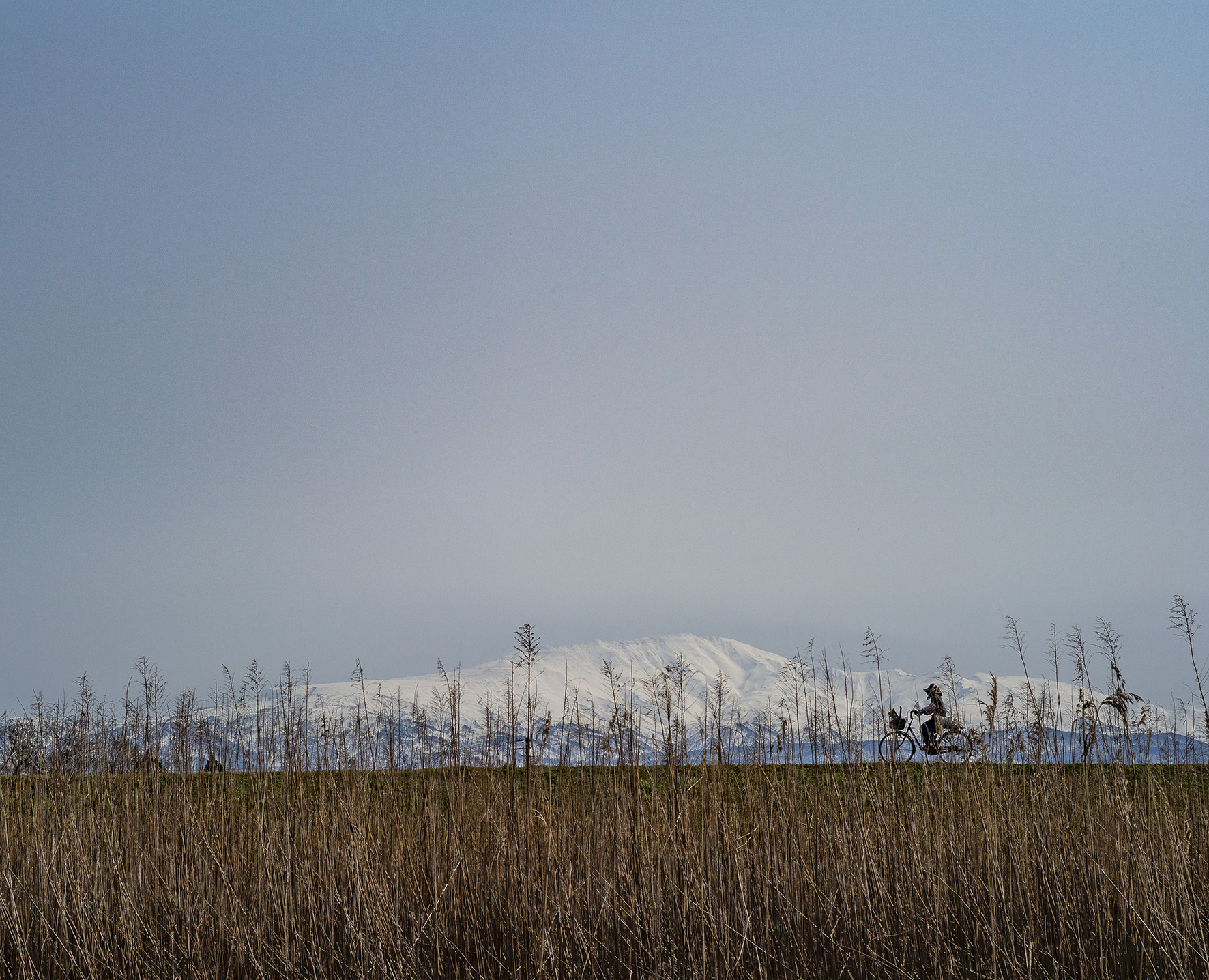
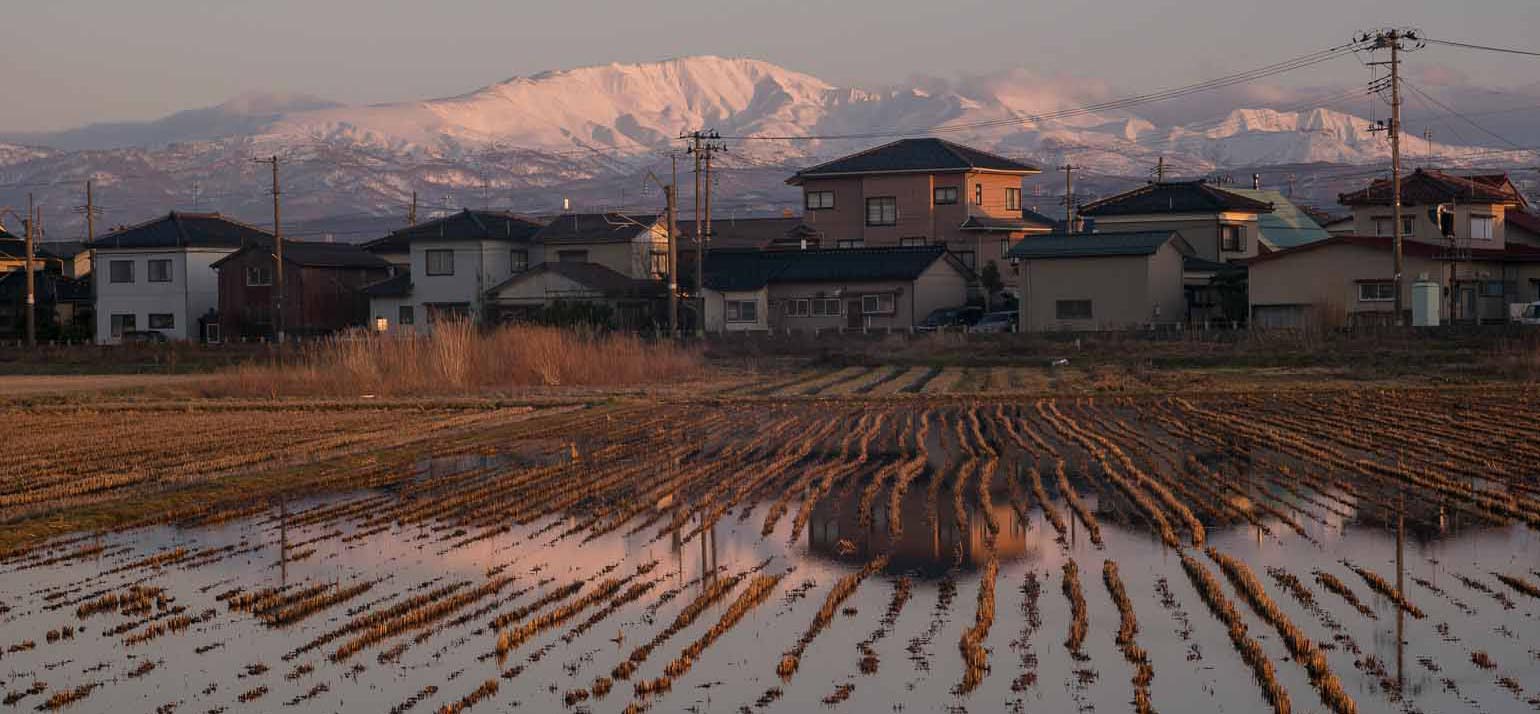
The snowy mountains of the ancient kingdom of ‘Dewa’ looking West towards Tsuruoka City and the Japan sea beyond.
Zen_Corona_02
The road towards Mount Gassan passes the venerated Gyokusenji Temple on the left in among the trees. Gassan is these days a ski resort in the winter, but still draws pilgrims, especially from Yamabushi mountain ascetics for whom it is one of the three sacred peaks of the ancient kingdom...
Zen_Corona_03
An ancient Japanese cedar grows beside a spirit house on the path to the summit of Mount Haguro.
Zen_Corona_04
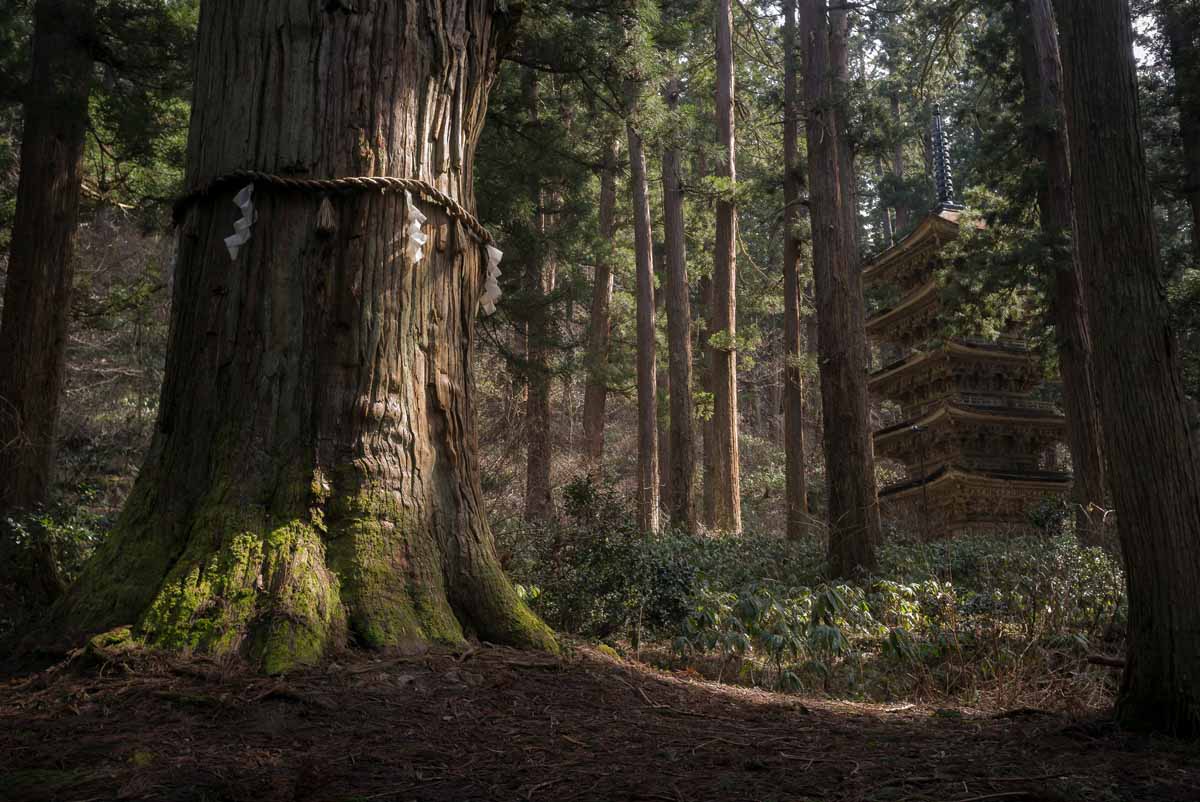
This ancient Japanese cedar tree is estimated to be over one thousand years old and is affectionately called ‘Grandpa’ or ‘jijisugi’. An equally old ‘Grandma’ tree which used to stand next to it, was torn down in a storm in 1902. In the background stands the ‘Gojunoto’ a five-storey pagoda.
Zen_Corona_05
The base of a rare six hundred year old wooden five-storey pagoda or ‘Gojunoto’, in cedar forest on Mount Haguro.
Zen_Corona_06
Thousands of stone steps constructed by priests 600 years ago lead the way to the Saikan temple at the summit of Mount Haguro.
Zen_Corona_07
An avenue of Japanese cedar trees lines the path to Mount Haguro.
Zen_Corona_08
Cedar trees and temple reflected in an icy, still pond at the summit of Mount Haguro.
Zen_Corona_09
An old stone pond at the summit of Mount Haguro.
Zen_Corona_10
A giant ‘Torii’ gate greets visitors to Haguro Mountain. In times past during the Edo period, up to three hundred lodges received pilgrims, visiting the three sacred mountains of the ‘Dewa Sanzan’.
Zen_Corona_11
Summer sunset over a paddy field outside Tsuruoka City.
Zen_Corona_12
Reflections in the window of Tsurugaokajoshi Park Temple, in Tsuruoka City, Yamagata Prefecture.
Zen_Corona_13
Garlands or origami cranes, each one handmade from paper and a symbol of peace, adorn Zenpoji temple near Oyama village in Yamagata Prefecture.
Zen_Corona_14
Two graves at the cemetary of Ota village with 2236 metre Mount Chokai in the distance, Yamagata Prefecture.
Zen_Corona_15
Sun lights up the ‘sakura’ cherry blossom as dark clouds brood overhead. Tsuruoka Park is home to many mature cherry trees and the annual blossom usually draws crowds of spectators. In April 2020 the first blooms coincided with the start of national emergency measures on coronavirus and celebrations were cancelled.
Zen_Corona_16
Cherry trees in blossom outside Tsuruoka, facing east towards Mount Gassan.
Zen_Corona_17
Zen_Corona_18
A rural fire station outside Tsuruoka city, Yamagata Prefecture.
Zen_Corona_19-1
Summer sunset over a paddy field outside Tsuruoka City.
Zen_Corona_20
A scarecrow in a cornfield outside Tsuruoka City, Yamagata Prefecture.
Zen_Corona_21
Before Corona. Girls dressed in kimonos take a rest from the instense heat during the procession of the Oyama Inu Matsuri (Dog Festival) June 2019. The festival is based on a 300 year old legend that takes place in the 1500 year old Sugio Jinja Shrine in Oyama. Legend has...
Zen_Corona_22
Before Corona. Elderly residents of a care home in Oyama village watch the passing parade during the Inu Matsuri (Dog Festival), June 2019. Oyama village, Yamagata Prefecture.
Zen_Corona_23
Before Corona. A couple embrace behind a memorial stone in Tsuruoka Park, summer 2019. Yamagata Prefecture.
Zen_Corona_24
Before Corona. Lost in summer mist on Zao Mountain, Yamagata Prefecture.
Tea harvesting on the slopes of Kerinci volcanoLake Kerinci's floods leave fertile sediment on the rice paddiesValley cultivation puts pressure on the forestRain clouds over the Tiger forest
Sumatra’s Kerinci Seblat National Park is part of a UNESCO World Heritage Site known as the Tropical Rainforest Heritage of Sumatra (TRHS), which has been inscribed on UNESCO’s List of World Heritage in Danger since 2011.
UNESCO has noted particular concern about a spate of road projects planned for Kerinci Seblat and other protected areas within the TRHS.
According to park officials, Indonesia’s forestry ministry has refused permits for all new roads within the park; the sole project to receive permission is the upgrade of an existing road.
The park still faces immense pressure from encroachment for agriculture, logging, mining and poaching.
The rainforests that once carpeted Indonesia’s Sumatra Island are among the world’s most biodiverse ecosystems, home to iconic species like the Sumatran tiger, rhino and orangutan. They are also among the most imperiled; in just two decades, between 1990 and 2010, Sumatra lost 40 percent of its old-growth forest. The tigers, rhinos and orangutans that roamed those forests are now critically endangered.
Much of the intact forest that remains is protected, at least nominally, in a series of National Parks, and, since 2004, as a UNESCO World Heritage Site known as the Tropical Rainforest Heritage of Sumatra (TRHS).
In recent years, concern has grown that Indonesian authorities are not doing enough to protect this critical biodiversity hotspot. Since 2011, the site has been inscribed on UNESCO’s List of World Heritage In Danger due to the risks of logging, encroachment, road expansion and poaching.
In 2016, UNESCO flagged up concerns about road construction in the area, particularly in Kerinci Seblat National Park, a protected area extending for 350 kilometers (217 miles) from northwest to southeast along the rugged spine of the Bukit Barisan Mountains.
In the years since, it’s been some good news and some bad news for Kerinci Seblat National Park.
Cancelled Roads
In 2016, UNESCO identified 12 planned or proposed road projects in four zones of the park. Now, park officials say, the list of road expansion projects of concern has been whittled down to five. And of those, four are cancelled. The only project currently set to go forward is the improvement of an existing road, which runs from Sandaran Agung mountain across to Tapan near the West coast.
According to Hadinata Karyadi, a spokesman for Kerinci Seblat National Park in Sungai Penuh, the town encircled by the park, the local office of the forestry ministry had formally recommended to the minister that the four now-cancelled projects be denied approval. For example, Karyadi says his office urged the ministry to refuse approval for a proposed road through the village of Lempur because it threatened critical tiger habitat. Those rejections were duly issued over a two-year period, with the last project being denied a permit in 2018.
The road-improvement project that was approved presents fewer environmental concerns, Karyadi says, because it involves upgrading an already existing road rather than building a new one. The current road is steep, winding and currently in such bad condition that even public minibuses will not use it, Karyadi says. Once improved, though, he says the road will be sufficient to serve as an evacuation route in case of natural disasters — one of the frequent justifications for proposing new road projects in the park. “Improving the existing road is better than building a new one,” he says. “If it is good, it will be enough for evacuation needs for now.”
Some concerns do remain, because any increase in traffic on a road through the park could affect the local wildlife. In late 2018, Fauna & Flora International (FFI), an NGO working closely with the national park management, planned an “intensive biodiversity survey” to “assess impacts of upgrading a road running through the national park and make recommendations to government.”
For now, the most hazardous road proposals seem to be off the table, though FFI notes that “local political elites” continue to push for the revival of the cancelled projects. But the park and its ecosystems remain under serious threat due to population growth, agriculture and industry.
“Encroachment on the national park is the main problem,” Karyadi says. He adds that the current staff of around 70 rangers isn’t enough to police the huge perimeter and that his office has requested a larger budget.
A rejected road
One of the most controversial projects was the proposed new road in the south of the park, through Lempur. At present a trail runs from Lempur, through the village rice fields and continues as a wide rocky walking trail that winds through the forest. According to locals, it’s been there ever since anyone can remember. These days it’s used mainly to get to local tourist sites such as Kaco Lake and for trekking to the national park.
“My team made a full report and gave it to the ranger,” says trekking guide Andi Tiasanoawa in Lempur, explaining his response to the road proposal. “We don’t want people cutting the trees,” he says, adding that he makes his living from the forest and doesn’t want it damaged.
Guide Zacky Zaid, who has been trekking these hills regularly for 10 years, says a past road project in the area made people aware of the potential downsides such developments can bring. Zaid says that around five years ago the government agreed to build an access road to the village of Renah Kemumu inside the park boundary. “This route was one of the popular five-day treks that we did,” Zaid says. But once the road was built, the wildlife that the tourists came to see dwindled. “Lots of people cut the trees when the government built the road,” he says. “The nature is not really good anymore. There are no big trees anymore. For us I’m so sad. We closed trip there a couple of years ago.”
Ultimately, the Lempur road was rejected “because it threatened the tiger core area,” Karyadi says.
Fertile farming
At 3,805 meters (12,483 feet) above sea level, Mount Kerinci is the tallest volcano in Indonesia, and dominates the landscape here. The alluvial sediment deposited by past eruptions provides the valley with mineral-rich soil that draws farmers. Steep hills that ring the valley create the boundary to the national park beyond. Migration into the valley has led to pressure on the park as farmers encroach on the hills.
A huge 10,000-hectare (24,700-acre) tea plantation stretches across the valley floor; in between, farmer’s plots host a variety of everything from potatoes to tomatoes and coffee.
As the elevation rises and the valley floor gives way to the steep mountain slopes, the crops change to cinnamon, rubber, coffee and cloves. These tree crops give the slopes a forested appearance, but close up the hills are cultivated and densely populated with farming communities.
“The cinnamon boom is a particular problem” driving encroachment, says Karyadi. Others see it as a benign and sustainable traditional practice that also has economic benefits for poor farmers.
In the farming village of Talang Kemulun at the foot of the hills that form the valley’s southern perimeter, Eibru Hajar says he mainly grows cinnamon and coffee on his own land. “I have around a hundred cinnamon trees and cut them in a rotation cycle of 15 years,” he says. “I get around 50 kilos [110 pounds] per tree.
“The rangers come by every couple of months,” Hajar adds. “So I’m afraid of cutting the trees [inside the park boundary]. The penalty for cutting forest trees is a big fine and if you don’t have money you get several months in prison.”
But the threat of penalties doesn’t deter everybody, and NGOs like FFI report that land continues to be cleared within the borders of the park.
Illegal mining is another threat. In a 2018 report, FFI said it found alluvial gold mining sites in and around the park’s borders, “posing serious threat to a key tiger corridor with a dirt road constructed which entered the edge of the national park.” Despite the central government’s commitment to protecting the park, local political pressure on the park remains high. In 2017, it spilled into open conflict when gold miners held a municipal government official hostage, according to FFI.
FFI also tracks illegal logging and poaching of pangolins, tigers and other wildlife. It notes that law enforcement efforts since 2016 did seem to have an impact on reducing the poaching, but that these efforts remain a challenge.
With agribusiness and extractive industries hungry for new land, the pressure on Sumatra’s forests is relentless. Kerinci Seblat is no exception, and migrant farmers have swelled the local population, placing further pressure on the national park.
Last year the park management set up a Role Model Program, to try and stem escalating encroachment, especially by migrant farmers who frequently claim that the park’s boundaries are unclear.
“The park boundary is well demarcated with concrete markers about one meter [3 feet] tall,” Karyadi says. “In some places locals have dug up the marker posts.”
The scheme aims to restore encroached forest and establish alternative livelihoods. Along the way are manifold obstacles, not least gaining the participation and cooperation of sometimes reluctant farmers.
“This week we caught some illegal loggers and handed them to the police. They will be judged by the law,” Karyadi says. His office is trying to navigate a tricky path between encouraging farmers to change their practices through incentives (some get financial rewards under the Role Model scheme), and punishing offenders who have clearly broken national park rules.
For now, encroachment by farmers is ongoing, but local political attempts to accelerate this by opening up new areas through road-building have been limited. Meanwhile, political tensions remain between politicians seeking more infrastructure building and the forestry ministry, which works with the support of international NGOs to maintain the integrity of the national park and its borders.
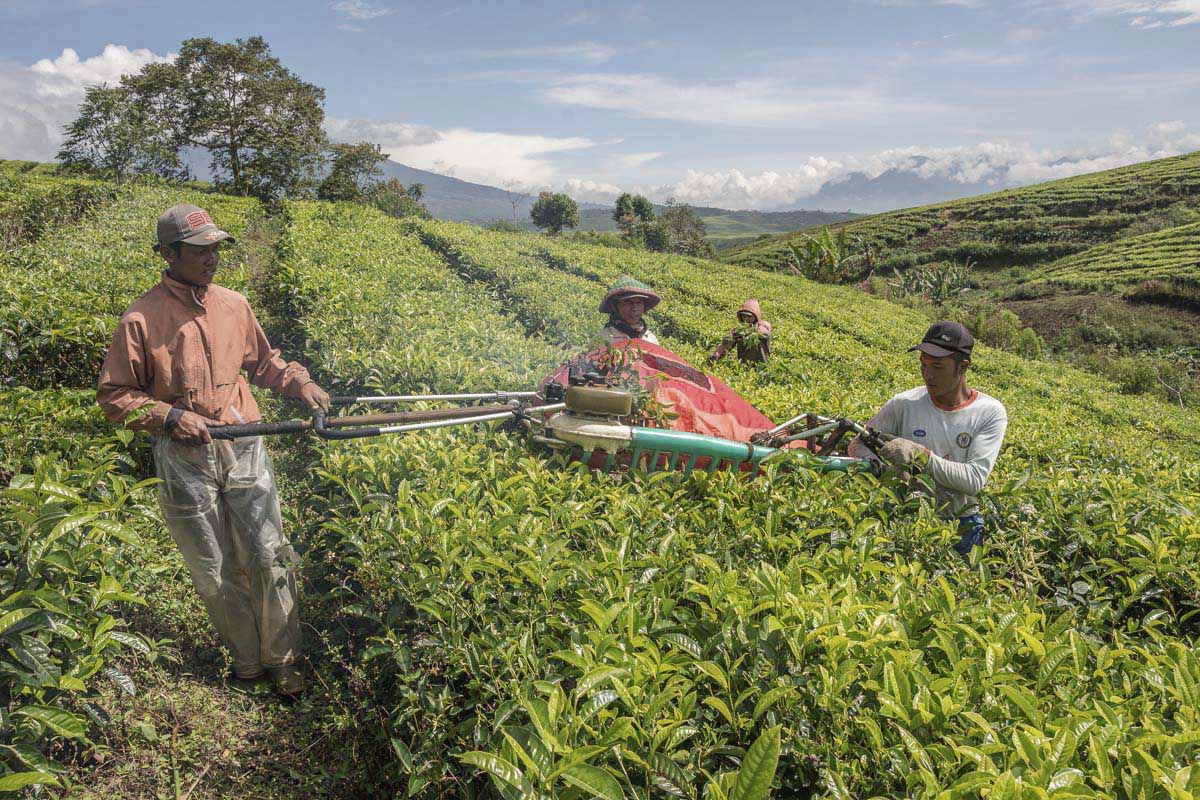
Workers cut and transport tea at the government owned PTPN tea plantation which has expanded across a large area of the Kerinci valley.
Kerinci_01
A man rides motorbike loaded with firewood through a tea plantation in Kerinci valley.
Kerinci_03
Workers cut and transport tea at the government owned PTPN tea plantation which has expanded across a large area of the Kerinci valley.
Kerinci_04
Workers cut and transport tea at the government owned PTPN tea plantation which has expanded across a large area of the Kerinci valley.
Kerinci_05
A sugar farmer selects cane for processing into juice for making into sugar.
Kerinci_06
workers feed cane into a sugar cane crushing machine to extracts juice for processing into sugar at a cottage industry sugar mill in the Kerinci valley.
Kerinci_07
A woman feeds sugar cane stalks into a fire used to evaporate liquid from the sugar juice so that it will turn to sugar.
Kerinci_08
A worker fills the hopper with coffee beans on a hulling machine at a coffee cooperative processing factory in the Kerinci valley.
Kerinci_09
A woman sorts and cleans hulled coffee beans at a cooperative factory in the Kerinci Valley.
Kerinci_10
A worker pours freshly milled rice onto the floor at a rice threshing mill near Sungai Penuh in the Kerinci valley.
Kerinci_11
A worker in a rice threshing mill near Sungai Penuh in the Kerinci valley.
Kerinci_12
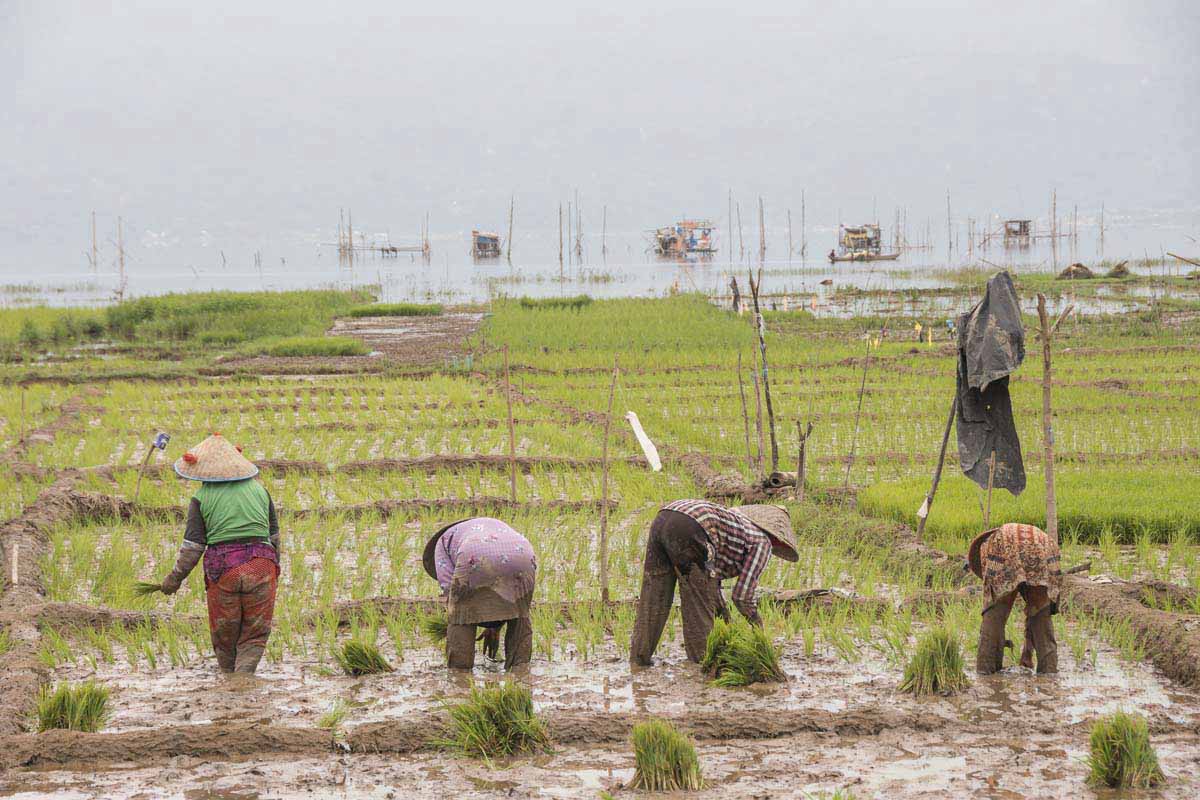
Women transplant rice seedlings in a rice paddy next to lake Kerinci which seasonally flloods to provide valuable nutrient rich irrigation water for the fields.
Kerinci_13
Kerinci_14
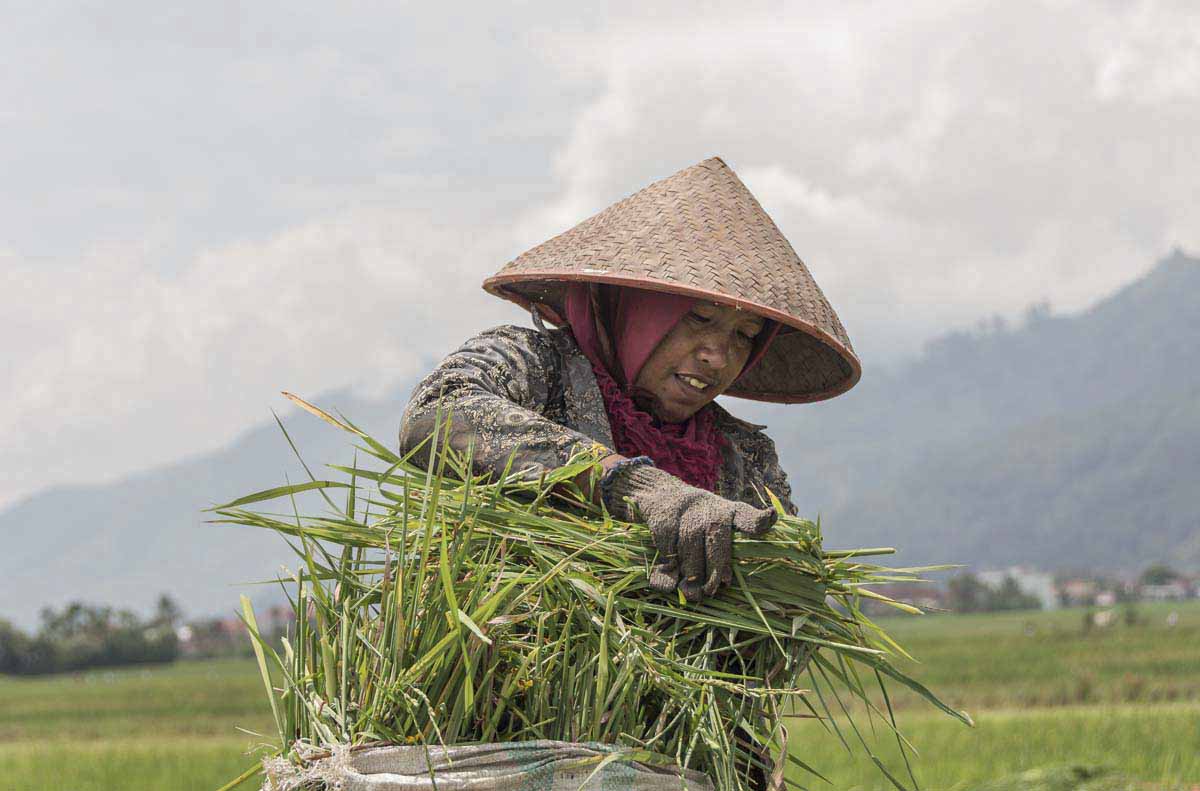
A woman working in a rice paddy next to lake Kerinci which seasonally flloods to provide valuable nutrient rich irrigation water for the fields.
Kerinci_15
A man harvests rice from a paddy near Sungai Penuh in the Kerinci valley.
Kerinci_16
Women transplant rice seedlings in a rice paddy next to lake Kerinci which seasonally flloods to provide valuable nutrient rich irrigation water for the fields.
Kerinci_17
Women sit in Talang Kemulun village discussing the diverse agriculture of the village from rice to cloves. It is close to the border of the Kerinci Seblat Natioanl Park.
Kerinci_18
Mr Eibru Hajar is a cinammon farmer in Talang Kemulun village which sits at the bottom of steep hills marking the border of the Kerinci Seblat national park.
Kerinci_19
A woman stands beside her house next to cinammon bark drying in the sun, which she has gathered from trees on her plantation near the national park. This common practice means the roadsides in the kerinci valley are lined with cinammon bark.
Kerinci_20
Mr Oyong Liza, director of the Pasar Kerman cinammon company, says that since starting up ten years ago the volume of cinammon shipped has incresed fourfold.
Kerinci_21
Women at the the Pasar Kerman company sort cinammon bark into different sizes before it is weighed and packed into bales for shipping.
Kerinci_22
Sacks of dried cinnamon bark are loaded onto a truck at the storage depot of TP.CGC, the biggest cinnamon depot in the Lempur region. Cinnamon is a prized crop and involves growing plantations on previously forested land.
Kerinci_23
Men working deep in the labyrinth of storage rooms at the TP.CGC cinnamon factory in Lempur. The factory ships 5000-6000 tons of cinammon bark per year.
Kerinci_24
Sacks of dried cinnamon bark are loaded onto a truck at the storage depot of TP.CGC, the biggest cinnamon depot in the Lempur region. Cinnamon is a prized crop and involves growing plantations on previously forested land.
Kerinci_25
This road from Lempur village towards the Kerinci Seblat national park was proposed for upgrading by local politicians. So far national park authorities have refused because the area it would cross is in a highly sensitive biodiveristy area and tiger core zone.
Rainforest foliage surrounds a waterfall outside Lempur village in Sumatra.
Rainforest foliage surrounds a waterfall outside Lempur village in Sumatra.
Kerinci_27
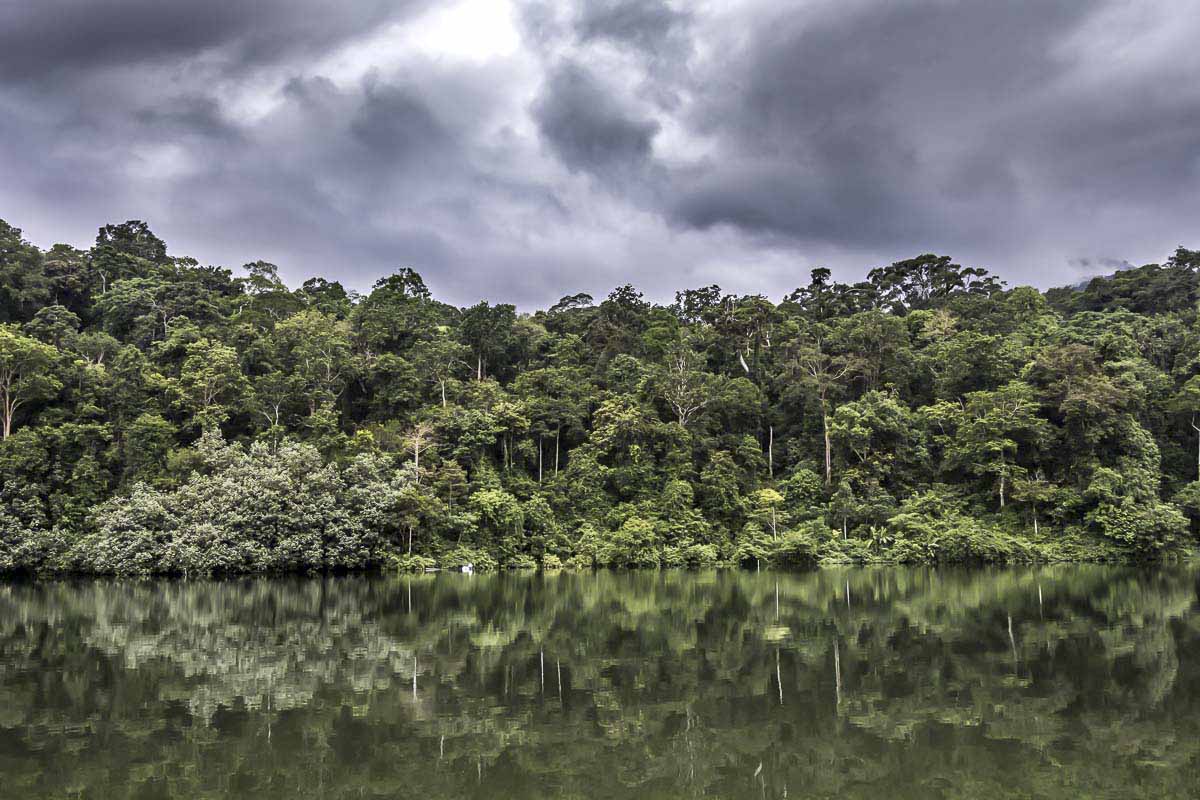
Rainforest overhangs Kaco lake near Lempur village near Kerinci Seblat National Park.
Many Palawan indigenous communities say they have suffered unfair land acquisition or lease arrangements for oil palm plantations. The situation hit a peak around 2007, when palm oil company Agumil Philippines promoted palm oil around the island as a miracle get-rich-quick crop.
Many tribal landowners leased or sold parcels of land to Agumil. Those who leased said they were provided loans from the government-run Land Bank of the Philippines, negotiated by Agumil, to clear the land and plant oil palm saplings. Title deeds to the leased land were lodged with the bank as collateral against the loans, where they remain.
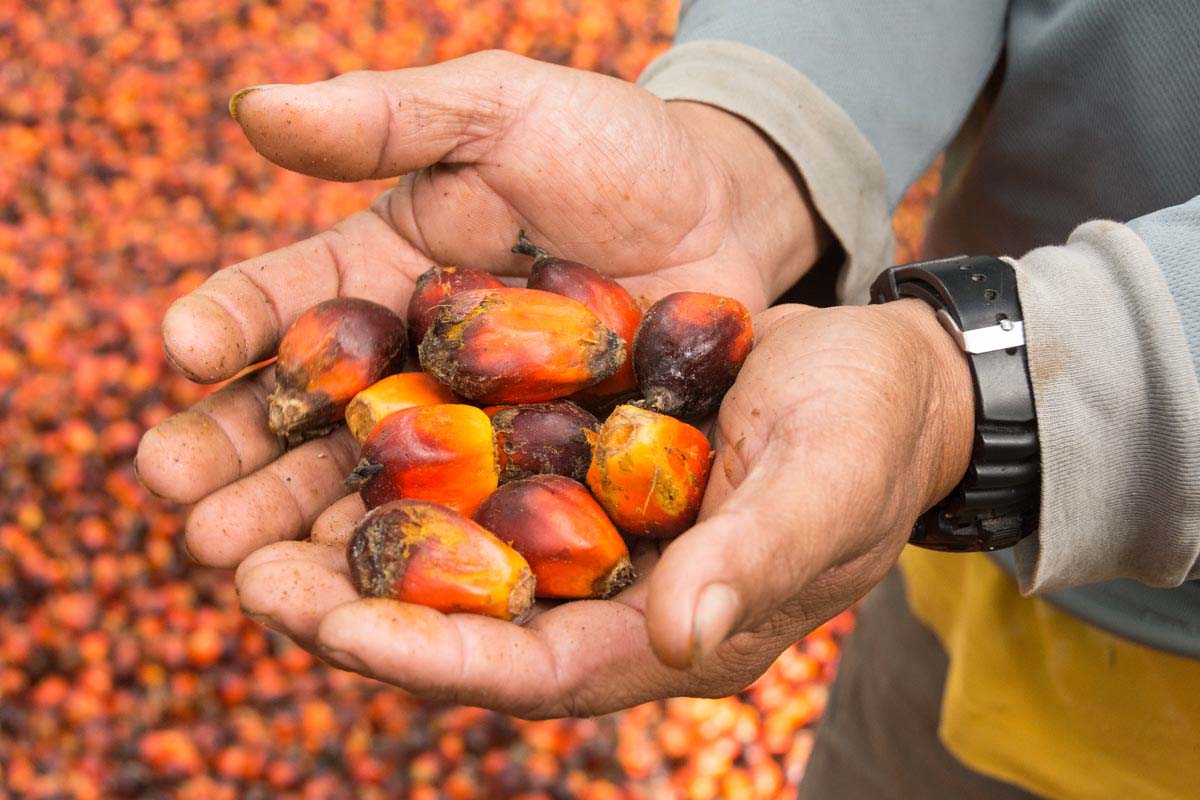
Today the plantations are producing plentiful bunches of oil palm fruit. Still, landowners say they have yet to see any financial returns on their leased land. The problem all cite is that the loans came with crippling 14 percent annual interest rates, which left the original loan amounts inflating out of control. The terms of the lease contracts also stipulate that ongoing operational and managements costs be subtracted from the loan and harvest income.
Now tribal groups are fighting back on multiple fronts. A tribal representative in the municipality of Rizal recently won a mayoral election. The re-elected mayor of neighboring Brooke’s Point has also pledged a halt to more oil palm plantations. Three of the seven municipalities in southern Palawan have now placed limitations on oil palm cultivation.
The sandy path from the village of bamboo houses winds down through the coconut palms, which gives way to mangroves growing along the muddy shoreline. The seven elders inspect their fishing boats. Hand-built using timber from their communal forest, the small craft have bamboo outriggers to keep them stable in the open sea.
The Sarong community on the island of Palawan in the Philippines has for generations been living a similar way of life from the forest, cultivated fields, stands of coconut and fishing. But a few years ago, in 2012, their lives were turned upside down when they noticed that their communal forest was being logged and cleared without any consultation, let alone their permission.
“A contractor coming from another barangay [village] was clearing the land,” says Romeo L. Japson, who grew up in the community.
Community members say the company responsible then went on to plant oil palm saplings on 200 hectares (500 acres) of their ancestral land. They add that now, every time they pass by the plantation, they’re reminded of how their community forest was razed. To this day they are bitter that the situation persists and they have no redress.
They are not alone, as many other Palawan indigenous communities have also suffered what they see as unfair land acquisition or lease arrangements for oil palm plantations. The situation hit a peak around 2007, when palm oil company Agumil Philippines promoted palm oil around the island as a miracle get-rich-quick crop. Twenty-five percent Filipino- and 75 percent Malaysian-owned, Agumil is a subsidiary of Agusan Plantations (API) and operates the only palm oil processing plant on Palawan.
Now tribal groups are fighting back on multiple fronts. A tribal representative in the municipality of Rizal recently won a mayoral election. The re-elected mayor of neighboring Brooke’s Point has also pledged a halt to more oil palm plantations. Three of the seven municipalities in southern Palawan have now placed limitations on oil palm cultivation.
Meanwhile, a growing number of communities are responding to threats to their ancestral domains by pursuing legal recognition of their community land and water resources. Two communities celebrated success in 2018, and at least 12 more claims are in process.
Tribal land appropriation
Many tribal landowners leased or sold parcels of land to Agumil. Those who leased said they were provided loans from the government-run Land Bank of the Philippines, negotiated by Agumil, to clear the land and plant oil palm saplings. Title deeds to the leased land were lodged with the bank as collateral against the loans, where they remain.
“Until now I am riding only in my thongs,” said Mily Saya, landowner and member of the village cooperative in the barangay of Aramaywan. He explains how early company promises of a car and stone house failed to materialize. He says he “has no idea how to get back the land title” for his 4.7 hectares (11.6 acres) from the Land Bank.
“I don’t know how big the loan is from the Land Bank,” he says, explaining how the company planted oil palm seedlings on 1 hectare (2.5 acres) of his land but abandoned the rest with no explanation.
In time, the saplings matured and today the plantations are producing plentiful bunches of oil palm fruit. Still, members of the landowner cooperatives say they have yet to see any financial returns on their leased land. The problem all cite is that the loans came with crippling 14 percent annual interest rates, which left the original loan amounts inflating out of control. The terms of the lease contracts also stipulate that ongoing operational and managements costs be subtracted from the loan and harvest income.
“You will become a rich man,” Larry Arcuyo says he and other landowners were promised, “before entering into contracts” with Agumil. Arcuyo chairs the Aramaywan farmers’ cooperative, one of 14 such growers’ cooperatives on the island. He says Aramaywan has 26 members who have leased land to Agumil. “There are rich men in Palawan — rich of debt,” he says. “We are praying that someone helps us to resolve that problem.
“From the start almost 11 years [ago], the landowners have never seen any money even through the harvesting started eight years ago … Some landowners already died in the meantime,” Arcuyo says. He adds that the price per kilo of palm fruit set by Agumil “is already very low.” Even then, he says, this payment never reaches the farmers who have leased their land to the company; instead, “it is given to the Land Bank for settling the debt,” including for preparation of the land and the initial seedlings. “All decisions regarding finances are controlled by the company,” Arcuyo says.
According to the Coalition against Land Grabbing (CALG), a local indigenous organization campaigning for indigenous people’s rights, 9,000 hectares (22,200 acres) in Palawan have been cleared for oil palm plantations, and the government is inviting foreign investors to develop more. Agumil spokesman Eric Ang told Mongabay, “We intend to expand our business in the oil palm industry but for now we are consolidating in Palawan.”
CALG says that if rules and regulations had been implemented properly, Agumil would never have been able to develop its plantations in the first place. It claims the Philippines’ Indigenous Peoples’ Rights Act (IPRA Law) has been ignored, and that the Palawan Council for Sustainable Development (PCSD) has failed to implement its Strategic Environmental Plan as required under a 1992 act. The group also says that environmental compliance certificates should never have been issued to palm oil companies by the Department of Environment and Natural Resources. The department did not respond to an email request to comment from Mongabay.
Arbitration between tribes and company
The Palawan Palm Oil Industry Development Council (PPOIDC), a multi-stakeholder industry body, is seeking a solution to the ongoing disagreements. However, four meetings “resulted in deadlock,” according to the minutes of the most recent meeting, held last November, and an agreement has still not been reached.
According to lease agreements obtained by Mongabay, Agumil offered a land rental rate of 17,000 pesos ($333) per hectare for a 10-year period, amounting to 1,000 to 2,000 pesos ($20 to $40) per hectare per year to each landowner. In addition, it offered 200 pesos ($4) per ton for harvested palm fruit.
The price of processed palm oil has been dropping in recent months, and on May 31 stood at $563 per metric ton, the sixth-lowest monthly valuation in the past five years.
It was noted at the PPOIDC meeting that the estimated tonnage of palm oil per hectare was well below that promised to farmers by Agumil at the project initiation. In contrast, the palm oil cooperatives demanded a signing bonus of 20,000 pesos ($400), production sharing of 400 pesos ($8) per metric ton, and land lease rental of 10,000 pesos ($200) per hectare per year.
The meeting recommended that Agumil reconsider its offer to the cooperatives and if still no agreement could be reached, the committee should “render a report to the committee on Cooperatives, House of Representatives, and recommend/request Congress to provide legal assistance to the Palm Oil Cooperatives for the filing of appropriate case, a class suit against Agumil.”
It also recommended that the “Top management of the Landbank of the Philippines conduct a thorough investigation on the various accounts of the Oil Palm Cooperatives and possibly cooperate with the Oil Palm Cooperatives in filing appropriate legal charges against Agumil.”
Back in 2015, only one co-op had already repaid its loan and four were up-to-date with payments and on course for full repayment by 2023. Seven, however, needed loan restructuring and two had defaulted on their repayments. Restructuring in previous meetings had involved interest rate reductions from 14 percent to 7 percent, and the management fee charged by Agumil reduced from 10 percent to between 2.5 and 5 percent.
Summing up, board member B.M. Rama said that, “with what had happened to this industry, somebody must be [held] responsible and liable to this problem and that this case should be brought to the proper forum which is the court.”
Asked by Mongabay whether Agumil would be improving terms to co-ops in future, Ang said: “There is no change in the terms and conditions of the Lease Agreement entered between the Coops and the Company.” He maintained that the coops are still liable for a start-up 20 percent equity advance, a matter hotly disputed in the meeting. “We are agreeable to an independent audit of the 20 percent equity advance,” Ang said, adding that none of the co-ops had yet initiated the auditing process.
The idea that the capital debt of the co-ops be assumed by another entity was recommended by a study commissioned by the government’s Cooperative Development Authority. Ang says this “was explored by the Land Bank of Philippines (LBP) and Agumil.” Such a restructuring scheme has yet to be implemented, and according to Ang, would entail a new company assuming the capital debt and a further loan from the Land Bank along with a “processing agreement with Agumil.”
Moratoria stop palm oil plantations
These days, the tribes are getting organized and pursuing ways to seek justice for their lost earnings. Mobilizing to stem the spread of oil palm plantations in Palawan, groups such as CALG have networked with Palawan’s tribal groups to explain the risks of leasing their land. According to CALG chairman Kemil Motalib, the lessons have been learned and nobody is leasing land to Agumil any longer, though some are selling plots in areas where cultivation is still permitted.
There’s another cause for celebration among Palawan’s indigenous communities: the planting of oil palm has been banned in two other provinces in the Philippines, a trend others may follow in the coming months.
“No to expansion of palm oil planting in Rizal for five years,” says Motalib, explaining the substance of the moratorium declared by the Rizal municipal government in October 2018. Motalib, who is from the Tagbanwa tribe, said that a year of painstaking lobbying that included frequent meetings with government officials by CALG members and local indigenous people had finally paid off: “After one year the moratorium was signed by the Municipal Mayor of Rizal,” he says. “Agumil cannot question it because that is ordinance. That is the law made by the municipal government.”
This sense of victory was reinforced by the election of Rizal’s first indigenous mayor. Otol Odi, a member of the Palaw’an tribe, was won the May 13 election, polling nearly twice his nearest rival. Odi, now in his seventies, attracted widespread support among Rizal’s population of 50,000 with his platform of defending the area’s natural resources from big business.
The municipality of Quezon was the first in the Philippines to declare a moratorium on oil palm cultivation, back in 2014. After recent victories, CALG is now pressing for similar moves in the municipalities of Española and Bataraza. When asked by Mongabay whether Agumil would respect the moratoria, Ang said, “We will abide by any rules and regulations imposed by the Government.”
A further challenge to palm oil companies came from the May 16 re-election of Mary Jean Feliciano as mayor of Brooke’s Point. Despite Agumil being headquartered at Maasin near Brooke’s Point, where its processing plant is located, and using the town’s port facilities for exporting palm oil, Mayor Feliciano has pledged no new oil palm plantations in her region. (She says the two existing plantations can stay for now.) When asked what impact this would have on Agumil’s business, Ang said the company was “not aware of Mayor Feliciano’s pledge.”
Recognizing ancestral domain land
In an August 2018 ceremony, ancestral domain titles were awarded to the Tagbanwa tribes in the barangays of Berong and Aramaywan. In all, the titles awarded by the National Commission on Indigenous People (NCIP) covered 31,000 hectares (76,600 acres) of territory, comprising 23,000 hectares (56,800 acres) of land and 8,000 hectares (19,800 acres) of ancestral waters.
“The forest land is inside the ancestral domain because the forest provides many things, such as honey, rattan, and almaciga [Agathis philippinensis] tree resin,” says Sarong resident Romeo Japson. “They are hunting grounds and provide clean water to drink. There are also natural medicines in the forest that can prevent and cure many illnesses.”
After an application has been filed, it is assessed by the NCIP at the national office in Manila. Here the order is issued for a survey of the area to determine parcel size and boundaries.
“Ancestral domain land is the common land of the indigenous peoples. So the indigenous people are claiming their land, no limits to the thousands of hectares that they claimed. They can own that but only communally, not in the name of one person,” Japson says. He adds that marine and mangrove areas can also be applied for under ancestral domain.
However, there are hurdles. According to Motalib, it takes at least five years to process an application, with the domains granted to Berong and Aramaywan the result of “12 years hard work.” Part of this is due to the average cost per application of around 1 million pesos ($19,500), which can take a while to amass. Then there’s the issue of capacity.
“The NCIP is very stretched as there is only one office in the whole of Palawan and only a few staff,” Motalib says.
Despite the obstacles, the number of ancestral domain applications has grown, with 12 currently in the pipeline. CALG has an ambitious program in the works that intends to support three barangays each in the municipalities of Batarazza and Matarazza and six in Quezon, according to Motalib.
After years of struggling against the odds for the rights to their land, the indigenous peoples of Palawan appear to be making progress.
“Ancestral domain is the only way the Katutubo [indigenous peoples] can protect their rights, their land,” Japson says. “It will decide whether they live freely and whether they maintain their own traditions and culture.
“Indigenous people believe if there is a forest, there is food, there is medicine, there is everything else.”
This article documents the indigenous Mentawai communities of Siberut Island, Indonesia, exploring environmental change, traditional livelihoods and the impact of development projects.
Globally recognized for its outstanding biodiversity and unique cultural heritage, the Mentawai Archipelago’s Siberut Island is under increasing pressure
Siberut Island, part of the Mentawai archipelago in western Indonesia, is recognized as a U.N. Biosphere Reserve due to its outstanding cultural and ecological value.
The traditions of the indigenous Mentawai people, including agroforestry and customary land tenure, have allowed the people of the island live off the forest without depleting it.
Roughly half of the island is protected as a national park. The rest, however, has been parceled out for timber and biomass plantations, road building, and the development of a special economic zone including a yacht marina and luxury resort.
A Mentawai tribesman on motorbike fords a river on the only trail connecting Madobag village with the coast. There are few vehicles, and most people walk.
DOROGOT, Indonesia — Toikot rises as the golden light of dawn begins to shine on the heavy mist that cloaks the rainforest canopy outside his home in Indonesia’s Siberut Island. The pigs leave their sleeping place under his traditional uma clan house and set out to forage in the forest. Later they will return to the farmstead to eat sago.
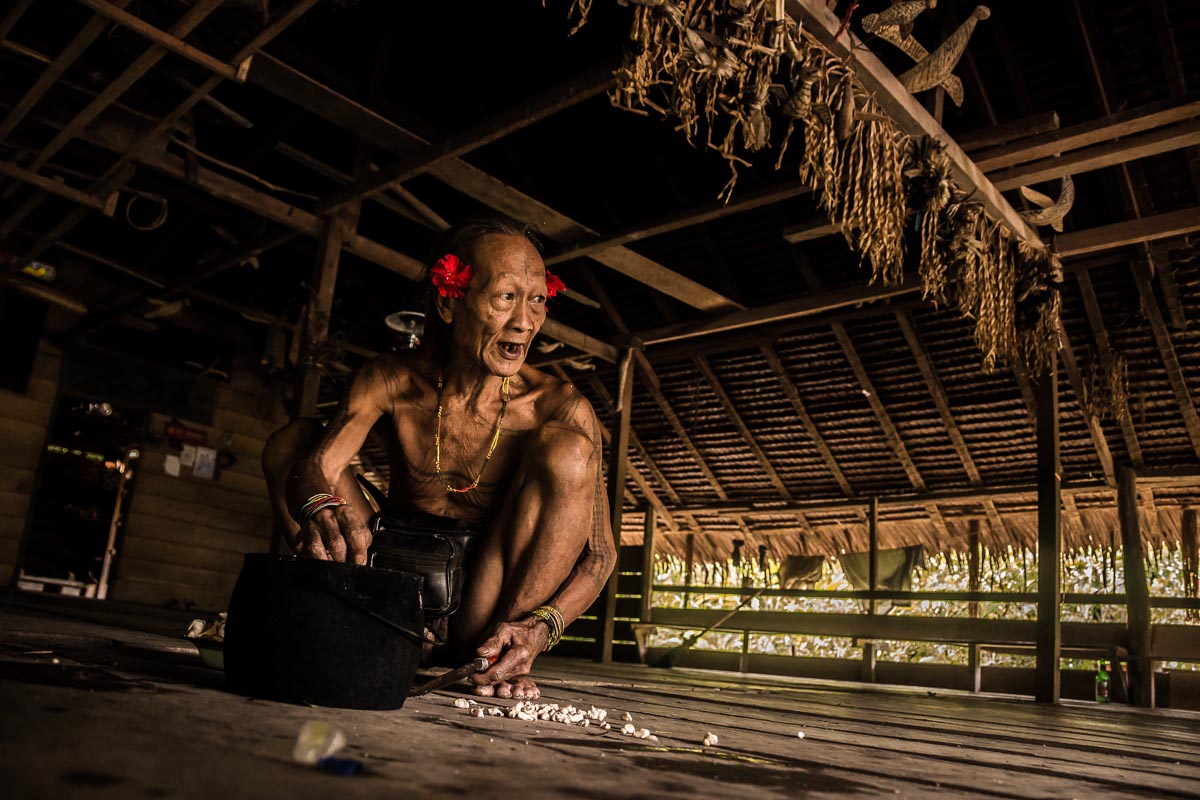
Toikot shaves the woody sago heart into a course flour using his machete. He will then pack it into fresh bamboo stems and roast them over the fire. He is a traditional healer ‘Sekerei’ as denoted by his tattoos and customary dress.
An elderly indigenous Mentawai traditional healer, or sekerei, Toikot’s first task of the day is to gather “something beautiful from nature” with which to adorn himself. Today he plucks two red flowers and places one behind each ear. A loincloth, elaborate tattoos and headdress complete the distinctive customary dress for which the sekerei are known.
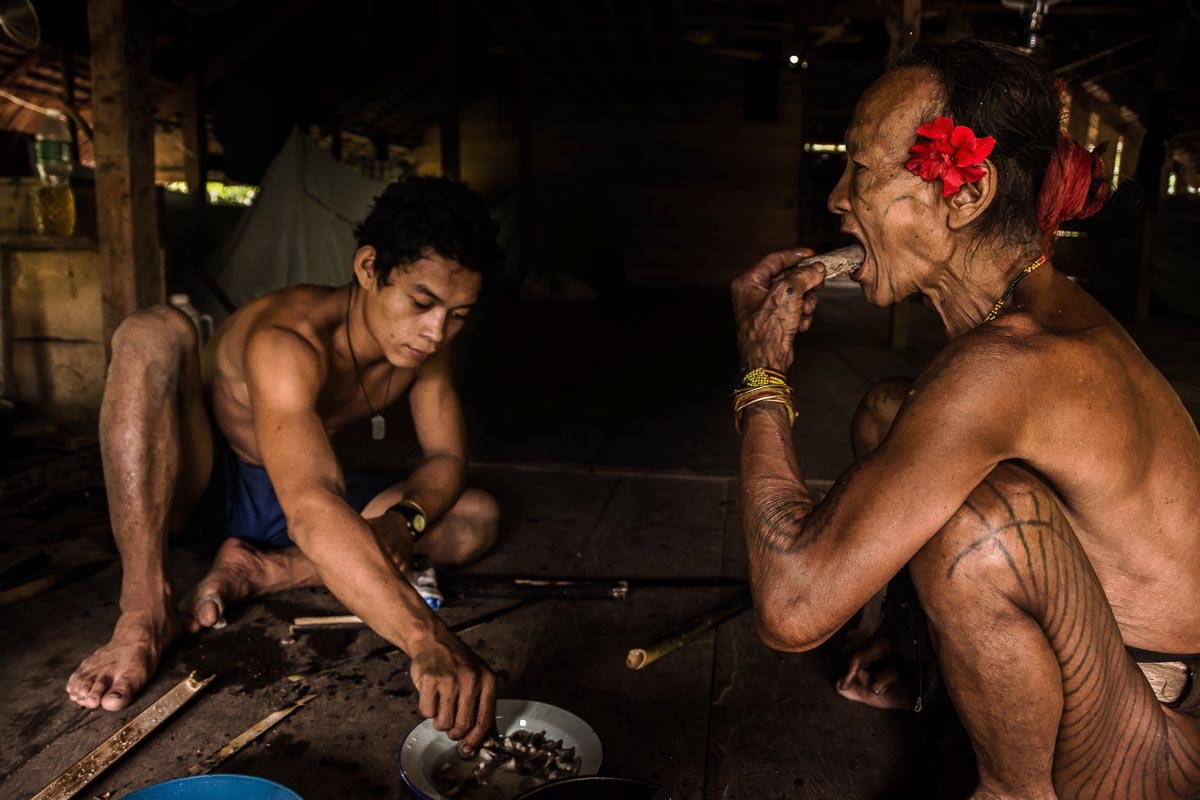
Toikot and his grandson eat sago which has been baked in green bamboo stems. Sago is the staple carbohydrate on which the tribespeople depend. It is extracted from sago palm cut in the forest.
Toikot’s home, the farming community of Dorogot, is a cluster of forest farmsteads on the eastern side of Siberut, around three hours’ walk from the nearest village, mostly through arduous lowland swamp forest.
Skulls of hunted monkeys, hornbill and pigs hang from the rafters in an Uma clan house in Dorogot hamlet. Many Mentawai people still follow an old animist belief system of which this decoration is a part.
Siberut is the largest island in the Mentawai archipelago, which lies 140 kilometers (87 miles) west of the Indonesian island of Sumatra. The rainforest-swathed island has been isolated from the rest of Indonesia for half a million years, leading to an unusually high level of endemism. Two-thirds of the animals here are thought to be unique to the island.
Toikot is a traditional shaman healer with his animals inside his traditional Uma house. Siberut Island, part of the Mentawai archipelago in western Indonesia, is recognized as a U.N. Biosphere Reserve due to its outstanding cultural and ecological value.
This unique biological and cultural diversity was recognized in 1981 when UNESCO designated the island a Biosphere Reserve. This was consolidated in 1993 when Indonesia’s Ministry of Forestry established Siberut National Park, spanning 1,905 square kilometers (736 square miles) and covering most of the island’s western half.
Toikot looks out from his uma house across the forest where he lives in Dorogot hamlet. A traditional Sekerei shaman, the flowers behind his ears comprise part of his traditional dress.
Now, though, both Siberut’s traditional lifestyles and its biodiversity are under pressure from a spate of development projects. While the western half of the island is largely protected, the northeast is already home to a sizable timber concession and a biomass forestry concession. The central government also has big plans to develop a special economic zone in the south, and a highway linking it to the forest concessions in the north. The local government and a private company also plan to bring electricity to villages via a biomass project.
Construction of the trans-Mentawai highway in town of Muara.
Land ownership and logging
These development plans are already coming into conflict with indigenous traditions in Siberut.
Mentawai ownership patterns are complex, relying on ancestral history passed orally from one generation to the next. Land tenure is deeply entwined with extended family clan kinship patterns, which create ties between the indigenous Mentawai people. “A land certificate is not so important as here we don’t sell the land. We know the story about the land, so that’s like a certificate,” says Fransiskus Samapoupou from Madobag village, echoing a widely held view on land ownership among the Mentawai. A candidate for a major political party in recent elections, he made land rights one of his key campaign issues. (Final election results are still not in, but Fransiskus’s name doesn’t appear among the winners in an unofficial tally.)
Two elderly Mentawai tribesmen compare tattos in Madobag village. Siberut Island, part of the Mentawai archipelago in western Indonesia, is recognized as a U.N. Biosphere Reserve due to its outstanding cultural and ecological value.
These sophisticated land ownership patterns, however, are not generally recognized by the government, since they rely on oral tradition rather than state-issued paper titles. As a result, the government claims ownership of most Siberut lands, and has allocated huge chunks to big development projects.
A boy site on a digger outside Muara town, during construction of the trans-Mentawai highway.
The government has since 1969 used its claim over the land to award forestry and logging concessions in the Mentawai Islands. The current logging operator is a Sumatra-based firm, PT Salaki Summa Sejahtera, which was in 2004 awarded a 45-year, 47,605-hectare (117,635-acre) timber concession covering the northeastern part of the island. Only a narrow buffer zone separates the logging concession and the national park. As of 2016, the company’s annual extraction target was 64,000 cubic meters (2.26 million cubic feet) of timber, focused on valuable species such as meranti, keruing and nyato mersawa.
A woman cuts open a fresh cacao fruit to feed to her son on a porch in Madobag village.
Activists say that logging has brought few benefits, and many hardships, to the community. “The economic situation of the community has not improved. Our investigation shows that some of the company’s social obligations are not carried out,” says Rifai Lubis, director of the NGO Citra Mandiri Mentawai Foundation (YCMM).
As of 2011, the company was working with the Borneo Initiative, a forestry certification platform, to achieve a certificate of sustainable forest management. However, NGOs including YCMM have blamed the logging operations for increased incidence of flooding in the concession areas in recent years. “Logging carried out by this company must be one of the causes of flood event,” says Lubis. “The occurrence of flooding is increasingly common, and the volume of water during floods is also increasing.” These floods damage crops and have even washed away houses, he says.
Three Mentawai men walk out of a traditional Uma clan house in Madobag village. The path in front of the house is slated to be widened and paved into a two lane road to form part of the Trans-Mentawai highway project.
Biomass plantations
In Siberut’s central eastern area, a company called PT Biomass Andalan Energi (BAE) was in 2015 granted a 20,030–hectare (49,500-acre), 36-year concession to cut down rainforest and replace it with fast-growing exotic tree species for export as feedstock to be burned to generate biomass energy. Most of this concession abuts the national park. According to plans, three main species are due to be planted: kaliandra (Calliandra calothyrsus), gamal (Gliricidia sepium) and lamtoro (Leucaena leucocephala). Maps show a network of service roads due to be constructed on the concession.
“These invasive trees species grow easily and can displace native species. It is feared that they could disturb the trees and biodiversity of Siberut National Park,” Lubis says. YCMM has launched a petition against the project as part of ongoing advocacy efforts, which in 2016 saw local protests against the project on the island. In 2017 the district government reacted by recognizing traditional rights as a step toward granting customary forest status.
Men sit on the porch of a roadside house which has lost its garden due to road building as part of the trans-Mentawai highway project in Muara town, Siberut island.
The YCMM petition, which calls on Indonesia’s president to revoke PT BAE’s permit, alleges that the biomass company acquired the permit without obtaining the consent of the local indigenous people, and that letters and petitions from tribal councils and Mentawai environmentalists, submitted in 2017, were ignored.
A previous petition to stop the company by Rainforest Rescue ended in May 2018 after drawing 245,576 signatures.
A newly constructed road bridge in Muara town is part of the trans-mentawai road building programme.
New road project
“I walk to Madobag once a week to see my grandson,” says Toikot.
His grandson, like many high school students, lives away from home because the arduous six-hour round trip makes a daily commute impossible. To market their farm produce, people living in the interior often make the longer and more expensive journey to the market at Muara or the port at Maillepet by motorized dugout canoe. Even so, Toikot is against the prospect of new roads in the area. “A road might make it easier to walk, but there would be more accidents with cars and motorbikes,” he says. “People’s chickens would get run over.”
A muddy walking trail is all that links the school village of Madobag to the outside world for now. But the route is set for a major upgrade. Work is already underway to build the Trans-Mentawai highway, a two-lane paved road running north-south along the eastern half of Siberut Island, with transport links to neighboring islands, passing through the villages of Rogdog, Madobag and Matotonan along the way.
Islanders take a motorised twon to market at Muara town downstream. Siberut Island, part of the Mentawai archipelago in western Indonesia, is recognized as a U.N. Biosphere Reserve due to its outstanding cultural and ecological value.
As of April, only one river bridge and a few miles of paved road had been completed, in the Muara area, an hour by motorized canoe downstream from Dorogot. A second river bridge now nearing completion has taken eight months to build and abruptly stops on the south bank, where dense forest remains. A worker on the project told Mongabay he had been working on it for six to seven months, earning the equivalent of $5.70 per day.
“A big road would be good, but if it means cutting down my areca nut trees, the government must pay,” says Aman Derik Ogo, an elderly man at a trailside coffee shop in Mangaroot village, just beyond the current end of the paved road.
An elderly Mentawai tribesman site on a porch in Madobag village. Siberut Island, part of the Mentawai archipelago in western Indonesia, is recognized as a U.N. Biosphere Reserve due to its outstanding cultural and ecological value.
On the track towards Madobag, Kornelius Sakaliou disappears from the path and slashes weeds at the base of a huge durian tree towering some 20 meters (60 feet) high. “I inherited this durian tree from my grandfather who planted it years ago,” Sakaliou says. He adds he’s horrified that widening the track into a road could condemn his durian tree, and he’s not alone.
“The government must ask who the land and trees belong to,” says local politician Fransiskus. “I want people to get money for their land and money for their durian trees.” That he’s put this issue at the top of his agenda reflects the widespread concern here about compensation for land and property requisition.
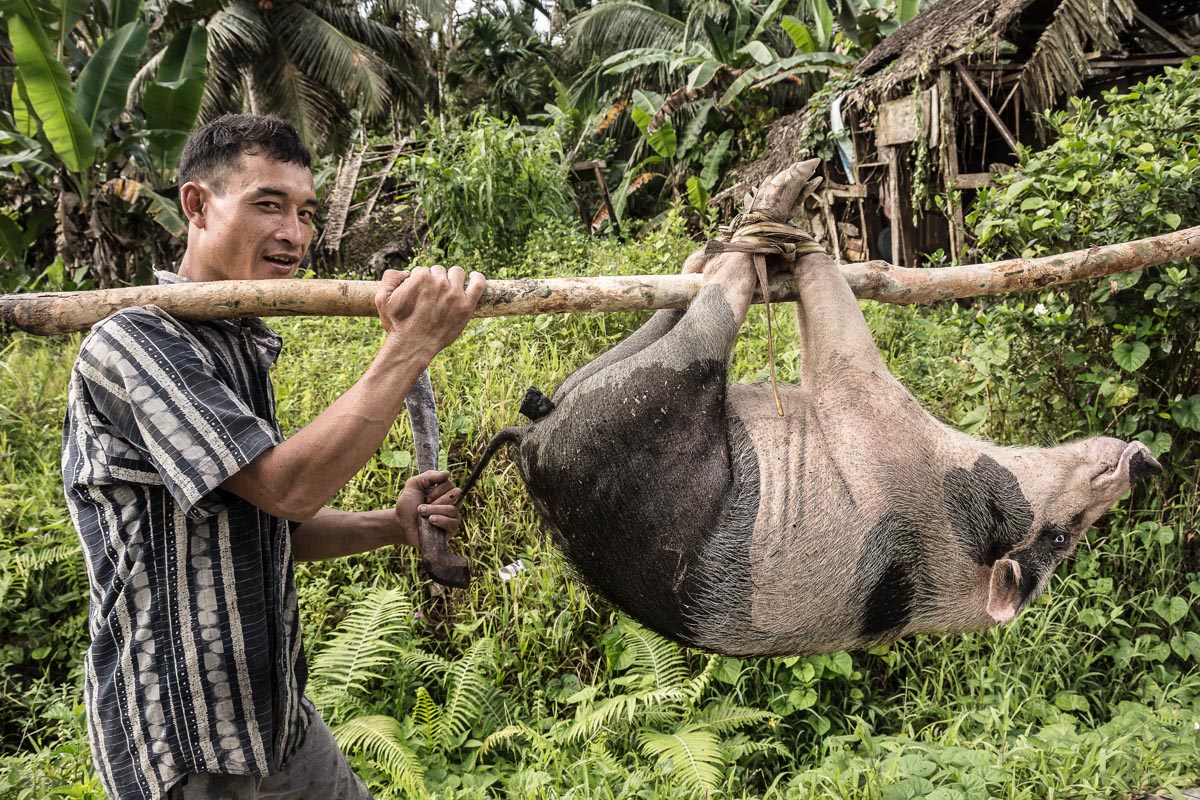
A mentawai man carries a pig in Madobag village. Pig farming is traditionally the main form of animal husbandry, in contrast to the Muslim majority of the population for whom pork is not allowed.
Coastal development
Life in the forest contrasts starkly with plans by the district government to establish a special economic zone on the south coast. Key to this project is the Mentawai Bay Resort, a 2,639-hectare (6,521-acre) coastal development, for which Java-based firm PT Putra Mahakarya Sentosa was awarded a contract. According to the company’s plans, the resort will stretch across about 10 kilometers (6.2 miles) of beachfront and extend up to 6 kilometers (3.7 miles) inland, into what is currently a traditional farming area full of multi-cropped agroforestry gardens among the forest. The area that will be swallowed up by the project also includes a freshwater lake on which people rely for fishing, particularly during the stormy rainy season when rough seas make it dangerous for fishing boats.
A man in Durogot hamlet prepares a dugout canoe. He says it takes him two weeks to make a dugout canoe which is made from a single tree. They are a popular source of transport through the forest, especially for taking produce like cocoa, banana, cloves and sago to coastal markets.
The first phase of construction will focus on a 300-hectare (741-acre) airport, an adjacent harbor and yacht marina, hotels, and a theme park. In all, five beachfront hotels, villas and condominium towers will take up 900 hectares (2,224 acres). A golf course, zoo, eco-theme park, hospital, college, and industrial center are also planned. A spiritual area and cultural village are included in recognition of Siberut’s unique cultural heritage.
When it comes to recognition of land rights, however, the developers are lagging behind, says Lubis of the YCMM. “There is compensation given, but only for coconut palms. Whereas land is not compensated.” Lubis says the compensation varies depending on the number or coconut palms lost, and is paid out on an annual basis for five years. Local farmers are still holding out for a comprehensive compensation package that recognizes other assets such as fruit trees, and for now construction remains deadlocked.
A mentawai man in Dorogot hamlet eats a sago grub, a traditional source of protein. Siberut Island, part of the Mentawai archipelago in western Indonesia, is recognized as a U.N. Biosphere Reserve due to its outstanding cultural and ecological value.
Biomass electricity
In addition to these large, state-backed initiatives, projects at the local level are already having an impact. In March 2017, work commenced on a biomass power plant, developed by Jakarta-based PT Charta Putra Indonesia (CPI). According to its project portfolio, the company has plans to generate power from tourist trash in Bali and establish a biomass plant in Jambi, on the Sumatra mainland. The Mentawai Distributed Power project is the company’s flagship, a $12.4 million project financed by international donors including the U.S. Agency for International Development (USAID), via the Indonesian government-administered Millennium Challenge Account (MCA).
In a 2018 presentation, founding director Jaya Wahono described biomass energy as a way to make use of the 20 million hectares [49 million acres] of degraded and marginalized lands in Indonesia. By harvesting just two to three bamboo poles per month, he said, households can meet their energy needs.
A Mentawai woman bathes her baby in a traditional Uma clan house in Dorogot hamlet. Siberut Island, part of the Mentawai archipelago in western Indonesia, is recognized as a U.N. Biosphere Reserve due to its outstanding cultural and ecological value.
In the villages of Rogdog and Madobag, electricity meters freshly installed on the porch of each house remain a mystery to many people. In particular, people are unclear how the new electricity they have been receiving for the past year will be paid for.
“I don’t have an agreement with the company yet. They just gave me a hundred bamboo saplings to plant and 100,000 rupiah [$7] as payment for planting them,” says clan leader Aman Patdoini in Rogdog.
A boy jumps from a new road bridge constructed across the river outside Muara town. The bridge is part of the Trans-Mentawai highway project which plans to run the length of the island and beyond to other islands in the archipelago.
Wahono anticipates that after five years of growth, each seedling will yield 100 poles, equal to around 200 to 300 tons of bamboo feedstock per household. If that proves correct, the 200 households in Rogdog village would produce up to 60,000 tons of bamboo feedstock in five years, more than enough to cover the 2,555 tons required annually to fuel the plant at seven tons per day.
Toikot, a traditional Mentawai shaman or ‘Sekerei’ at home in Dorogot hamlet.
These estimates may be optimistic: instead of the monocrop plantation depicted in the company’s marketing materials, seedlings planted in one garden visited by Mongabay were interspersed among other crops, as is customary on the island. Several farmers also said that because they keep pigs they had given their seedlings to neighbors and helped plant them.
But most hope the sale of bamboo will be enough to cover their electricity bill. “It’s undecided whether they’ll have to pay for electricity,” says Gervasius Tasiriottoi of Rogdog village, who is in charge of keeping population records for the local government. “Maybe they can give harvested bamboo in exchange,” he speculates.
Toikot (right) is a traditional shaman healer here speaking to his Grandson inside his traditional Uma house. Siberut Island, part of the Mentawai archipelago in western Indonesia, is recognized as a U.N. Biosphere Reserve due to its outstanding cultural and ecological value.
“For now, while staff training takes place, the generator is being run on gasoline. It will be switched to wood in a few months’ time,” says Tasiriottoi. The bamboo harvest is still several years away, though. “In the meantime the company are offering 300 rupiah per kilo [less than a cent per pound] for wood,” says Tasiriottoi. At the entrance to the 300-kilowatt power plant is a pile of logs gathered locally.
“There is plenty of wood, so for now they’re not cutting trees,” Tasiriottoi says. However not all agree, and there’s widespread concern about the impact the project could have on the remaining forest in the area. “There will be a four-year wait until the first bamboo harvest, so I worry the jungle will be destroyed because there is not enough wood. Wild pigs and monkeys will be affected,” says Aman Patdoini.
“Electricity is good, but if the company plant in my garden there will be problems,” says Aman Derik Ogo. “This is our land. Even for me I’m old already. If they grow bamboo everywhere, where can a person find their livelihood? No trees anymore, no medicine, no food. Water all gone. No more firewood. Nothing, because everything used in the biomass plant. No trees anymore so Mentawai people will die.”
Kornelius lights a paraffin lamp in the traditional Uma clan house in Dorogot hamlet, an isolated community in Siberut’s swamp forest. Electricity has yet to reach Dorogot, but is already being rolled out in neighbouring villages Rogdog and Madobag as part of a Biomass generation scheme.
An island at the crossroads
The Mentawai are a tight-knit tribe proud of their cultural heritage. Their forest-dependent customary beliefs and livelihood traditions have proven resilient over the ages, allowing them to live off the land without depleting it. Now, development projects are attracting a mixed reception from the Mentawai. While some benefits like electricity and transportation are broadly welcomed, concerns and suspicions about the negative impacts of development are widespread, and opposition is growing to projects that threaten the forest and cultivated gardens.
Toikot is a traditional shaman healer with his animals inside his traditional Uma house. Siberut Island, part of the Mentawai archipelago in western Indonesia, is recognized as a U.N. Biosphere Reserve due to its outstanding cultural and ecological value.
Back in Dorogot, life remains much as it has been for generations. To the untrained eye the multi-crop forest garden, where natural forest has grown around cultivated trees, could easily be mistaken for dense jungle. As the sun sinks in the sky and the pigs amble back in search of sago feed, Toikot leaps to his feet with a start. “Can you hear that eagle?” he exclaims. “It’s after my chicks.” The ambitious development plans about to take shape nearby seem distant for now, but for how much longer?
Toikot, a traditional Mentwai ‘sekerei’ shaman, looks over to his pig stye to check on his pigs which are feedling on sago logs.
Citation:
Meyers, K., Pio, D., Rachmania, S., Hernandez, A. (2006) 25 Years of Siberut Biosphere Reserve: Saving Siberut and Its Unique Culture and Natural Heritage. UNESCO, Jakarta, Indonesia.
“It is an extraordinarily perverse decision given the reality of accelerating climate change. Essentially the government is locking us in to a whole new fossil fuel industry.”
At least twelve earthquakes have awoken the usually quiet rural area around the village of Newdigate. The area is close to the oil exploration sites of UK Oil and Gas (UKOG) at Horse Hill and Angus Energy at Brockham.
Along with searing global temperatures attributed to climate change, the quakes have not deterred the government from pressing ahead with measures to smooth the way for the onshore oil and gas industry.
Water reinjection
Critics say the timing is a cynical ploy to accelerate development over the summer – traditionally a time of low public scrutiny.
David Smythe, Emeritus Professor of Geophysics at the University of Glasgow, told The Ecologist: “We know from the US that re-injection can trigger quite major earthquakes, bigger than the ones in Surrey.
“For every barrel of oil that’s produced … you get seven barrels of water that you have to get rid of … The usual way of doing it that you have another borehole nearby and you force it down there back underground … That’s called re-injection.”
The reinjection site doesn’t even need to be close by to trigger an earthquake: “They can be 40-50 miles away”.
It has now become clear that the quakes were relatively near the surface, increasing the likelihood that they were caused by human interference.
Weak regulation
Smythe explained: “In the case of UKOG at Horse Hill it is just possible that they started some activity that they haven’t told anyone about. Re-injection or well testing or something like that, before the first of the Newdigate earthquakes that was on 1 April this year.”
On the 27 June 2018, the same day as one of the bigger earthquakes, UKOG put out a press release that stated: “Production flow test operations commence.”
The Ecologist invited UKOG to comment on reports linking its operations to the earthquakes but it did not respond.
Smythe said: “It’s clear from the evidence that they will ignore the regulations and permits with impunity. And they say they’re not active at a certain day but you know, whose checking up on them?”
Recent regulatory and government approvals coupled with a draft law designed to dissolve planning obstacles, have given oil and gas companies a summer fillip.
Commercial fracking
On 24 July, energy minister Claire Perry announced: “I am content that Hydraulic Fracturing Consent should be granted” for an extraction license at the Preston New Road exploration site in Lancashire.
This is the first time that horizontal commercial fracking has been allowed on mainland Britain since a moratorium was put in place in 2011 due to earthquakes linked to operations.
Green MP Caroline Lucas said in parliament the decision had been: “smuggled out on this last day before recess.”
“It is an extraordinarily perverse decision given the reality of accelerating climate change. Essentially the government is locking us in to a whole new fossil fuel industry.”
Residents Action on Fylde Fracking have challenged fracking company Cuadrilla’s apparent exemption to water restrictions at a time when Northwest water provider United Utilities has imposed a hosepipe ban from 5 August.
‘Water protector’
That same day that the government awarded the license, six activists were arrested for locking on using arm pipes and obstructing the fracking site entrance road. A Cuadrilla press release on 24 July stated: “Cuadrilla can confirm that it plans to take legal action against six individuals.”
When asked whether he was there to enforce the injunction one policeman at the site that day said the injunction covered, “actions on this road and any other road as well, but that’s their [Cuadrilla’s] concern and not the police. It’s a civil matter.”
Fiona [last name withheld], an activist at Preston New Road, described herself as a “water protector” and was doing her shift on “rig watch.”
She said that the injunction had not stopped protesters blockading the site. “I’m staying here all the time. It feels really important.” she said. One protestor said that the cost of challenging the injunction at Preston New Road had so far proved prohibitive.
The six anti-frackers from Surrey including from Leith Hill Protection Camp, were in court in early July and are expecting the verdict on their legal challenge in August. The ruling could have significant implications for civil liberties including the right to protest against fracking companies.
Eroding democracy
On 17 May, government minister Greg Clark announced that it would introduce a bill to allow oil companies to bypass the planning application process altogether by allowing exploration to go ahead as “permitted development.”
The bill is currently under public consultation over the summer and if successful could see central Government excluding local and county planners from much of the process.
Campaigners say this amounts to an erosion of local democracy. Fiona said the campaigning organisations around Preston plan group meetings with their MPs to lobby against the plans. The plans could enable companies such as Angus Energy easier access to drill.
According to campaign group Brockham Oil Watch, Angus has ignored planning requirements and went ahead with unauthorised drilling. Now, a year and a half later, its retrospective application was approved on 8 August by Surrey County Council, to the dismay of campaigners.
Ada Zaffina of Brockham Oil Watch said: “They [Angus Energy] misled the council into believing they were doing maintenance on an existing well and not drilling.”
Ignoring opposition
In a letter to The Times, 6 August, four senior academics said: “A moratorium is urgently needed on hydrocarbon exploration in the area of Surrey recently affected by 12 earthquakes.”
However their professional concerns failed to sway Surrey County Council which on 8 August passed a controversial application by 7 votes to 4 for Brockham operator, Angus Energy to drill. The company said it was “pleased to acknowledge today’s planning approval.”
Zaffina, who spoke at the meeting, said: “This permission was given against the objections by the Parish Council, Mole Valley District Council and the local people”. Campaigners were shocked that the Council decision had ignored widespread local opposition.
Referring to letter in The Times, Zaffina said: “The Oil & Gas Authority can hardly be regarded as independent or impartial. Its objective is to support the industry in maximising the economic recovery of oil and gas, and it is largely funded by the industry.
“We are disappointed that the planning officers relied on such advice in favour of the recent advice from a group of leading independent geologists.”
Self regulation
Smythe argued that existing permits do not require the company to submit an appropriate level of detail: “Unfortunately under the regulations in which Angus energy operate, there has been no requirement for them to report on a daily or weekly basis, what they are doing to report about re-injection – how much and how often.”
Zaffina agreed that self-monitoring by the industry is not adequate: “Even the way the permit applications work is really old school. In some US states you have a live, searchable online database that can be accessed by the public. Here you have nothing like that.”
At nearby Leith Hill campaigners were dismayed to receive news that the Environment Agency had issued an approval decision for exploration to go ahead on 23 July.
In its decision the Environment Agency highlighted the biological sensitivity of this ancient woodland classified as both a Site of Special Scientific Interest (SSSI) and an Area of Outstanding Natural Beauty (AONB).
Yet it has still given the green light for industrialisation of this protected area.
Radioactive materials
The decision report stated that: “The permit will authorise as part of the mining waste activity the flaring of any waste gas arising from well testing.”
The decision also allows naturally occurring radioactive materials “in concentrations exceeding those set out in … the Regulations.” It also determines that “an environmental permit for a groundwater activity is not required.”
A concerted Government drive to promote the industry is now underway. Ongoing consultations over the summer could decide whether onshore projects are included in the Nationally Significant Infrastructure Projects regime, allowing central government to override regional decisions about projects.
This dovetails with provision for extra resources for fast-tracking decisions on appeals of oil and gas applications that were refused at the county level. Whether the measures will kickstart the nascent industry in the face of widespread public opposition, has yet to be seen.
Simon Blevins, Richard Roberts and Rich Loizou (pictured) shortly after their release from prison for climbing lorries at Cuadrilla's Lancashire site at Preston New Road. Their sentences were overturned by the court of appeal.
Fracking_42
Thousands of protesters turned out at Preston New Road near Blackpool in Lancashire to demand an end to fracking at the Cuadrilla gas fracking site.
Fracking_41
Thousands of protesters turned out at Preston New Road near Blackpool in Lancashire to demand an end to fracking at the Cuadrilla gas fracking site.
Fracking_40
Thousands of protesters turned out at Preston New Road near Blackpool in Lancashire to demand an end to fracking at the Cuadrilla gas fracking site.
Fracking_39
THE LANCASHIRE NANAS is a group of elderly women, many of them Grandmothers who oppose fracking. They turned out in force at the gates of the Cuadrilla Preston New Road fracking site near Blackpool in Lancashire today to protest against the first fracking since a seven year hiatus ended when...
Fracking_37
THE LANCASHIRE NANAS is a group of elderly women, many of them Grandmothers who oppose fracking. They turned out in force at the gates of the Cuadrilla Preston New Road fracking site near Blackpool in Lancashire today to protest against the first fracking since a seven year hiatus ended when...
Fracking_36
THE LANCASHIRE NANAS is a group of elderly women, many of them Grandmothers who oppose fracking. They turned out in force at the gates of the Cuadrilla Preston New Road fracking site near Blackpool in Lancashire today to protest against the first fracking since a seven year hiatus ended when...
Fracking_35
THE LANCASHIRE NANAS is a group of elderly women, many of them Grandmothers who oppose fracking. They turned out in force at the gates of the Cuadrilla Preston New Road fracking site near Blackpool in Lancashire today to protest against the first fracking since a seven year hiatus ended when...
Fracking_31
UK_Oil_08
Protesters at the entrance gate of Cuadrilla’s Preston New Road fracking site near Blackpool in Lancashire. The same day, July 24, the Government awarded a license to allow Cuadrilla to switch from exploration to commercial extraction.
Horse Hill oil site blockaded by protesters
The Horse Hill oil exploration well site which has recently begun tests, was blockaded by protesters. Around 90 protesters blockaded the gates to the site and prevented a truck from entering by walking in front of it. An initially small police presence grew as the day progressed. Credit: RodHarbinson.com
Horse Hill oil site blockaded by protesters
The Horse Hill oil exploration well site which has recently begun tests, was blockaded by protesters. Around 90 protesters blockaded the gates to the site and prevented a truck from entering by walking in front of it. An initially small police presence grew as the day progressed. Credit: RodHarbinson.com
Horse Hill oil site blockaded by protesters
The Horse Hill oil exploration well site which has recently begun tests, was blockaded by protesters. Around 90 protesters blockaded the gates to the site and prevented a truck from entering by walking in front of it. An initially small police presence grew as the day progressed. Credit: RodHarbinson.com
UK_Oil_19
Around 350 people gathered at Leith Hill Tower in the Surrey Hills to protest against proposed oil drilling on the hill by Europa Oil Co, December 2016.
Fracking_11
People gather on the summit of Leith Hill in Surrey and stand in formation to create a heart shape. Protest against oil drilling and fracking in the UK.
UK_Oil_18
Around 350 people gathered at Leith Hill Tower in the Surrey Hills to protest against proposed oil drilling on the hill by Europa Oil Co, in December 2016. The site of special scientific interest is one of several exploration wells that the government has given the go-ahead for in The...
UK_Oil_09
A fort constructed out of discarded wooden pallets at Leith Hill Protection Camp in Surrey. In June 2017 the camp was evicted and demolished. Four activists locked themselves inside the tower overnight and were removed by a specialist team. Underneath the fort a network of tunnels had been built.
UK_Oil_14
A protester remonstrates with a security guard during the eviction of Leith Hill protest camp in June 2017.
UK_Oil_10
A specialist eviction team look up at the wooden tower where protesters are being cut from their 'lock-ons' during eviction of Leith Hill Protection Camp in June 2017.
UK_Oil_11
Having been locked-on overnight, a protester is lowered from a wooden fort by a specialist team during the eviction of Leith Hill Protection camp in June 2017.
UK_Oil_12
A protester is led out of the site by security guards. She has been locked-on inside a wooden tower for many hours during the eviction of Leith Hill Protection Camp in June 2017.
UK_Oil_13
Two protesters are re-united having been locked-on in a wooden tower overnight during hte eviction of Leith Hill Protection Camp in June 2017. Four protesters were cut out off lock-ons in a makeshift wooden tower 22 June. The protest camp was established on the proposed exploration drilling site in Novermber...
UK_Oil_15
The day after the eviction of Leith Hill Protection Camp a digger demolishes the wooden fort which had been constructed by protesters to hold up work and protect the area from oil drilling.
UK_Oil_16
Local people and protesters hold a minutes silence outside the external fence of an evicted protest camp against proposed oil drilling on the hill by Europa Oil Co.
UK_Oil_28
A protester at a protest camp set up to blockade operations by Angus Energy in Brockham, Surrey. The site was one of several exploration wells that the government has given the go-ahead for in The Weald Basin in Surrey.
UK_Oil_27
Activist Jared was living at Leith Hill Protection camp and was part of the group that set up a camp in Brockham and alerted the council to unauthorised activties by Oil company Angus Energy which is drilling in this Surrey village.
UK_Oil_06
A protester dressed as a Samurai warrior at Preston New Road fracking site in Lancashire, July 2017.
UK_Oil_05
A confrontation between protesters and police at the entrance gate of Cuadrilla’s Preston New Road fracking site near Blackpool in Lancashire.
UK_Oil_04
A protester is confronted by police at the entrance gate of Cuadrilla’s Preston New Road fracking site near Blackpool in Lancashire.
UK_Oil_03
A protester is moved off the road by a policeman at Preston New Road fracking site in Lancashire, July 2017.
UK_Oil_01
A protester at Preston New Road in July 2017 holds up a sign while he is accosted by police officers.
UK_Oil_02
A protester in front of a line of police at the entrance gate of Cuadrilla’s Preston New Road fracking site near Blackpool in Lancashire.
UK_Oil_07
Protesters hug at the entrance gate of Cuadrilla’s Preston New Road fracking site near Blackpool in Lancashire, July 2017.
UK_Oil_21
Children in an old double decker bus go for a tour around Balcombe to protest against fracking.
UK_Oil_20
Children take a tour in a double-decker bus around the village of Balcombe to protest against fracking.
UK_Oil_25
Protesters sit in front of a line of police at an anti-fracking demonstration in Balcombe.
UK_Oil_24
Protesters are cut out of arm lock-ons by police at the Cuadrilla drilling site in Balcombe.
UK_Oil_23
A protester in front of the police line at the anti-frackiing protest in Balcombe, Sussex.
UK_Oil_22
Protests in summer 2013 against oil exploration in Balcombe, Surrey, drew protesters from far and wide to blockade operations. Since then oil exploration has spread throughout the county. This image was published in The Guardian.
UK_Oil_26
Protests in summer 2013 against oil exploration in Balcombe, Surrey, drew protesters from far and wide to blockade operations. Since then oil exploration has spread throughout the county.
STATELESS CHILDREN OF BORNEO Children of Sabah's migrants are invisible to the stateSorting fish from a month at sea Stateless means no schoolMarket work starts young
Thousands of undocumented immigrant children live in Sabah, East Malaysia on Borneo Island. Some have lived there for many years and have families. Not eligible for official documentation they are stateless people.
Lacking official recognition, children cannot attend state school and many end up with no education working in menial jobs. Others are exploited by traffickers. Many are Bajau sea-gypsies, others are immigrants from the Muslim Sulu area of Southern Philippines. Indonesian workers also come across the porous border from Kalimantan seeking work.
Sea gypsies migrate
Many of the Bajau Laut sea gypsies have now settled in Sabah. Climate change, overfishing and poverty have caused them to give up their nomadic life on the sea in favour of the shanty towns of coastal Sabah. The presence of migrants has been tolerated because many are contributing work in the state. However in recent years a rise in Muslim terrorist activity at tourist resorts around the coast has made the government less tolerant towards the migrants and less inclined to provide residency papers. So these shanty communities remain in limbo, trapped in an insecure situation where they cannot progress.
This story follows children from the shanty villages of Gaya Island, offshore from capital Kota Kinabalu, as they fight, play and hustle for a living in the capital’s busy fish docks and markets.
Stateless_Sabah01
A boatman climbs into his boat beneath a shanty village built over the water offshore from Gaya island. Thousands of undocumented immigrants live in Sabah, East Malaysia on Borneo Island. Some of them have lived there for many years and have children. Not eligible for official documentation they are stateless...
Stateless_Sabah02
Children look out from a mosque in the shanty village of Gaya island.
Stateless_Sabah03
A boy paddles using his shoes in an upturned aluminium washing-up bowl he is using as a boat offshore from Gaya Isand, Sabah, East-Malaysia. He is one of thousands of stateless people on Gaya island, mainly from the Bajau Laut community of sea-gypsies and immigrants from the Sulu area of...
Stateless_Sabah04
Thousands of undocumented immigrants live in Sabah, East Malaysia on Borneo Island. Some of them have lived there for many years and have children. Not eligible for official documentation they are stateless people. Lacking official recognition, children cannot attend state school and many end up with no education working in...
Stateless_Sabah05
A boy leaps of a rickety walkway outside his shanty home into the sea below. Sprawling shanty villages have grown up around Gaya island offshore from the capital Kota Kinabalu.
Stateless_Sabah06
A boy walks through discarded garbage covering the beach at his shanty village of houses on stilts roughly built over the water on Gaya Island, offshore from the State capital of Kota Kinabalu, Sabah, East Malaysia. Like thousands of others, he has no formal immigration status and is considered ‘stateless’....
Stateless_Sabah07
People await the taxiboat off Gaya island to take them to the capital Kota Kinabalu in the background.
Stateless_Sabah08
Thousands of undocumented immigrants live in Sabah, East Malaysia on Borneo Island. Some of them have lived there for many years and have children. Not eligible for official documentation they are stateless people. Lacking official recognition, children cannot attend state school and many end up with no education working in...
Stateless_Sabah09
The Filipino fish docks in Kota Kinabalu are a hive of activity where fish are landed from Filipino trawlers, many of which have been out to sea for weeks at a time. The fishermen are among thousands of undocumented immigrants living in Sabah, East Malaysia on Borneo Island. Some of...
Stateless_Sabah10
Fish cover the Filipino fish dock having been unloaded from the hold of a trawler. The trawler had been at sea for 30 days. The different species of fish are separated into boxes, labelled, weighed and loaded onto vehicles for distribution from Kota Kinabalu the capital of Sabah, East Malaysia.
Stateless_Sabah11
A boy who has just been hit looks enviously at another boy who is holding a handful of fish. Stateless, these Bajau Laut sea-gypsy boys cannot go to school. Instead they loiter around the fish dock pretending to work and scrounging or stealing fish which they will then try to...
Stateless_Sabah12
A Filipino dock worker sorts different species of fish into separate boxes as they are unloaded from trawlers at the Filipino fish dock in Kota Kinabalu the capital of Sabah, East Malaysia.
Stateless_Sabah13
This boy is getting bullied by the older boys at the Filipino ship dock, some of whom now work there. The Filipino fish docks in Kota Kinabalu are a hive of activity where fish are landed from Filipino trawlers, many of which have been out to sea for weeks at...
Stateless_Sabah14
The Filipino fish docks in Kota Kinabalu are a hive of activity where fish are landed from Filipino trawlers, many of which have been out to sea for weeks at a time. The fishermen are among thousands of undocumented immigrants living in Sabah, East Malaysia on Borneo Island. Some of...
Stateless_Sabah15
The Filipino fish docks in Kota Kinabalu are a hive of activity where fish are landed from Filipino trawlers, many of which have been out to sea for weeks at a time. The fishermen are among thousands of undocumented immigrants living in Sabah, East Malaysia on Borneo Island. Some of...
Stateless_Sabah16
Trawler fishermen unload their catch onto the dockside having been at sea for a month. The Filipino fish docks in Kota Kinabalu are a hive of activity where fish are landed from Filipino trawlers, many of which have been out to sea for weeks at a time. The fishermen are...
Stateless_Sabah17
A boy plays in an icebox on the dockside in Kota Kinabalu.
Stateless_Sabah18
Masked trawler men unload their catch.
Stateless_Sabah19
The Filipino fish docks in Kota Kinabalu are a hive of activity where fish are landed from Filipino trawlers, many of which have been out to sea for weeks at a time. The fishermen are among thousands of undocumented immigrants living in Sabah, East Malaysia on Borneo Island. Some of...
Stateless_Sabah20
A boy stands on the edge of a garbage skip at the entrance to the Filipino market in Kota Kinabalu. With no immigration documentation, he and the other children in the picture are classed as ‘Stateless’ and cannot go to school. Instead they start work at an early age as...
Stateless_Sabah21
The hair of the boy to the right has a nutrient deficiency common among immigrant street kids.
Stateless_Sabah22
Stateless street children loiter around the Filipino market in Koto Kinabalu, getting up to mischief and searching for menial work as porters and bag carriers. Tens of thousands of undocumented immigrants live in Sabah, East Malaysia on Borneo Island. Some of them have lived there for many years with children...
Stateless_Sabah23
A boy points at another boy among a groups standing on porter trolleys and watching the sunset. Every evening ‘stateless’ children gather at the Filipino market in the town centre, where they work as porters because they are not eligible to join the state school education system. Kota Kinabalu, Sabah.
Stateless_Sabah24
Stateless street children loiter around the Filipino market in Koto Kinabalu, getting up to mischief and searching for menial work as porters and bag carriers. Tens of thousands of undocumented immigrants live in Sabah, East Malaysia on Borneo Island. Some of them have lived there for many years with children...
Stateless_Sabah25
A trawler off the coast of Kota Kinabalu at sunset.
Stateless_Sabah26
Stateless street children self-study at dusk outside the Filipino market in Koto Kinabalu. Tens of thousands of undocumented immigrants live in Sabah, East Malaysia on Borneo Island. Some of them have lived there for many years with children born there. Not eligible for official documentation they are stateless people. Lacking...
Stateless_Sabah27
A fishwoman displays her fresh fish in the Filipino market in Sabah.
Stateless_Sabah28
Market stallholders at their fish stall in the Filipino market.
Stateless_Sabah29
A boy sits on an icebox at dusk among the junk and garbage at the back of the Filipino market. Stateless street children loiter around the Filipino market in Koto Kinabalu, getting up to mischief and searching for menial work as porters and bag carriers. Tens of thousands of undocumented...
Stateless_Sabah30
A boy in the Filipino market receives a coin from a customer for his services of providing a plastic bag for fish which he will then carry for his customer. Thousands of undocumented migrants live in Sabah, East Malaysia on Borneo Island. Some of them have lived there for many...
Stateless_Sabah31
Children play fighting at night outside the Filipino market. Stateless street children loiter around the Filipino market in Koto Kinabalu, getting up to mischief and searching for menial work as porters and bag carriers. Tens of thousands of undocumented immigrants live in Sabah, East Malaysia on Borneo Island. Some of...
Stateless_Sabah32
Two undocumented migrant sisters hustle for customers in the Filipino market in Sabah state capital Kota Kinabalu.
Stateless_Sabah33
Two girls await payment for a plastic bag in the Filipino market in Kota Kinabalu.
Stateless_Sabah34
A girl is caught red handed stealing sate chicken in the Filipino market. Stateless street children loiter around the Filipino market in Koto Kinabalu, getting up to mischief and searching for menial work as porters and bag carriers. Tens of thousands of undocumented immigrants live in Sabah, East Malaysia on...
Stateless_Sabah35
Sate stalls at the Filipino market in Kota Kinabalu, Sabah's capital.
Stateless_Sabah36
Stateless street children loiter around the Filipino market in Koto Kinabalu, getting up to mischief and searching for menial work as porters and bag carriers. Tens of thousands of undocumented immigrants live in Sabah, East Malaysia on Borneo Island. Some of them have lived there for many years with children...
Stateless_Sabah37
A boy plays in the Filipino market with a plastic bag over his head. Having received no school education he is unaware of the dangers of suffocation. Stateless street children loiter around the Filipino market in Koto Kinabalu, getting up to mischief and searching for menial work as porters and...
Stateless_Sabah38
Two boys play a favourite game of 'coin' outside a public toilet in Kota Kinabalu, capital of Sabah. Stateless street children loiter around the Filipino market, getting up to mischief and searching for menial work as porters and bag carriers. Tens of thousands of undocumented immigrants live in Sabah, East...
Tens of thousands of undocumented immigrants live in Sabah, East Malaysia on Borneo Island. Some of them have lived there for many years with children born there. Not eligible for official documentation they are stateless people.
Locals suspect their mangroves were poisonedLand for tree plantations is disputedCollecting shellfish among the mangroves
A development plan establishing shrimp farms and timber plantations begun purportedly to reduce poverty in northern Sabah, Malaysia, has attracted criticism from local communities and NGOs, which say the project is ignoring communities’ land rights.
Satellite imagery shows the clearing of large tracts of mangrove forest for shrimp farms. Critics of the development say this is depriving forest-dependent local communities of their livelihoods as well as threatening mangrove wildlife.
Several communities have banded together and are together petitioning the government to officially recognize their rights to the remaining mangroves and prevent further clearing for development.
TELAGA, Malaysia — The district of Pitas in the Malaysian state of Sabah is situated on the 40-kilometer Bengkoka peninsula on the island of Borneo, stretching east into the South China sea.
This forested, hilly area slopes down to the coast along the Telaga River, through ancient mangrove forest. But since the 1980s, it has been increasingly opened up by government-sanctioned development projects; more recently, in 2013, mangrove clearance has resumed for the commercial farming of shrimp (also referred to as prawns). This resurgence has brought the company Sunlight Inno Seafood Company Sdn Bhd, which is supported by the government, into conflict with local communities that depend on the mangroves for their livelihoods.
In response to mangrove clearance, six indigenous Orang Asli communities in the district have come together to form the “Group of Six” (G6) collective Pitas action committee. It aims to save around 1,000 acres of the remaining mangroves and get this area legally designated under their Native Customary Rights (NCR).
Farmer and fisherman Mastupang Bin Somoi, 52, from Kampung Sungai Eloi, is founder and Chairman of the G6 collective. In his gardens he grows vegetables, rice and a few rubber and oil palm trees. He shows me a handful of large shellfish he has gathered from the muddy riverbed at the nearby boat landing. He says the villagers in the area depend on a mix of farming, fishing and collecting non-timber forest products from the mangrove forest for their livelihoods.
“They used to be quite friendly, they were not scared of humans, but now after their habitat’s been destroyed they’ll keep their distance,” Somoi says as he watches two proboscis monkeys (Nasalis larvatus) bound through the trees. As the boat he’s on proceeds along a channel through the mangroves, a two-meter (6.5-foot) estuarine crocodile (Crocodylus porosus) slides from the bank into the water. These mangrove forests are home to a wide diversity of vulnerable species, some of them listed under the Convention on International Trade in Endangered Species of Wild Fauna and Flora (CITES).
“This sign says, ‘no encroachment’,” says Somoi, pointing to a sign tied to a tree. The signs have been placed by the communities to demarcate the perimeter of the mangrove forest claimed under their NCR. Around 2,300 acres have already been cleared under the project and this is set to expand next into an additional 1,000 acres, pending the outcome of an Environmental Impact Assessment (EIA) started in 2015.
Further along, Somoi points out a burial site he says is sacred to the communities. Soon the dense mangrove forest opens into a clearing of stark devastation with dead mangrove roots bleached silver by the tropical sun and the dark peat earth beneath torn into grooves by heavy equipment. Most of the forest has already been cleared and the communities are desperate to retain the remainder on which they depend for resources, as well as the other ecosystem services it provides.
The shrimp farms cut out of the mangrove forests are secured with two-meter-high solid metal fences backed with coils of razor wire to keep people out. One plot visited by Mongabay was an area about 400 meters (1,300 feet) across containing artificial ponds in which water was being circulated with turbine pumps; a handful of workers was on-site.
Lanash Thanda, president of the NGO Sabah Environmental Protection Association (SEPA), described how the project was originally initiated by the Sabah Forest Development Authority (SAFODA) as part of the 2010 Malaysian Economic Transformation Programme to bring economic development to the poverty stricken area. “There is no water connection so people save rainwater from their roofs and when that is gone have to pay for deliveries,” Thanda said. She explained that levels of poverty in Pitas are high compared with most of Sabah. However, according to Thanda, the project has floundered due to mismanagement and a lack of processing, storage and transportation infrastructure. “Look at their office – it’s new. That’s the prawn farm company. When I came in November it wasn’t there,” said Thanda, explaining how the project is proceeding despite initial deficiencies. “The Sunlight company was supposed to open a plant in Pitas to process prawns and provide 3,000 jobs, but nothing is happening,” Thanda told Mongabay. She said local people are dismayed that foreign workers have been brought in, and that few of the jobs originally promised have materialized. Sunlight Inno Seafood Company Sdn Bhd did not respond to requests for comment.
The boat stops at a large stand of dead mangrove trees. The communities suspect they were poisoned because at the same time the trees died, “all the fish died” in the area, Thanda said. This area of mangroves was frequently used by local communities, and its destruction galvanized members from the G6 collective into action. In June 2015 they confronted workers clearing the area with heavy equipment.
“We spoke to the other G6 communities. Thirty-seven members came down. We posted a notice and painted the hitachis [digging equipment],” Somoi said. “In the notice we explained that we are giving you [the equipment operators] 24 hours notice to vacate this area, because this is our NCR [Native Customary Rights] area. If you do not leave after this we will not be responsible for actions taken against you from the communities. Then we left.” According to Thanda, thirty staff from the G6 communities working in the shrimp farms were sacked within the following month. She suspects that this was punitive retaliation by the shrimp company for protesting further clearance.
The equipment was subsequently removed and the Environmental Protection Department responded that an EIA would now be conducted on the area to assess whether clearance should proceed. But despite beginning in 2015, the EIA is still pending. The G6 collective has since been active in denouncing the conduct of the EIA process and the project in general. Meanwhile, according to SEPA, in December 2015 the State Cabinet approved clearance of a further 3,000 hectares of mangrove forest in the region.
On April 27, 2017, a delegation from the G6 collective travelled to the state capital Kota Kinabalu to deliver a letter to Chief Minister Datuk Seri Musa Aman, requesting that he intervene to stop the mangrove clearance. The Borneo Post reported that the letter requested the First Minister “to intervene and protect the land in their villages from alleged encroachment by the owners of a prawn farming project there.” The Chief Minister has yet to respond to their request.
Clearance of the forest is nothing new to the communities. Bihahon Rumindon, 67, from Kampong Boluuh village (which is a member of the G6 collective), has been fighting for recognition of his land title for years. He says that while he was awarded the land by the Sabah Forestry Development Authority (SAFODA) in 1971, SAFODA did not follow though on the allocation commitment and instead used it for a local acacia plantation project now managed by Acacia Forest Industries Sdn Bhd (AFI). The company is currently structured as a 50:50 joint venture between SAFODA and the Hijauan Bengkoka Plantations Sdn Bhd (HASB) company and supported by SAFODA.
According to AFI literature, HASB is: “a Sabah based company the ultimate shareholders of which are two international timber funds. Tropical Asia Forest Fund (TAFF) is the majority shareholder managed by New Forests.” Requests for comment sent to AFI were unanswered by press time. Rumindon explained that his people, the Rungus indigenous people, were originally nomadic. He and his neighbors agreed to settle on the land offered to them by SAFODA. He said the department offered 18 acres of land per family if they agreed to give up their nomadic tradition, settle there and clear the forest to cultivate crops. “There was a survey conducted and stones put in the ground in 1974,” Rumindon explained, thumbing through a thick folder of correspondence with government officials.
According to Rumindon, in the late 1970s the community agreed to requests from the original acacia company, Hijuan Planters, to rent the land, because the company said it would clear it. Mongabay visited AFI’s loading dock where cranes load vast piles of acacia logs onto barges destined for pulp and paper mills. “SAFODA says we are encroachers” said Rumindon, who despite his age is still struggling for a just outcome and says it was SAFODA that leased it to the company. Rumindon says the land was never returned. AFI, which took over operations more recently, retains occupation of the plantation area still under operation, and their claim appears to be supported by SAFODA.
“It took seven years to get hold of the [paper] plan,” Rumindon explained, unrolling a large detailed plan of community land from the land department. It appears to conflict with an earlier plan that clearly shows the plots allocated to community families. “SAFODA began designing reforestation and settlement projects in Bengkoka in early 1979,” reads a translated version of SAFODA’s website. “Acaciamangium cultivation was started in 1981. This project is the only large-scale institutional farm dedicated to commercial purposes.” The site does not mention an earlier land agreement, and requests for comment sent by Mongabay to several senior SAFODA staff went unanswered.
In its charter, translated from Malay to English, SAFODA says it is committed to: “Restoring and maintaining an environmentally friendly balance including flora and fauna through forestry activities.”
Rapid clearance of natural eco-systems for development projects in Sabah is an ongoing issue of concern to conservationists, and the situation in Pitas is no exception. As forest is razed for development, already-threatened species may be placed at greater risk. Meanwhile, local communities may face the loss of the many valuable ecosystem services mangrove forests provide, such as fishing, foraging and water catchment.
So far, local indigenous groups say their appeals for official recognition of their rights over these lands have largely been ignored. Critics say government development plans remain firmly in favor of supporting big businesses, despite damaging environmental consequences.
Mastupang Bin Somoi, 52, from Kampung Sungai Eloi stands in front of an area of mangrove forest which has been killed off for clearance through unknown means. The authority for clearing the area is contested because at the time the company responsible did not have the required environmental impact assessment.
Pitas_Sabah06
Mastupang Bin Somoi, 52, from Kampung Sungai Eloi paddles his boat through ancient mangrove forests on which his community depends for fish and produce. Much of the forest has already been cleared and the community is keen to maintain an area to sustain their livelihoods. The mangrove are an important...
Pitas_Sabah07
Mastupang Bin Somoi, from Kampung Sungai Eloi in Pitas holds a handful of shellfish that he has foraged in a stream in the mangrove forest.
Pitas_Sabah04
Mastupang Bin Somoi stands amongst the threatened mangroves he is campaigning to save from prawn farms and get recognised under the community native customary rights.
Pitas_Sabah01
Mastupang Bin Somoi, inspects the operations of the AFI company which operates acacia plantations on land claimed by the neighbouring communities.
Pitas_Sabah03
Two indigenous 'Orang Asli' fishers row through an area of mangroves on forest claimed for their customary native forest. It was previously destroyed for prawn farms being set up in the area.
Pitas_Sabah05
A fenced off area of prawn farm established in an area cleared from the surrounding mangrove forest which is claimed by local indigenous communities.
Pitas_Sabah08
A truck laden with Acacia logs is transported along a trail in Pitas district, Sabah, East Malaysia.
Temiar children in their villageInspecting logging damage to indigenous forestSheltering from tropical rain
Deep in the rainforests of northern Malaysia, anti-logging campaigns are trying to stop logging companies from entering forests they say belong to Orang Asli communities.
Blockades are being set up in peninsular Malaysia’s northern state of Kelantan by groups that say logging activities are damaging forests and the surrounding environment.
Kelantan has seen more forest clearing in recent years as the state ramps up tree plantation development.
Activist groups say forestry departments are granting forest access to logging companies, while restricting access to forest-dependent communities.
Malaysian courts ruled recently that forests being targeted by logging companies belong to indigenous Orang Asli communities.
GUA MUSANG, Malaysia – In their fight for the rights of peninsular Malaysia’s native people, the Orang Asli, an alliance of women are making waves in the country’s highly conservative society as they support the efforts of communities and activists trying to stop logging of the region’s forests. The women represent a variety of fields and organizations and are speaking out and even risking arrest in their struggle for the forests and the communities that depend on them.
Mongabay joined them on a convoy deep into the rainforests of northern Malaysia’s Kelantan State to supply provisions to anti-logging campaigns, traveling by night to evade detection by State Forestry Department police. Here, the Temiar indigenous peoples are resisting deforestation by setting up road blockade camps in local forest reserves. By March 2017, three blockade camps had reportedly been torn down by forestry police, but the Temiar vowed to set up more.
The terrain was mountainous and the dirt logging trail had been regularly pounded by the heavy monsoon rains, making progress treacherous. The convoy passed Orang Asli villages along the road, punctuated with log piles and bulldozers at the trackside.
“If we see any of the big guys [elephants], turn off your engine and lights and wait for them to pass,” Karin Lee of PEKA (Preservation of Natural Heritage Organization) announced over the radio to the convoy.
“We brought cooking oil, rice, milk for the children, all the dry stuff for their basic everyday use,” said Sabrina Syed (full name: Puan Sri Shariffa Sabrina Syed Akil), president of PEKA. The convey of three four-wheel-drive vehicles loaded with food supplies, arrived at the isolated community of Kampong Tambaga in Pos Gob district in Kelantan State at 4 a.m., after an arduous ten-hour journey.
“We have no choice but to come in at night,” Syed said. “Of course if they see us, they have the right to arrest us,” A successful entrepreneur with an eco-resort and restaurant, Syed established PEKA in 2010.
No permit, no entrance into the forest
In November 2016, the State Forestry Department stopped issuing permits to enter the forest reserve areas where the Orang Asli live, reportedly in response to the blockades. However, the forest is still subject to licenses that authorize private companies to log the forest.
“It’s not that we don’t want to ask for a permit, but they have frozen the permit at the moment because they do not want us giving any support to the Orang Asli,” Syed said.
“The sentence is three years and 15,000 Malaysian Ringit just for entering a jungle,” said Ong during an interview in March 2017. He thinks he will find out next month whether he will be charged. Despite this, he still decided to join the supply convoy into the forest reserve without a permit.
Section 47(1) of Malaysia’s National Forestry Enactment (NFE) prohibits entering a forest reserve without a valid permit.
“You can apply for a permit [at] the Gua Musang Forestry office,” Encik Razali Bin Abdu Raman from the Kelantan State Forestry Department said during a March 23 interview. He was unclear, however, on whether the freeze on permits was still in place. The Gua Musang Forestry Department office confirmed that a permit was required to enter the forest reserve, but refused to clarify whether it would issue one to enter the area where the blockades had taken place. Although the Orang Asli – which translates to “original people” and refers collectively to the indigenous groups of West Malaysia – have been living a subsistence livelihood for millennia, community members say their high level of dependence on food gathered from the forest has made them vulnerable to the impacts of logging.
“The logging companies keep on coming to the area. We want to stop that. This land has belonged to us for hundreds of years, since our ancestors,” said Yussuman Bin Andor, a Temiar man from the village of Kampong Pos Gob.
“We plan to do the blockades again to protect the waterfalls, the river, the medicinal plants,” Bin Andor said. “The fish in the river are all finished, we don’t have fish anymore. So we have to stop the logging however we can.” He explained that the river has silted up due to soil erosion from nearby logging. He said the variety and amount of plants gathered for use in cooking and healing has also declined, leading to concern about the impacts of logging on their region.
The main reason for bringing in the food supplies, Syed explained, is to sustain the communities while they are spending time on their logging blockades.
“They have to spend a lot of time on the blockade so they don’t have time to look for food,” she said.
‘We will be mounting another blockade’
The headman of Tambaga convened a meeting the morning after our arrival on March 12 to welcome the guests and thank them for the food supplies. Then, more than forty men assembled from the surrounding Temiar communities to discuss their next steps together with their lawyer Siti Kasim and PEKA’s Sabrina Syed.
“We will be mounting another blockade in the coming weeks,” announced Temiar activist Mustafa Along after the discussions, which included a debate on whether or not forming human chains would make future blockades more effective.
They agreed that they would keep the blockades peaceful despite what they described as heavy-handed tactics from the Forestry Department. Singaporean English language Asian cable television news agency Channel NewsAsia (CNA) reported the Forestry Department used chainsaws to cut down their manned barricades in January, allegedly leaving one man seriously injured.
“Blowpipes are not for fun, not for display, they are used for a certain reason. If we use blowpipes it is to kill,” said the elected headman elder known as the “Panghulu.” He reminded those assembled that the presence of poison dart blowpipes at the blockades was unacceptable as tribal protocol stipulates they are reserved only for killing. The Orang Asli live in permanent forest reserves administered and policed by the State Forestry Department. According to CNA’s investigation, 90 percent of reserves are licensed out to logging companies.
Syed says that the Forestry Department profits handsomely from the logging business.
“When they give out the licenses they get money immediately,” she said.
Experts say that logging, though not a new part of the economy in Kelantan, has taken a new turn in recent years. “Selective logging [of big trees] is being replaced by clear-cutting for plantations,” said Shamila Ariffin, research officer with Friends of the Earth Malaysia.
According to Forestry Department numbers, Kelantan had 867,866 hectares of forest in 2008 and is the state with the third-largest forested area in peninsular Malaysia. However clearance for conversion to timber plantations has skyrocketed from 14,819 hectares in 2008 to 166,291 hectares in 2014, for a total of 151,472 hectares converted over this period, and still continuing.
Tree cover loss — which signifies both deforestation and tree plantation harvesting/clearing activity – has increased in Kelantan in recent years. Satellite data from the University of Maryland show nearly a third of the state experienced tree cover loss from 2001 through 2015, with 2014 showing the highest loss numbers over that period. Intact forest landscapes – areas of original land cover large and undisturbed enough to retain their native biodiversity levels – are relegated to Kelantan’s southern and western peripheries.
Areas targeted by logging companies include remaining intact forest landscapes (IFLs), with satellite imagery from Planet Labs captured April 2017 showing a large network of logging roads infiltrating a now-degraded IFL. Activist and indigenous groups are setting up blockades in the region to stymie further logging activities.
“What the authorities are doing now is they are clear-cutting the forest to plant rubber trees and it affects the water catchment area,” Syed said, explaining how heavy erosion after logging has caused siltation in rivers. “Once the water catchment is affected, the rivers are affected, and the fish in the rivers, so everything is affected like a domino effect.”
Those working with the Orang Asli say there is little official recognition of their rights. In a report, the NGO Friends of the Earth Malaysia states “in Peninsular Malaysia forestry resources are stipulated to be the absolute property of the state, while Orang Asli communities are burdened with numerous legal restrictions and impediments in their efforts to manage their ancestral forests.”
Taking the conflict to the courts
Siti Zabedah Kasim is a lawyer with the Malaysian Bar Council. She has dedicated herself to legally representing the rights of the Orang Asli for several years and is a frequent visitor to their communities.
“I‘ve decided to choose the Orang Asli area because I feel they are still under-represented and they need empowerment, they need more help,” Kasim said in an interview. She added that it is a painstaking task because “the court case will take so long,” by which time the loggers may have concluded operations and moved on.
According to Kasim, Orang Asli claims of land rights and ownership to their communal forest are routinely ignored by the State Forest Department.
“The Forest Department seem to think that the Orang Asli here are only ‘tenants at will,’ meaning they are not the occupier or the land-owners,” she said. “They keep saying that these people are merely squatters, have no rights basically. So because of that, the Forestry Department seem to think they can do whatever they like by taking the land or log around their ancestral land, without thinking how it will affect the community.”
The Malaysian governance structure provides state governments with the highest level of control over decisions relating to land use.
“It’s a problem when even the Human Rights Commission set up by the government…came up with a report with 16 recommendations [that] are still not done,” Kasim said, adding that the federal government does have a responsibility for the rights of the Orang Asli but have been reluctant to get involved.
“The federal government can actually do something because the Orang Asli welfare comes under the federal government,” she said. “The six million dollar question that we lawyers keep asking is why? Why is it not being taken seriously by the government, the federal or the state government?”
On January 17, 2017, Kasim won a high court judgement against logging company Jejarang Wagasan, which had taken the Temiar to court for blockading their logging operations.
“We established that the Orang Asli are actually in possession [of the land], not the loggers,” said Kasim, adding, “the court agreed with us.”
However, local resident Yussuman Bin Andor alleges the Forestry Department defied the judgement and ordered guards to break down three blockades, arresting 16 indigenous Temiar people in the process.
“On that day they just ambushed and destroyed everything,” Bin Andor said.
Mongabay made several requests for comment from officials at Kelantan and Gua Musang Forest Departments, but those requests were denied or went unanswered.
“They [the logging company] actually now have appealed…so we are just waiting for the date for them to appeal. So it’s still ongoing,” Kasim said.
Kasim added that she regularly receives threats for her outspoken work, but that she intends to continue: “They don’t like that I’m an outspoken woman. I receive a lot of threats, even death threats,” she said.
Arrested, again
Sabrina Syed and her colleagues from PEKA departed a day early in one vehicle to make the long journey out of the forest. But they did not make it out.
“We have to get out now!” Siti Kasim shouted as we were woken in the community longhouse at 1 a.m. Syed had been arrested along with two colleagues and their driver, and their vehicle impounded. With no telephone signal, a Temiar scout had made the arduous journey through the night on his motorbike to alert us that the same temporary Forestry Department checkpoint that had caught them was still in place.
Attempting a longer route that would have bypassed the checkpoint, our way out was halted by a landslide. Instead we waited in the forest until Temiar scouts could check the situation. We finally got word in the small hours of the night that the checkpoint had been left unmanned and at 6.30 a.m. we finally emerged from the forest.
Syed and her companions were arrested at the roadblock, then escorted in a vehicle convoy to the town of Gua Musang. On the advice of her lawyer, Syed insisted on going to the police station rather than the Forest Department office. After a night in the police station, Syed and her companions were able to leave on bail terms. Mongabay spoke to her immediately after her release.
“You are trespassing on a Forest Reserve so you have to come with us,” Syed said, relaying what the Forestry Department guard had told her at the moment of their arrest. She said they were escorted out of the forest by three vehicles.
“Our lawyer recommended we go to the police station instead of the Forestry Department,” she said, and once there they filed a police report. She said that when they had finished, they attempted to leave the police station but were blocked by Forestry Department guards.
“They started getting rowdy. They pushed our hands behind our backs,” she said, adding that they retreated back into the police station.
“This Forestry Department is furious at us for opening this can of worms, the corruption and so on,” Syed said.
The Forestry Department did not respond to attempts made by Mongabay to confirm the events.
“We are all on verbal bail and have to return here April 14,” said Karin Lee of PEKA.
On April 23, Malaysia’s High Court ruled that 9,300 hectares of Gua Musang forest legally belongs to the Orang Asli – including 1,000 hectares the Forest Department had slated for clearing.
However, Lee said that the Forest Department is still threatening to destroy any new blockades.
“They [the Forestry Department] also ‘advise’ the community to not further set up any [more] blockades,” Lee said, adding that the department provided a warning that “if they continue with [a] blockade, the [Forestry Department] will NOT hesitate to demolish it under the forestry act.”
Syed, who was also arrested in December 2016 for making comments about deforestation, which the Sultan of Johor Baru regarded as insulting, vows to continue.
“They expect me to stop doing all this or what?”
GUA MUSANG, Malaysia – In their fight for the rights of peninsular Malaysia’s native people, the Orang Asli, an alliance of women are making waves in the country’s highly conservative society as they support the efforts of communities and activists trying to stop logging of the region’s forests. The women represent a variety of fields and organizations and are speaking out and even risking arrest in their struggle for the forests and the communities that depend on them.
Mongabay joined them on a convoy deep into the rainforests of northern Malaysia’s Kelantan State to supply provisions to anti-logging campaigns, traveling by night to evade detection by State Forestry Department police. Here, the Temiar indigenous peoples are resisting deforestation by setting up road blockade camps in local forest reserves. By March 2017, three blockade camps had reportedly been torn down by forestry police, but the Temiar vowed to set up more.
The terrain was mountainous and the dirt logging trail had been regularly pounded by the heavy monsoon rains, making progress treacherous. The convoy passed Orang Asli villages along the road, punctuated with log piles and bulldozers at the trackside.
“If we see any of the big guys [elephants], turn off your engine and lights and wait for them to pass,” Karin Lee of PEKA (Preservation of Natural Heritage Organization) announced over the radio to the convoy.
“We brought cooking oil, rice, milk for the children, all the dry stuff for their basic everyday use,” said Sabrina Syed (full name: Puan Sri Shariffa Sabrina Syed Akil), president of PEKA. The convey of three four-wheel-drive vehicles loaded with food supplies, arrived at the isolated community of Kampong Tambaga in Pos Gob district in Kelantan State at 4 a.m., after an arduous ten-hour journey.
“We have no choice but to come in at night,” Syed said. “Of course if they see us, they have the right to arrest us,” A successful entrepreneur with an eco-resort and restaurant, Syed established PEKA in 2010.
No permit, no entrance into the forest
In November 2016, the State Forestry Department stopped issuing permits to enter the forest reserve areas where the Orang Asli live, reportedly in response to the blockades. However, the forest is still subject to licenses that authorize private companies to log the forest.
“It’s not that we don’t want to ask for a permit, but they have frozen the permit at the moment because they do not want us giving any support to the Orang Asli,” Syed said.
“The sentence is three years and 15,000 Malaysian Ringit just for entering a jungle,” said Ong during an interview in March 2017. He thinks he will find out next month whether he will be charged. Despite this, he still decided to join the supply convoy into the forest reserve without a permit.
Section 47(1) of Malaysia’s National Forestry Enactment (NFE) prohibits entering a forest reserve without a valid permit.
“You can apply for a permit [at] the Gua Musang Forestry office,” Encik Razali Bin Abdu Raman from the Kelantan State Forestry Department said during a March 23 interview. He was unclear, however, on whether the freeze on permits was still in place. The Gua Musang Forestry Department office confirmed that a permit was required to enter the forest reserve, but refused to clarify whether it would issue one to enter the area where the blockades had taken place. Although the Orang Asli – which translates to “original people” and refers collectively to the indigenous groups of West Malaysia – have been living a subsistence livelihood for millennia, community members say their high level of dependence on food gathered from the forest has made them vulnerable to the impacts of logging.
“The logging companies keep on coming to the area. We want to stop that. This land has belonged to us for hundreds of years, since our ancestors,” said Yussuman Bin Andor, a Temiar man from the village of Kampong Pos Gob.
“We plan to do the blockades again to protect the waterfalls, the river, the medicinal plants,” Bin Andor said. “The fish in the river are all finished, we don’t have fish anymore. So we have to stop the logging however we can.” He explained that the river has silted up due to soil erosion from nearby logging. He said the variety and amount of plants gathered for use in cooking and healing has also declined, leading to concern about the impacts of logging on their region.
The main reason for bringing in the food supplies, Syed explained, is to sustain the communities while they are spending time on their logging blockades.
“They have to spend a lot of time on the blockade so they don’t have time to look for food,” she said.
‘We will be mounting another blockade’
The headman of Tambaga convened a meeting the morning after our arrival on March 12 to welcome the guests and thank them for the food supplies. Then, more than forty men assembled from the surrounding Temiar communities to discuss their next steps together with their lawyer Siti Kasim and PEKA’s Sabrina Syed.
“We will be mounting another blockade in the coming weeks,” announced Temiar activist Mustafa Along after the discussions, which included a debate on whether or not forming human chains would make future blockades more effective.
They agreed that they would keep the blockades peaceful despite what they described as heavy-handed tactics from the Forestry Department. Singaporean English language Asian cable television news agency Channel NewsAsia (CNA) reported the Forestry Department used chainsaws to cut down their manned barricades in January, allegedly leaving one man seriously injured.
“Blowpipes are not for fun, not for display, they are used for a certain reason. If we use blowpipes it is to kill,” said the elected headman elder known as the “Panghulu.” He reminded those assembled that the presence of poison dart blowpipes at the blockades was unacceptable as tribal protocol stipulates they are reserved only for killing. The Orang Asli live in permanent forest reserves administered and policed by the State Forestry Department. According to CNA’s investigation, 90 percent of reserves are licensed out to logging companies.
Syed says that the Forestry Department profits handsomely from the logging business.
“When they give out the licenses they get money immediately,” she said.
Experts say that logging, though not a new part of the economy in Kelantan, has taken a new turn in recent years. “Selective logging [of big trees] is being replaced by clear-cutting for plantations,” said Shamila Ariffin, research officer with Friends of the Earth Malaysia.
According to Forestry Department numbers, Kelantan had 867,866 hectares of forest in 2008 and is the state with the third-largest forested area in peninsular Malaysia. However clearance for conversion to timber plantations has skyrocketed from 14,819 hectares in 2008 to 166,291 hectares in 2014, for a total of 151,472 hectares converted over this period, and still continuing.
Tree cover loss — which signifies both deforestation and tree plantation harvesting/clearing activity – has increased in Kelantan in recent years. Satellite data from the University of Maryland show nearly a third of the state experienced tree cover loss from 2001 through 2015, with 2014 showing the highest loss numbers over that period. Intact forest landscapes – areas of original land cover large and undisturbed enough to retain their native biodiversity levels – are relegated to Kelantan’s southern and western peripheries.
Areas targeted by logging companies include remaining intact forest landscapes (IFLs), with satellite imagery from Planet Labs captured April 2017 showing a large network of logging roads infiltrating a now-degraded IFL. Activist and indigenous groups are setting up blockades in the region to stymie further logging activities.
“What the authorities are doing now is they are clear-cutting the forest to plant rubber trees and it affects the water catchment area,” Syed said, explaining how heavy erosion after logging has caused siltation in rivers. “Once the water catchment is affected, the rivers are affected, and the fish in the rivers, so everything is affected like a domino effect.”
Those working with the Orang Asli say there is little official recognition of their rights. In a report, the NGO Friends of the Earth Malaysia states “in Peninsular Malaysia forestry resources are stipulated to be the absolute property of the state, while Orang Asli communities are burdened with numerous legal restrictions and impediments in their efforts to manage their ancestral forests.”
Taking the conflict to the courts
Siti Zabedah Kasim is a lawyer with the Malaysian Bar Council. She has dedicated herself to legally representing the rights of the Orang Asli for several years and is a frequent visitor to their communities.
“I‘ve decided to choose the Orang Asli area because I feel they are still under-represented and they need empowerment, they need more help,” Kasim said in an interview. She added that it is a painstaking task because “the court case will take so long,” by which time the loggers may have concluded operations and moved on.
According to Kasim, Orang Asli claims of land rights and ownership to their communal forest are routinely ignored by the State Forest Department.
“The Forest Department seem to think that the Orang Asli here are only ‘tenants at will,’ meaning they are not the occupier or the land-owners,” she said. “They keep saying that these people are merely squatters, have no rights basically. So because of that, the Forestry Department seem to think they can do whatever they like by taking the land or log around their ancestral land, without thinking how it will affect the community.”
The Malaysian governance structure provides state governments with the highest level of control over decisions relating to land use.
“It’s a problem when even the Human Rights Commission set up by the government…came up with a report with 16 recommendations [that] are still not done,” Kasim said, adding that the federal government does have a responsibility for the rights of the Orang Asli but have been reluctant to get involved.
“The federal government can actually do something because the Orang Asli welfare comes under the federal government,” she said. “The six million dollar question that we lawyers keep asking is why? Why is it not being taken seriously by the government, the federal or the state government?”
On January 17, 2017, Kasim won a high court judgement against logging company Jejarang Wagasan, which had taken the Temiar to court for blockading their logging operations.
“We established that the Orang Asli are actually in possession [of the land], not the loggers,” said Kasim, adding, “the court agreed with us.”
However, local resident Yussuman Bin Andor alleges the Forestry Department defied the judgement and ordered guards to break down three blockades, arresting 16 indigenous Temiar people in the process.
“On that day they just ambushed and destroyed everything,” Bin Andor said.
Mongabay made several requests for comment from officials at Kelantan and Gua Musang Forest Departments, but those requests were denied or went unanswered.
“They [the logging company] actually now have appealed…so we are just waiting for the date for them to appeal. So it’s still ongoing,” Kasim said.
Kasim added that she regularly receives threats for her outspoken work, but that she intends to continue: “They don’t like that I’m an outspoken woman. I receive a lot of threats, even death threats,” she said.
Arrested, again
Sabrina Syed and her colleagues from PEKA departed a day early in one vehicle to make the long journey out of the forest. But they did not make it out.
“We have to get out now!” Siti Kasim shouted as we were woken in the community longhouse at 1 a.m. Syed had been arrested along with two colleagues and their driver, and their vehicle impounded. With no telephone signal, a Temiar scout had made the arduous journey through the night on his motorbike to alert us that the same temporary Forestry Department checkpoint that had caught them was still in place.
Attempting a longer route that would have bypassed the checkpoint, our way out was halted by a landslide. Instead we waited in the forest until Temiar scouts could check the situation. We finally got word in the small hours of the night that the checkpoint had been left unmanned and at 6.30 a.m. we finally emerged from the forest.
Syed and her companions were arrested at the roadblock, then escorted in a vehicle convoy to the town of Gua Musang. On the advice of her lawyer, Syed insisted on going to the police station rather than the Forest Department office. After a night in the police station, Syed and her companions were able to leave on bail terms. Mongabay spoke to her immediately after her release.
“You are trespassing on a Forest Reserve so you have to come with us,” Syed said, relaying what the Forestry Department guard had told her at the moment of their arrest. She said they were escorted out of the forest by three vehicles.
“Our lawyer recommended we go to the police station instead of the Forestry Department,” she said, and once there they filed a police report. She said that when they had finished, they attempted to leave the police station but were blocked by Forestry Department guards.
“They started getting rowdy. They pushed our hands behind our backs,” she said, adding that they retreated back into the police station.
“This Forestry Department is furious at us for opening this can of worms, the corruption and so on,” Syed said.
The Forestry Department did not respond to attempts made by Mongabay to confirm the events.
“We are all on verbal bail and have to return here April 14,” said Karin Lee of PEKA.
On April 23, Malaysia’s High Court ruled that 9,300 hectares of Gua Musang forest legally belongs to the Orang Asli – including 1,000 hectares the Forest Department had slated for clearing.
However, Lee said that the Forest Department is still threatening to destroy any new blockades.
“They [the Forestry Department] also ‘advise’ the community to not further set up any [more] blockades,” Lee said, adding that the department provided a warning that “if they continue with [a] blockade, the [Forestry Department] will NOT hesitate to demolish it under the forestry act.”
Syed, who was also arrested in December 2016 for making comments about deforestation, which the Sultan of Johor Baru regarded as insulting, vows to continue.
Early morning mist hangs over the forest in Pos Gob district in Kelantan state, West Malaysia.
Forest_Blockades02
Indigenous Temiar children lean against a tree at the centre of their village of Kampong Tambaga, Pos Gob district in Kelantan state, West Malaysia.
Forest_Blockades03
Early morning mist hangs over the forest in the Pos Gob district of Kelantan state, West Malaysia.
Forest_Blockades04
Indigenous Temiar men take shelter from the rain in a dilapidated building in Pos Gob district in Kelantan state, West Malaysia.
Forest_Blockades05
An indigenous Temiar man stands in front of rainforest that has been selectively logged in Pos Gob district in Kelantan state, West Malaysia.
Forest_Blockades06
Temiar indigenous activists in Pos Gob district in Kelantan state, West Malaysia.
Forest_Blockades07
An indigenous Temiar woman with flowers in her hair from Kampong Tambaga, Pos Gob district in Kelantan state, West Malaysia.
Forest_Blockades08
Headman of Kampong Tambaga, Pos Gob district in Kelantan state, West Malaysia.
Forest_Blockades09
Women pounding the husks off rice, Kampong Tambaga village, Pos Gob district, Kelantan state, West Malaysia.
Forest_Blockades10
Sabrina Syed, President of charity PEKA, shortly before her arrest by Forestry Department guards from Gua Musang in Kelantan State, West Malaysia. Pos Gob district.
Forest_Blockades11
An indigenous Temiar man leans against a tree at the centre of his village of Kampong Tambaga, Pos Gob district in Kelantan state, West Malaysia.
Forest_Blockades12
A logging truck at the side of the road in Kelantan state, Malaysia.
A boy holds up a placard reading 'Be a star' in Whitehall. Protesters marched from Park Lane to Parliament Square in favour of remaining in the EU.
Within days of the June 2016 European Union (EU) referendum, anti-Brexit protests were held by ‘Remainers’ who gathered from all over the United Kingdom to protest in London.
Thousands took to the streets to object to the result of the EU referendum vote which was won by the leave campaign by a slim margin. The victory was attributed to lies perpetrated by the leave campaign and amplified by segments of the mainstream media, together with widespread discontent at ever-widening wealth inequality in the country. Growing evidence also shows that a US financed effort to spread pro-leave propaganda on social media was also influential.
Young people voiceless
The atmosphere of the protests was one of shock and disbelief at the result, mixed with hope that nobody in their right-mind would really follow through with the absurd agenda proposed by the pro-brexit camp. Large amounts of young people turned out for the marches, many of whom were disenfranchised and left voiceless in the referendum.
As the months have ticked by and the full reality has started to sink-in that the United Kingdom is being governed by Theresa May, an unelected virulently right-wing Prime Minister, who together with her hard-right brexit team appears hell-bent at dashing the future of the country’s young people against the rocks of the sinking island.
Negative impacts worsen
To date all the predictions of the negative impacts of Brexit have come true or show signs of doing so. The economy has tanked: the pound stirling currency has lost 17% of its value, inflation is rising, and property market growth has halted. Companies across the nation are assessing their options, and most are fast realising that being detached from the European Union makes no business sense and are making plans to relocate. The boom in high-paying foreign students arriving at UK universities was crushed by the imposition of onerous visa regulations. Meanwhile, EU research grants for universities and businesses are already drying up and alternative streams of funding have failed to materialise.
A mass brain-drain is underway as EU residents and other skilled workers leave, along with many English people not prepared to live under xenophobic conditions that hark back to the dark days of colonialism and the 1930s rise of nationalism. Where recently there was pride in the multicultural tolerance of the UK, now hate crimes have gone through the roof, as foreigners and refugees are hounded on the streets.
Unwillingness by the Brexit politicians to accommodate different realities within the Union has led to Scotland, Northern Island and many in Wales, to seek independence, raising the very real prospect of the entire break-up of the United Kingdom.
This would leave the country of England alone to navigate the uncharted waters of trading alone in the global market. Serious proposals by Brexit politicians for unique selling points for England have so far included tea and biscuits, and turning the country into a tax haven for the global super-rich.
Regulatory race to the bottom
Brexiters now talk openly of deregulation as a business opportunity, indicating that as EU regulations on environment, labour and human rights recede, there is currently little political will to replace them with homegrown alternatives. It seems that the design of little England is to win the global race to the bottom by marketing the country as a one stop sweatshop, where if you are a business investor anything goes, and no questions asked.
To tide the economy over through choppy Brexit waters, we are to rely on two familiar staples: more austerity at home, and increased arms sales to tyrants abroad.
01Brexit
A group of young women stand in front of the entrance to the House of Lords at the UK parliament of Westminster singing during a protest to remain in the EU six days after the referendum. Brexit Remain protest march from Trafalgar Square to Parliament Square, London, UK.
02Brexit
A woman stands in front of a lion in the middle of Trafalgar Sqaure six days after the EU referendum in the UK. Brexit Remain protest march from Trafalgar Square to Parliament Square, London, UK
03Brexit
Two young women with their faces painted listen to speeches during a protest to remain in the EU six days after the EU referendum. Brexit Remain protest march from Trafalgar Square to Parliament Square, London, UK
04Brexit
A placard of the EU stars within a heart is waved in front of Nelson's column at Trafalgar Square during a protest to remain in the EU six days after the EU referendum vote in June 2016. Brexit Remain protest march from Trafalgar Square to Parliament Square, London, UK.
05Brexit
A crowd of protesters listen to speeches during a protest to remain in the EU six days after the EU referendum. Brexit Remain protest march from Trafalgar Square to Parliament Square, London, UK
06Brexit
A placard depicting politician Boris Johnson is waved in front of Nelson's column during a protest to remain in the EU six days after the EU referendum in June 2016. Brexit Remain protest march from Trafalgar Square to Parliament Square, London, UK
07Brexit
Two young women sit on a lion at the foot of Nelson's column in London's Trafalgar Square, during a protest to remain in the EU six days after the referendum vote in June 2016. Brexit Remain protest march from Trafalgar Square to Parliament Square, London, UK
08Brexit
Two women with their faces painted in with the EU flag during a protest to remain in the EU six days after the EU referendum in June 2016. Brexit Remain protest march from Trafalgar Square to Parliament Square, London, UK.
09Brexit
Two young women sit on a lion at the foot of Nelson's column in London's Trafalgar Square, during a protest to remain in the EU six days after the referendum vote in June 2016. Brexit Remain protest march from Trafalgar Square to Parliament Square, London, UK.
10Brexit
Two women with their faces painted in with the EU flag jump off a wall during a protest to remain in the EU six days after the EU referendum in June 2016. Brexit Remain protest march from Trafalgar Square to Parliament Square, London, UK.
11Brexit
Two men hold up a sign during a protest to remain in the EU six days after the EU referendum. Brexit Remain protest march from Trafalgar Square to Parliament Square, London, UK.
12Brexit
Protesters march from Trafalgar Square, down Whitehall towards Westminster parliament during a protest to remain in the EU six days after the EU referendum in June 2016. Brexit Remain protest march from Trafalgar Square to Parliament Square, London, UK.
13Brexit
Women hold up placards reading We love EU outside the UK. Westminster parliament building during a protest to remain in the EU six days after the EU referendum in June 2016. UK Brexit Remain march from Trafalgar Square to Parliament Square, London, 28 June 2016
14Brexit
Protesters march from Trafalgar Square down Whitehall towards Westminster parliament during a protest to remain in the EU six days after the EU referendum. Brexit Remain march from Park Lane to Parliament Square, London, 2 July 2016.
15Brexit
A protester holds up a placard reading 'No more lies' during a Protest march from Park Lane to Parliament Square in favour of remaining in the EU.
16Brexit
A protester holds up a sign reading 'BREXIT built on lies' in Pall Mall during a Brexit Remain march from Park Lane to Parliament Square, London, 2 July 2016.
17Brexit
A boy holds up a placard reading 'Be a star' in Whitehall. Protesters marched from Park Lane to Parliament Square in favour of remaining in the EU.
18Brexit
Protesters march up Piccadilly from Park Lane to Parliament Square in favour of remaining in the EU.
19Brexit
A woman holds up a placard reading 'A referendum built on ignorance and lies is not a democracy' in front of Big Ben in Parliament Square. Protesters marched from Park Lane to Parliament Square in favour of remaining in the EU.
20Brexit
A protester holds up a sign reading 'Keep calm but remain outraged' in front of Westminster in Parliament Square at a protest march from Park Lane to Parliament Square in favour of remaining in the EU.
21Brexit
Cartoon placards of Micheal Gove and Nigel Farage held above the crowd during a Brexit Remain march from Park Lane to Parliament Square, London, 2 July 2016.
Women hold up placards reading We love EU outside the UK. Westminster parliament building during a protest to remain in the EU six days after the EU referendum in June 2016. UK Brexit Remain march from Trafalgar Square to Parliament Square, London, 28 June 2016
Protesters march from Trafalgar Square, down Whitehall towards Westminster parliament during a protest to remain in the EU six days after the EU referendum in June 2016. Brexit Remain protest march from Trafalgar Square to Parliament Square, London, UK.
error: Content is protected !!
We use cookies to ensure that we give you the best experience on our website. If you continue to use this site we will assume that you are happy with it.