delta025


“Many forests are destroyed in Cambodia – Areng is the last of our great forest areas”, says Sothea Khmer a women’s activist from Phnom Penh, explaining why she is here at the road blockade protest camp:
“We want to stop the Chinese company here. We don’t want them to bring their machinery here to cut the trees, build a dam or dig mines in the Areng valley. The commitment from youth and monks joining us is that they have to stop the company. So they will dedicate their lives here.”
Her words highlight the dramatic decline of Cambodia’s forests which just ten years ago covered large swathes of the country. With some of the highest logging rates in the world it is estimated that since 1990, Cambodia lost 84% of its primary forests [UN FAO].
Now the struggle to save the untold natural riches of these ancient forests has closed in on this patch in the Cardamom mountains, still home to Asian elephants, clouded leopards and the most important breeding site of only 250 wild Siamese crocodiles found globally. Home in all to 31 endangered species.
Here the last stand is being played out by activists and local indigenous Chong people. A protest camp hurriedly set up in March [2014] to stop Chinese dam builders entering the Areng Valley to start construction, has since been successful at repelling the dam-builders on several occasions.
As the tropical rain thunders down on the tarpaulin Meng Kheang Seang explains he has come from Phnom Penh to share his experiences. He supports local resistance by people being thrown off their land to make way for Government development schemes.
His friend Phoung shows photos of villagers in Kratie who have had their houses burned to the ground for refusing to move.
Alejandro Gonjalez Davidson asks to “add a little word to your description” when I ask about the Government’s role in the dam: “it is a criminal enterprise, they have assassinated people and they are able to put people in jail and threaten people.”
He explains how senior government officials often leading regional cartels, have systematically plundered the rich natural resources of the country with impunity.
Quitting his job 18 months ago to dedicate himself to the campaign, Anglo-Spanish Alex speaks fluent Khmer having been living in the country for 11 years.
He has become the figurehead of a rapidly growing movement, which is attracting youth groups, activists and monks. It is a role he is wary of and he bemoans his bearded face gracing the new banners.
At the same time he cannot deny that the viral popularity of his Facebook videos, has been useful at spreading the message among Cambodia’s youth.
They have even attracting funds from the many Cambodians overseas that fled the regime and along with at least half the population, deeply want to see the end of Prime Minister Hun Sen’s 29 year rule.
We don’t need any compensation because we are staying here on the lands of our ancestors. Our children will never forgive us if we move.
The opposition party has been boycotting the parliament at what it sees as the unfair rigging of the elections in July 2013. This caused huge protests that were finally crushed by a bloody military crackdown which killed striking garment workers.
Still Alex claims the situation has improved as in the past the authorities would have been much quicker to reach for the gun and these days are prepared to negotiate – up to a point.
Fearful of deportation and wanting to play down his leadership role, Alex decides not to join the activists at the blockade now bracing themselves for the arrival of a platoon of soldiers to be stationed near the protest camp to support Sinohydro, the Chinese state-owned dam building company.
The 1,640 mainly indigenous people living in the valley were due to be moved to a nearby relocation site called Veal Thom.
This has recently been rejected due to an outcry by conservation organisations keen to protect the elephant migration route that it would have severed. As yet no alternative has been put forward leaving villagers uncertain about their future.
Dam construction plans show it would include a pipeline, power station, accommodation for 1,200 workers and access roads. These would all add to the affected forest area, making the overall footprint of the dam site far greater than the proposed 20,000 hectare reservoir.
Forest observers are worried. The announcement to clear the neighbouring Tatai dam reservoir site, led to a feverish stampede of hunting and logging as outsiders flocked for rich pickings and inevitably the exploitation spilled into neighbouring forest areas.
Building of the almost complete Tatai dam has been carried out in secrecy at a high security Chinese compound off limits to most Cambodians and foreigners. Rumours circulating of poor working conditions at the site have proven difficult to verify.
Ame Trandem, Cambodia country director of NGO International Rivers, says details of the project under the new management remain obscure. “The project’s Environmental Impact Assessment has not been released to the public, so has never been up for public scrutiny.”
She adds that Sinohydro is notoriously difficult to contact and requests by the author to interview them were met with silence.
The Areng dam would be the fourth hydropower plant in the Cardamoms to provide energy to several provinces. It would be the first in the Cardamoms to displace people, the others having been constructed in forested areas.
This is all part of plans to increase electricity capacity to meet a national demand forecast to double by 2020.
With over 60 projects worldwide, Sinohydro is China’s biggest dam-building company and is the third company to take on the controversial project. First China Southern Power Grid pulled out citing the fragile environment and more recently China Guodian Corporation departed saying that it was not economically viable.
This economic view is supported by the Japanese International Cooperation Agency. Its report for the Cambodian government concludes that the £200 million price tag will result in a high cost of electricity per unit compared with other dams, for the modest 108 megawatt output it would provide.
It also says the 16 mile long valley to be flooded is large compared to the electricity it would generate. Financing for the project is already guaranteed by the Chinese state Exim bank.
Comparing the dam with similar projects, activist Sothea says that it is primarily an excuse to exploit the natural resources through logging and mining. She sees eventual dam construction as merely the conclusion of an exploitative process.
Soon it becomes clear that the Minister of Mines and Energy is visiting regional capital Koh Kong to instruct local officials to carry out a series of meetings with the villagers in the valley.
Sothea explains the purpose: “The commune Chief calls meetings to force people to agree with him and to accept the compensation from the Government. He uses his role and brings the words from the top management especially from the Minister of Industry, mines and Energy.”
Camp activists decide to attend the first meeting to support the villagers. Early morning, mist shrouding the forest canopy, a fleet of laden scooters sets out down the waterlogged trail through the jungle to the valley.
Locals have packed the local school of Chum Noeb village. The commune headman speaks first and seeks opinions about the government’s compensation offer of five hectares of land for each family.
Mrs Hom Khat is the first of many women to speak out and flatly rejects the offer saying, “We don’t need any compensation because we are staying here on the lands of our ancestors. Our children will never forgive us if we move.”
Sothea speaks out reminding the audience that the project has not been officially approved and that the Government and company have recently stated that it will only go ahead after feasibility studies and fresh Environmental and Social Impact Assessments have been done.
She highlights that under these circumstances talk of compensation is premature and inappropriate.
The government official sent to oversee proceedings intervenes to say that this meeting is only for villagers to speak and that no more members of the youth group may do so and in future they must report to police. The youth group react angrily with passionate speeches about their freedom of speech, strongly rejecting the official’s demand.
Kum Chae, the commune Chief of neighbouring valley commune Prolay, is feared locally for his past role as a Khmer Rouge official. Locals say he has been circulating photos of Alex and a fellow activist in the community in an attempt to discredit them.
But residents of the valley are growing wise to the official line and are increasingly joining the growing movement of resistance. Boek Sowan of the Chong tribe in the Areng valley remains defiant: “If the company try to build a dam in the valley we will destroy their machinery.”
Published in The Ecologist.


Palawan is a large island-province of the Philippines that lies midway between the rest of the archipelago and Borneo. The great beauty and biological value of the island was validated in 1990 when the United Nations Educational, Scientific and Cultural Organization (UNESCO) conferred the status of “Man and Biosphere Reserve” on this tropical paradise. In recent years, however, there has been an onslaught from mining and agribusiness keen to exploit its natural resources.
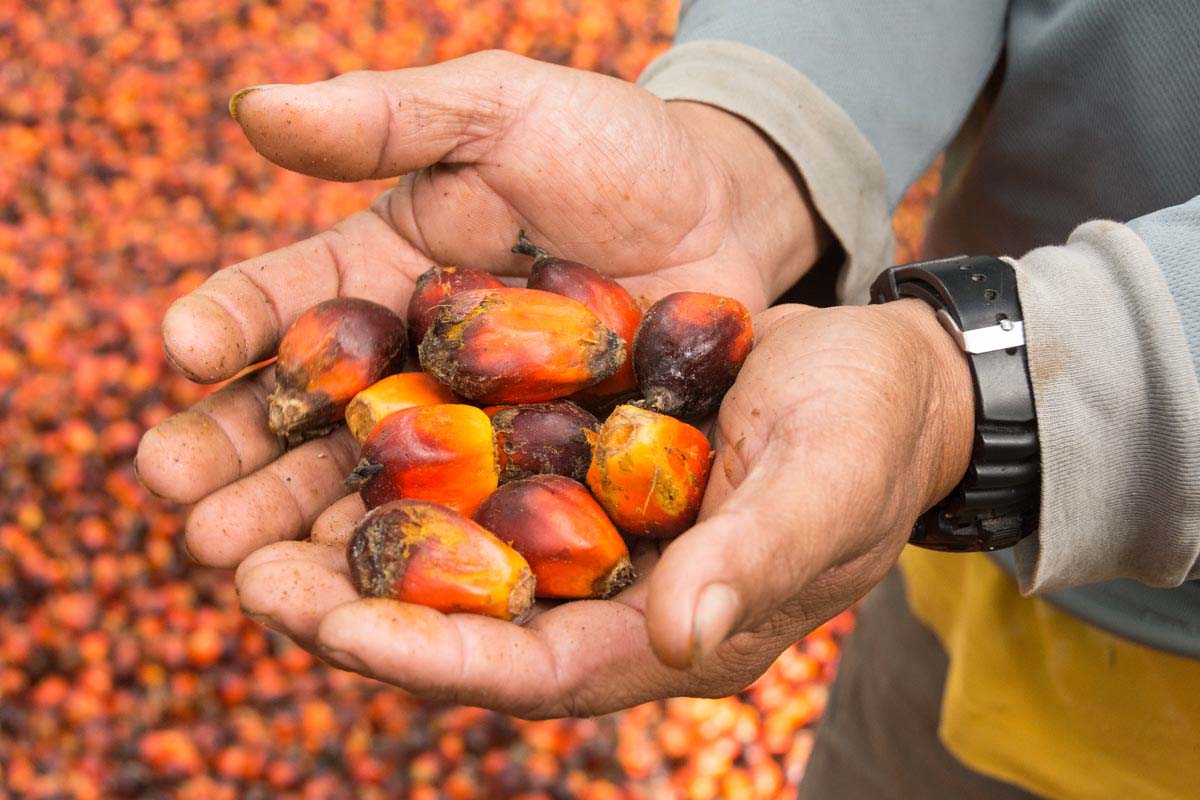
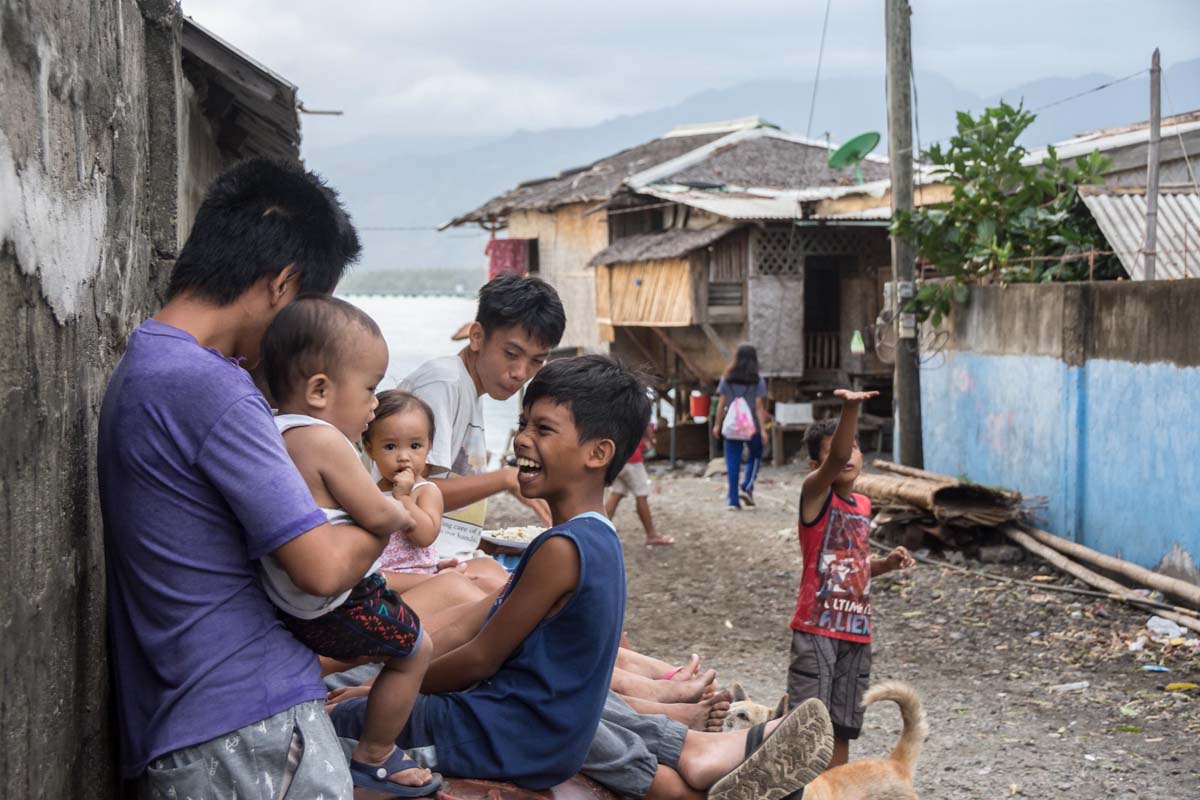
Palawan’s pristine coastline gives way to coconut palms and then lush rolling forested hills speckled with tribal houses. This municipality of Quezon in central Palawan is the domain of the Indigenous Tagbanua people . They say a proportion of their lands have now been appropriated for palm oil cultivation.
In 2002 the Philippine government decided to expand palm oil cultivation in the archipelago to reduce imports and to fulfil the country’s rapidly growing domestic consumption. That same year, the Department of Agriculture calculated that average palm oil production was 54,333 metric tons, with consumption running at 94,400 metric tons. Growing demand was expected to have reached 171,700 tons by 2015.
Today these expansion trends continue and in 2013 The Philippine Palm Oil Development Council Inc. (PPDCI) published an ambitious roadmap for expansion reported the Sunstar newspaper in the Philippines on August 27, 2015. It said the PPDCI “is eyeing another 300,000 hectares to expand oil palm plantation in a bid to make the country self-sufficient to palm oil products…The council targets to achieve, under its palm oil industry roadmap, the expansion in eight years from 2015 to 2023.”
Two major palm oil companies operate in Palawan: Palawan Palm & Vegetable Oil Mills, Incorporated (PPVOMI) and Agumil Philippines, Incorporated (AGPI). PPVOMI is 60 percent Singapore-owned and 40% Filipino, whereas AGPI is 75% Filipino-owned and 25% Malaysian. The parent company of AGPI is Malaysian-registered Agusan Plantations Incorporated. Other smaller companies are also joining in the “golden oil” rush.
AGPI has established a palm oil mill in the Municipality of Brooke’s Point for the processing of plantation harvests. As such, it buys 100 percent of the PPVOMI production.
With 70 percent of processed oil due to be exported to Singapore, China and Malaysia, the original rationale to supply domestic production appears to have been contradicted.
In deals struck with palm oil companies, different communities in central and southern Palawan agreed to lease areas of their farm and forest land in return for a share of the income from the palm oil profits. In other cases, local people leased parcels of land under customary native title to palm oil companies at low rents.
“We wanted to plant palm oil because the conditions were good. The conditions offered by the companies. But until now, it has been six years and we have not received any benefits,” said Graciano Muniz, tribal farmer from Aramaywan community [Baringay], in the municipality of Quezon in central Palawan.
In the seven years since the first leases began, none of the participating cooperatives have reportedly received a single payment, despite four years of harvest since the plants reached production maturity at around three years.
“The landowners were fooled by this company. To the extent that prior to that they have lands to till, they have lands to plant the crops for their living,” said Rodiar Carlio, a member of the Coalition against Land Grabbing (CALG), an NGO galvanizing resistance to the palm oil companies in Aramaywan and neighboring communities. He is negotiating with AGPI for a solution to the dispute.
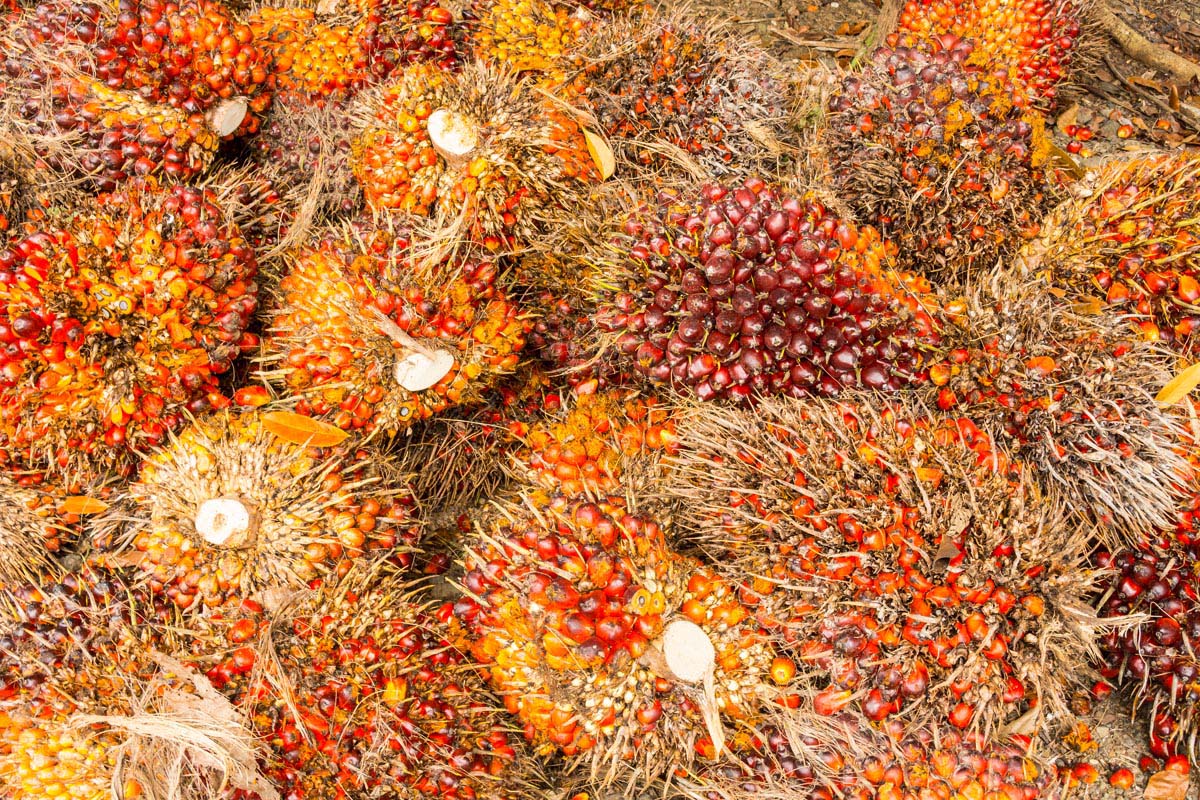
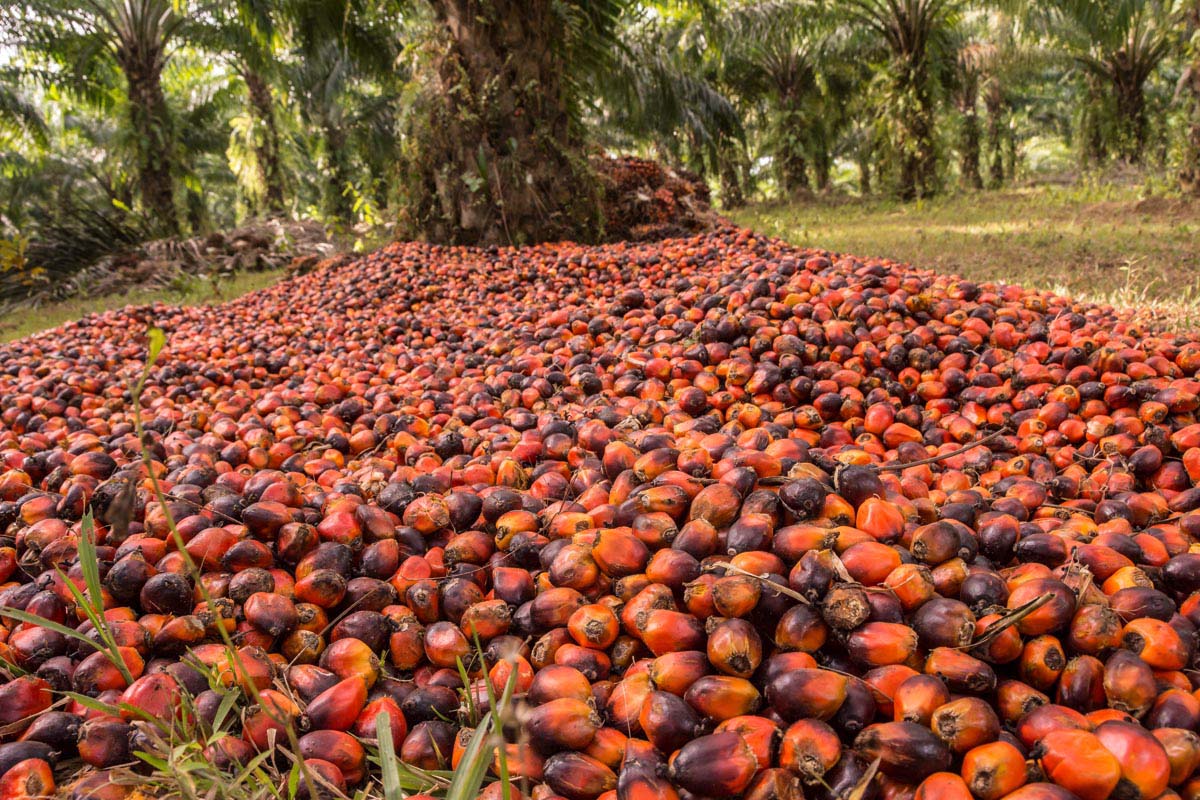
Palm oil has increasingly entered our food supply chain in the past 20 years and is now found in a multitude of consumer items from biscuits to shampoo. Viewed by food companies as a wonder crop, the prolific harvests of palm fruit are rich in saturated oil. However, the crop has courted controversy wherever it has been grown. Huge swathes of the great tropical forests on the island of Borneo have been felled to make space for oil palm plantations. Since then, cultivation has continued to spread throughout Southeast Asia – and even into Africa (where the wild oil palm originates) and South America – to feed an insatiable demand for the golden oil.
When sales teams from AGPI originally came knocking seven years ago, some tribal and farm communities were attracted to the high incomes the company promised relative to their dominant cash crop of coconut palm – which is still widely cultivated. Many signed-over a proportion of their private farmland for palm oil cultivation.
Roberto Bardolassa is one of these farmers. He moved to Palawan in 2007 from Rizal Island to cultivate his wife’s land.
“At that time the company was organizing and looking for landowners to cooperate with their company…so we decided to be their partner,” Bardolassa said.
Bardolassa and his wife leased three hectares to AGPI, but have since regretted it. “I think that what has happened here is indirectly land-grabbing,” he said. “If not why can’t we till our own land?…The rights of the poor people here – especially the farmers in Palawan, are being exploited by that crocodile Agumil.”
Some elderly farmers told Mongabay they found the scheme especially attractive because the company promised to arrange the plantation maintenance labor and provide steady income that would ensure pensions. “The original agreement – based on the conditions of the landowners and the co-op officials—meant there was a good possibility that we could improve our standard of living,” said farmer Graciano Muniz. “However, we have not received those benefits.”
Pasteur Motalib Kemil, tribal leader of the Tagbanua tribe, Aramaywan community [Baringay], in the municipality of Quezon, is Chairman of CALG. He told Mongabay that the 25-year contract was written in English, which the vast majority of farmers did not understand. He explained that officials from the tribal cooperatives often signed up on behalf of participating farmers and the title deeds for the land were handed over to the company for safekeeping. Kemil says he is not alone in suspecting that the company has passed the farmers’ land title deeds to the Land Bank of the Philippines (a government lender) as collateral to secure the loans used to set up the plantations.
“We haven’t received any payment for rental of our farmland – it has all gone to the Land Bank that provided the loan. These farmers provided their land titles as collateral to the Land Bank and it takes 25 years to pay before they receive their share of the profits from the harvest,” Boy Soda, elected representative of the Palawan Tribe from Baringay Salogunin in the Brooks Point municipality told Mongabay.
Land clearance and planting of the young palm oil saplings was then billed to the farmers as a loan incurring 14 percent interest annually. Farmers complain that many of the contractual details were kept hidden.
Rodiar Carlio explained: “to our surprise even the officers of the cooperative had entered into a contract, they called it PTME, the Production Technical Marketing Agreement, and they initiated the management services agreement. But the signing of PTME was concealed before the general assembly…. Even the officers who signed that contract had no total knowledge of what they were signing.”
The farmers had expected that their income would begin once the palm oil trees had matured to harvest stage, around three years. They had not expected to have to pay the setup costs and the onerous rates of interest from the Land Bank, and they claim they were deceived throughout the contractual negotiations.
“We are paying the company for the equity, for the services that they are giving the cooperative,” Carlio said. “In our cooperative alone we owe to the Landbank about 11 million pesos (US$237,000). Right now the interest is almost like the principal [loan] – another 11 million. Then that 11 million plus another 11 million that is 22 million and then that is compounded annually at 14%. In that contract the cooperative is required to pay all the debts for six years from the start of the harvest. But the cooperative, as we analyze, under the management of the company cannot pay its debts to the Landbank.”
Motalib Kemil shares Carlio’s opinion that once all costs are deducted from income accrued from the harvest, the farmers are unlikely to receive anything over the 25 year period, even if the company intended to make payments, which it shows no sign of doing. Many of the farmers fear that the debt mountain they have been duped into accumulating will mean that they will never see their land again. Part of the problem, according to Motalib, is that loan payments are insufficient because the size of the harvest has fallen short of that promised by the company.
In addition, Motalib explained that because it has a monopoly on processing, the company sets the price per kilogram it will pay for the palm oil fruit, which he complains is lower than the global commodity price.
Since AGPI began operations, it has made deals with six municipalities in central and southern Palawan (the target area for oil palm development spans the municipalities of Aborlan, Narra, Quezon, Sofronio Española, Brooke’s Point, Rizal and Bataraza) for rent or purchase of around 6,000 hectares. However, its sales teams are still active on the island trying to meet their 20,000-hectare target. As word spreads about payment failures, fewer tribal people and farmers are inclined to sign leases, according to Motalib. “I think it will be very hard to meet this target because now farmers do not want to sell because they have heard about the bad experiences of other farmers,” he said.
Harvested palm oil fruit is taken to the AGPI processing plant at Brookes Point in central Palawan and from there it is shipped to other islands such as Cebu, and also abroad to China, Malaysia and Singapore. Tribal representatives are disappointed with the lack of support they have received from state institutions for their plight. None seem prepared to help them.
“It would appear that Agumil and other oil palm enterprises have bypassed, with impunity, the Strategic Environment Plan (SEP), the very law which should ensure sustainable development and environmental protection in Palawan,” said Marivic B. Bero, CALG Secretary General. She explained that state institutions including the Palawan Department of Environment and Natural Resources (DENR) and the Committee for Sustainable Development (CSD) are both responsible for failing to properly enforce SEP regulations restricting land clearance.
Mongabay approached Agumil, Land Bank, the governor’s office, DENR and the CSD for their reactions to the criticisms of the cooperatives. No responses were forthcoming.
In 2004, the provincial board of the governor’s office passed Provincial Ordinance No. 739-04 promoting development of the palm oil industry and it is understood by tribal leaders that this remains its position. It was the culmination of a period of promotion by then-Governor Joel Reyes who successfully invited palm oil companies to Palawan. Promotion led to the creation of the Palawan Palm Oil Industry Development Council (PPOIDC), a multi-agency body tasked with promoting the palm oil sector in Palawan and ensuring that developments such as construction of a refinery took place.
Since oil palm plantations have rolled out across the landscape, farmers claim that new previously unknown agronomic problems have surfaced. For instance, the palm trees require high water usage, which can come at the expense of neighboring crops.
“Our discovery, is that palm oil [trees] absorbs a bunch of water compared to other trees, so if your land is planted by palm oil forget it. Only because of the palm oil, you can’t plant any more other crops,” Carlio said. In addition, the oil palms possess very thick and deep root formations that are difficult to remove.
According to Carlio, the plantations use high levels of external inputs like pesticides and herbicides and these too are having knock-on environmental effects.
“Some studies show that the insects that destroy the coconuts in the province emanate from the palm oil. But the company denied that. So we are using pesticides, especially the people who are engaged in coconut planting. So their coconuts are dying because [of] that insect that is destroying the coconut. Prior to the existence of palm oil in the province there was no such thing as that insect that destroys the coconut,” Carlio said.
A 2013 report by ALDAW supports Carlio’s suspicions.
“New pests are spreading from neighbouring oil palm plantations to indigenous cultivated fields and coconuts groves,” the report states. “Such pests include the Red Palm Weevil (Rhynchophorus ferrugineus) and Brontispa longissima. The latter, according to local informants, was not present in the area before the establishment of oil palm plantations.”
Graciano Muniz has made a pragmatic work transition to cultivating seaweed for the Chinese pharmaceutical market. “These days I don’t join in farming palm oil. We earn our living from the sea. Farming in the sea,” he said.
Tribal representatives are aware of the risks they face when speaking out about their predicament. According to a report by ALDAW, key architect of the Palawan palm oil industry and former Governor Joel Reyes is currently a “fugitive abroad and wanted by ICPO (International Criminal Police Organization) – INTERPOL. Joel Reyes, in fact, has been identified as the mandate and organizer of the killing of Gerry Ortega.”
Local radio journalist and environmental campaigner Gerry Ortega, was gunned down in January 2011 in Palawan capital Puerto Princesa, reportedly for his staunch anti-mining campaigning. Agence France Presse reported in March 2011 that Ortega was the latest in a line of at least four campaigners who lost their lives for speaking out against resource exploitation in Palawan.
Bardolassa is adamant that he will continue his fight for justice, despite what happens.
“I am willing to die even – yes – I am not afraid,” Bardolassa said. “What is the meaning of my life if I do not let the world know what I know? The reality of what is happening to our farms.”
In late September, CALG submitted a petition signed by 4,200 farmers and indigenous residents to Palawan Vice-Governor Dennis Socrates, calling for a moratorium of palm oil expansion on the island.
Bishop Pedro Arrigo personally endorsed the petition, saying it “comes directly from the very people who have suffered the environmental and social consequences of oil palm development in our province over the past seven years. It is about time that their grievances will be heard by the Provincial Government and acted upon.”
Published by Mongabay.

Sand-dredging is big business, especially in Asia, where demand has sky-rocketed thanks to the booming construction industry.
The sleepy fishing village of Koh Sralao, situated on a small island in a mangrove- lined estuary, is in the frontline of the resistance against rampant sand-dredging.
‘Sweetheart Island is the only place we can fish for crab now. Many islands have been lost to the sand-dredging already,’ said fisher Lim Lon. With its houses on stilts strung out over the water, the isolated village of Koh Sralao in Cambodia’s southwest Koh Kong Province is far from the tranquil backwater that it might appear at first sight. It is at the forefront of a movement to halt the sand-dredging which, since 2007, has blighted this and many other communities along Cambodia’s rivers and coastline.
As our fishing boat sailed upriver through an abandoned dredging site, the mangroves lay fallen and dying where the river bank had collapsed. A farmer complained that his riverside fields had receded 20 metres from erosion since the arrival of the dredgers.
‘Before the dredging, the water was only two metres [deep] or less, and in some places there were sand banks, but now the water is at least five metres and some places eight,’ explained another fisher, Phen Sophany. ‘When the water reaches five to seven metres, there are only a few male crabs. Crabs need shallower waters for breeding.’ Even when the dredgers have moved on, the crabs don’t return.
Studies have demonstrated that if sand extraction is greater than the rate at which it is naturally replaced by sedimentary deposits, then erosion will take place, not just at the dredging site, but upriver and downstream too, largely because the greater river capacity increases the speed of the flow, exacerbating erosion and increasing the potential for flooding.
Despite a seeming abundance of sand, and its low cost relative to other mined commodities, rapidly escalating global demand has led to pressure on supplies, and salt-free river sand is particularly prized for use in construction work.
‘It still impacts us when the dredgers are working upstream, because all the muddy water flows downstream – and crabs can’t live in muddy water,’ explained Sophany.
By 2015, dredging was hitting the community hard. Catches were down, and many families had taken out high-interest loans from loan sharks to stay in business. Others ‘collected water snails in the mangroves, but now there are no snail stocks’. Some quit crab fishing altogether to seek work in the new economic zone factories in Koh Kong city, a two-hour boat ride away.
Asia’s development boom is a key global driver of global sand demand – with Singapore by far the biggest importer. In 2012 academic Pascal Peduzzi estimated that ‘the world’s use of aggregates for concrete can be estimated at 25.9 billion to 29.6 billion tonnes a year – enough to build a wall 27 metres high by 27 metres wide around the equator.’ He estimates that between 47 and 59 billion tonnes of aggregate and sand is mined every year.
Satisfying Singapore’s hunger for sand led neighbours Indonesia and Malaysia to experience dramatic environmental impacts at home – including, in Indonesia’s case, the disappearance of entire islands. One by one, neighbouring countries stopped exporting to Singapore, leaving regional countries such as the Philippines, Vietnam, Burma and Cambodia to replace supplies. In a bid to open up a new supply front, in March a Singaporean company reportedly held talks with the government of Bangladesh to explore a nationwide sand-dredging deal.
In April 2015, when activists from NGO Mother Nature offered to help stop the sand-dredging works, many in Koh Sralao were only too keen to form a partnership. Together, they went from one sand-dredging barge to the next, demanding that they leave. To their surprise, the sand-miners complied. It was later discovered that, with no licence to dredge in the area, companies feared being exposed.
Mother Nature then started receiving calls about large-scale dredging operations from communities further west on the Andeung Teuk River. When activists arrived, they found more than 60 sand barges owned by the Direct Access sand-mining company.
The people who have benefited from all this, who have pocketed all this dirty money, are at the highest levels of government. ‘More than 100 people protested,’ says activist Sim Samnang, describing the flotilla of fisherfolk and activists who surrounded and boarded the barges. ‘We warned them away from the area, from our river.’ Each barge was carrying 10,000 cubic metres of sand to be transported out to sea and loaded onto giant cargo ships bound for Singapore.
The sand-dredging business is controlled by senior members of Cambodia’s ruling elite, notably Senator Ly Yong Phat, according to a report, ‘Shifting Sand’, by British NGO Global Witness. Ly Yong Phat is well known in Koh Kong Province, where he is known as the ‘King of Koh Kong’ for his widespread business dealings there.
In December 2016, five community fishers, activists (including this author) and a journalist were illegally detained by security guards from the Udum Seima Peanich Industry and Mine Co while visiting its dredging site on the Tatai River. Two of Prime Minister Hun Sen’s daughters, Hun Maly and Hun Mala, are listed as shareholders of the company.
Activists Sim Samnang, Try Sovikea and San Mala were imprisoned as a result of their efforts at the Andeung Teuk. ‘The government arrested us and left us in jail without trial for 10 months and 15 days,’ Sim told me in January from a secret location outside Cambodia, where the three were awaiting the outcome of their court appeal. Sim wasn’t hopeful: ‘The appeal court has summoned us to trial again in Phnom Penh, but we don’t trust them. Usually the Cambodian court is working under government power. It’s not independent, we cannot trust them. That’s why we came out of the country.’
At the appeal hearing their original sentence was upheld, and although they will avoid a further prison spell for now, they remain liable to pay $25,000 compensation to Direct Access, which brought the compensation case.5 Being in no position to pay the large sum, their situation remains precarious.
‘The people who have benefited from all this, who have pocketed all this dirty money, [are] at the highest levels of government, and [in] some of the companies – which are more like mafia cartels,’ says Alejandro Gonzalez-Davidson, founding director of Mother Nature Cambodia. He was deported in February 2015, for opposing construction of Cambodia’s proposed Areng dam.
He explains how in October 2016 he uncovered a scandal involving millions of tons of illegally exported sand to Singapore. By investigating sand import and export trade figures available on the UN Commodity Trade Statistics Database, Mother Nature identified a large discrepancy in quantities of sand exported by Cambodia to Singapore. The discrepancy was valued at around $750 million.6 So where had the missing sand gone?‘Hundreds of millions of dollars have been stolen from the Cambodian people,’ says Gonzalez-Davidson.
The Ministry of Mines and Energy have repeatedly dismissed the discrepancy, with spokesperson Dith Tina saying there was no ‘concrete proof’ and that re-import and export of the sand through third-party countries might be responsible. The response of the Cambodian government to the scandal was temporarily to halt sand exports to look into the matter.
In December 2016, the Cambodian Parliament’s anti-corruption commission called on mines and energy minister SE Suy Sem to explain the discrepancy, but in a letter to the Singapore Ambassador on 7 March 2017, the Commission said that it ‘did not find the explanation satisfying’.
The letter went on to request that the Singapore government share full details and documentation of all its sand imports: ‘Failure to effectively allay these suspicions and to collaborate with us might tarnish the reputation of Singapore, a country regarded as being one of Asia’s most transparent and least corrupt.’
A farmer complained that his riverside fields had receded 20 metres from erosion since the arrival of the sand-dredgers
At the beginning of April, opposition parliamentarian and Commission member Son Chhay said that he had met with officials from the Singapore embassy, who had declined to provide the information requested. The Cambodia Daily reported Chhay as saying: ‘I think that the Singapore side is trying to hide something. They are not honest with us.’
The controversy remains unresolved. Meanwhile, in April Mother Nature’s activists discovered that construction of a sand-washing facility was under way deep inside a national protected area. They suspect dredging operations will restart at any time. ‘It’s quite evident that sand is too valuable, too much money has been made by a lot of people, dirty money, and they’re just trying to make sure that this resumes eventually,’ explains Gonzalez-Davidson.
‘Fish have returned and dolphins have been spotted too,’ enthuses Mot Sopha. At Koh Sralao, things are looking up since the halt on sand-dredging. ‘We have money to repay our debts from buying fishing nets and boat equipment,’ her husband Sophany adds.
The community remains concerned, however, because some of the dredging boats have not left the area. Sophany remains undeterred. ‘Now we have changed our behaviour. We feel stronger than before. We will go and complain if they start dredging again,’ he concludes.
Sources
IOSR Journal of Pharmacy, Vol. 2, Issue 4 (July 2012), pp. 1-6
Environmental Development, 2014, vol. 11, p. 208-218
According to Commerce Ministry records.
Phoebe Seers ‘Singapore’s overdue response to Cambodian Sand trade data misses the point’, 17 January 2017 mlex.com
Published in New Internationalist Magazine

With a relatively small population Laos managed to maintain the integrity of its tropical forests for longer than most of its neighbours. In recent years however illegal logging has continued to accelerate and goes largely unchecked despite a government ban on roundwood logs in 1999.
A shadowy corrupt government allocates few resources to forest protection. Nearly all the timber is exported going to China and Vietnam and volumes have jumped dramatically in recent three years.
Many of the local farmers and indigenous peoples in Laos have been affected by the widespread deforestation which has severely impacted their livelihoods as their community forests have vanished. Although many raw logs are exported, sawmills operate along the border areas too.
Laos borrowed heavily to build hydropower dams to create surplus electricity for export and a highspeed railway line from Thailand to China. The investments have not paid off as hoped leaving this least developed country burdened with debt it can ill afford.
Pitcures were shot on Kodak Ektachrome, scanned with a Nikon LS9000 ED, using a Nikon FE2 body with lenses: Nikkor 50mm f1.4 Ais, 28mm f2.8 Ais, and a Nikon, 80-200mm f4 Ais.

Journey: Through Burma’s Irrawaddy Delta.
The delta marks the end of a long journey for the Irrawaddy River, having finally arrived from the faraway Tibetan plateau. As it enters these lowlands the river spills over into myriad rivers and streams that feed intense rice cultivation as they wend their way to the sea.
The vast Irrawaddy delta was for years isolated from the outside by political oppression and antiquated infrastructure. Navigating the river remains one of the few ways to trade and stay in touch. So demand is high for tickets to board the many rusting boats that ply its waters from the capital to the provinces.
Joining an antiquated ferry crammed with passengers and goods, I journey with the local people and get to know some of the dock-workers making a meagre living carrying cargo.
Nearly a hundred miles across, farming and fishing opportunities in the delta have attracted a diverse population, making the area one of the most densely populated in the country.
The mangroves that once proliferated have increasingly given way to farming. The timber used for construction and cooking charcoal is shipped out to the capital Yangon.


Years later, in May 1949, the Communists entered the city and the opposing Nationalists under Chiang Kai Shek fled to Taiwan. Dynamic, sometimes tumultuous change is nothing new to Shanghai. In 1533, during the Ming dynasty, a wall was built around the growing city to protect residents from attack by Japanese pirates. The eight-metre high structure, demolished back in 1912 had ten gates into the city. The West gate (in Chinese called ‘Laoximen’) is now a central district, the city having since expanded far beyond its former limits.
In the early 1920s, competing colonial powers built showcase banking buildings and hotels on the riverside ‘Bund’ promenade. Meanwhile Laoximen followed central Shanghai in building ornate blocks of tenements. Sweeping away the old wooden houses these new buildings for the booming middle classes were a fusion of traditional Chinese styles and architectural features introduced by the colonists, distinctive narrow streets and courtyards which became known as the ‘shikumen’ style, literally translated as ‘Stone Gate’.
Shikumen would become Shanghai’s dominant style of residential architecture. Porcelain kitchen sinks were typically located in the narrow alleys outside the houses. Ornate stone features such as door lintels, roof gables, and carved wooden doors and windows increasingly adorned the brick buildings. Later, as styles evolved, buildings displayed art-deco features. Despite the increasing assault of modern development on its historical buildings, Shanghai still claims more art deco architecture than virtually any other city in the world. However, holding on to the styles and themes of the past is a battle that some traditionalists are finding it increasingly hard to fight.
A group of three locals sit under the arched entrance to the condemned Jian Road shikumen discussing their bleak housing problems. ‘It’s more than a hundred years since our ancestors came’, says Mr Zhou. ‘I moved here half a century ago,’ says Mrs Zhang.
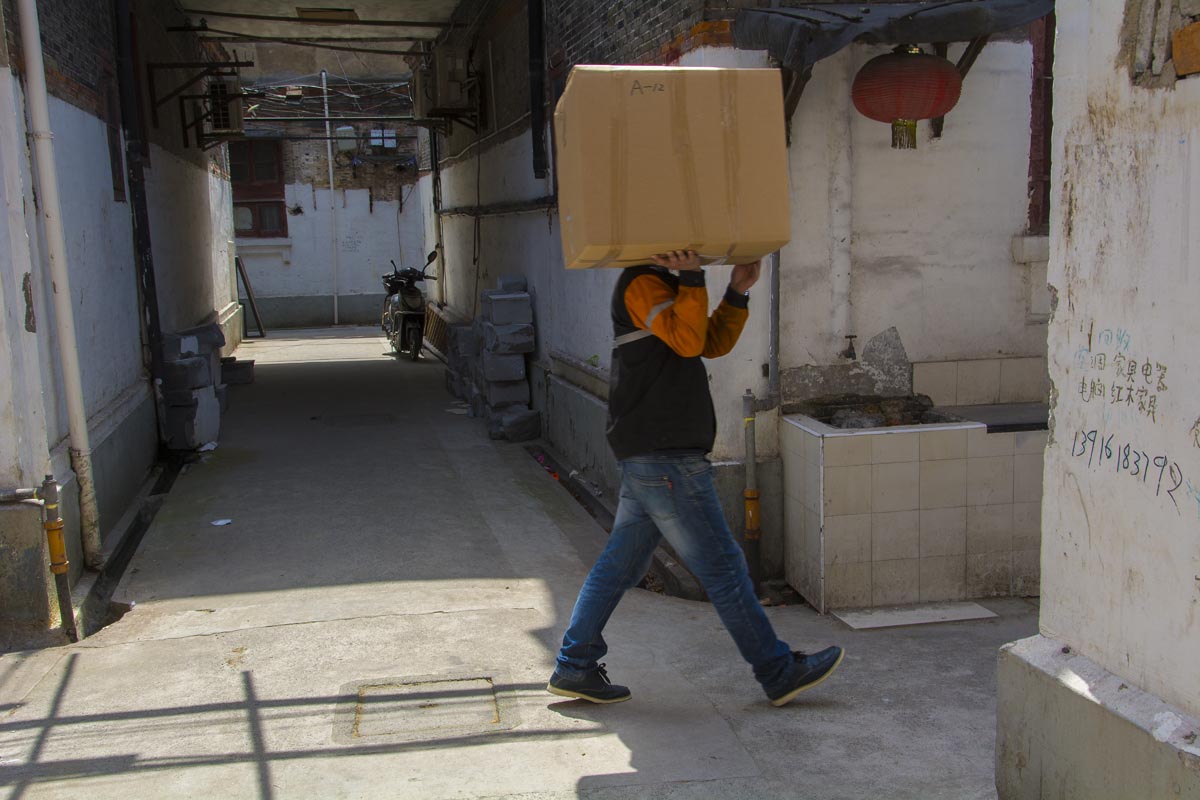
Now in the narrow alleys there is an eerie silence and most homes are boarded up, their doorways covered in paper seals to prevent re-entry. The elderly Mr Zhou confirms that, ‘most of the people have already moved.’ He explains how people were encouraged by the developers to leave: ‘People were asked to move by January and those who fail to do so will not receive a compensation bonus.’ ‘Yeah we will stay here,’ says the group in unison. ‘They could not give the compensation we want so we won’t move,’ they declare defiantly.
The group is angry that the size of their properties by floor area is not being fully considered in their claims. ‘Let me give you an example,’ says Mrs Zhang. ‘Some apartments have two kitchens, but they won’t count this area, nor the balcony or bathroom. Only the living-room and bedrooms are counted.’ With information scarce, the neighbours are in the dark about their rights and compensation procedures. ‘I don’t know who they are,’ says Mrs Zhang when asked who she is negotiating with. ‘There is no government department to talk to about it. It’s the developers who talk to us, who say they are working through the government.’ She says that the developers asked them for trust, but she remains suspicious saying, ‘They don’t have a license and we don’t have a contract with them.’ She suspects that the government just wants to get rid of her at minimum cost: ‘We went to the municipal government office and they turned a blind eye to it. They only care how to sell the lot.’
The group claims the developer offered them less than half of the square metre value for equivalent properties in the area. On top of this, they have to pay 20 per cent to the government for leasehold management: ‘We moved here before the communist liberation,’ says Zhang, ‘then the houses became government property, and thus we became tenants.’
Mr Ye was born in Shanghai and moved to his alley house in the Jian Road shikumen in 1972. He works from home as an electrical repairman. Sitting in his small living room he explains his housing worries as he sorts through a box of old electrical components. ‘We have to move soon. Actually it’s overdue. We need to negotiate,’ he explains. ‘I have a very serious disease, haemophilia, and can only go to the hospital here for medical care. The Royal family in Britain also had that disease. People who have it are like a glass which is very fragile.’ He explains that he has to visit the nearby hospital every day for treatment. Commenting on the eviction process Mr Ye says, ‘They were quite brutal before. They would force you out by cutting the supply of water and electricity. It’s better now, at least they won’t cut you off and demolish forcefully when you’re overdue.’
When asked whether the government will provide alternative housing Ye says, ‘Yes they do but it’s quite far away. Still in Shanghai but in remote areas. We have to negotiate – we need special treatment because of my disease. It’s really expensive to buy a new house around here, the compensation is not enough. We [he and his wife] are both disabled, we can’t walk like normal people. She can walk but not a long way. It’s very convenient to live here but not the new place. I can only get medical care in the centre.
Other hospitals don’t have the medicine for my disease. I told the authorities about our difficulties but they said according to the policy, people will only get houses in suburban districts. People did get houses in the centre in the old days but not now.’ Ye flicks through a thick catalogue of new build high-rise properties available in the outlying suburbs just being constructed. It’s as thick as a telephone directory. All of them are far from the centre. Time is pressing and Ye and his wife feel stressed about the urgency. He’s worried that the lack of attention he is receiving could be life threatening: ‘They have to make sure it’s not worse than we are now. Otherwise it’s risking my life, because I can’t get medical care in time. It will take at least two hours to get to the hospital from there. I’ll already be dead after two hours.’
Cutting through Laoximen is Dongtai street which has been an antiques and flea-market since the 1980s. Featured in many Shanghai guidebooks, it is a popular destination for tourists and locals who come to browse the 150 or so stalls hunting for bargains. The market is itself a product of the city’s immigrants. Many of the items for sale are cast-offs from settled migrants who no longer have need of them. At one stall a huge pile of old suitcases is testament to the stream of workers who continue to arrive. At another, a pile of Mao’s Little Red Book are unwanted reminders of the disastrous cultural revolution which most wish only to forget. Mao-era posters and magazines display fading images of communist realism – a bygone ideological dream, sitting among the crumbling façades of the shikumen buildings with their colonial story.
Many of the traders have moved no further than this market street since they originally arrived. Stallholders describe how the trinkets they had brought from their home-towns proved popular, and soon they were bringing more stock from visits home to the provinces. Among the personal ephemera can be found fixtures and fittings from glazed roof tiles to enamel door numbers, all scavenged from the rolling demolition of the old shikumen neighbourhoods across the city.
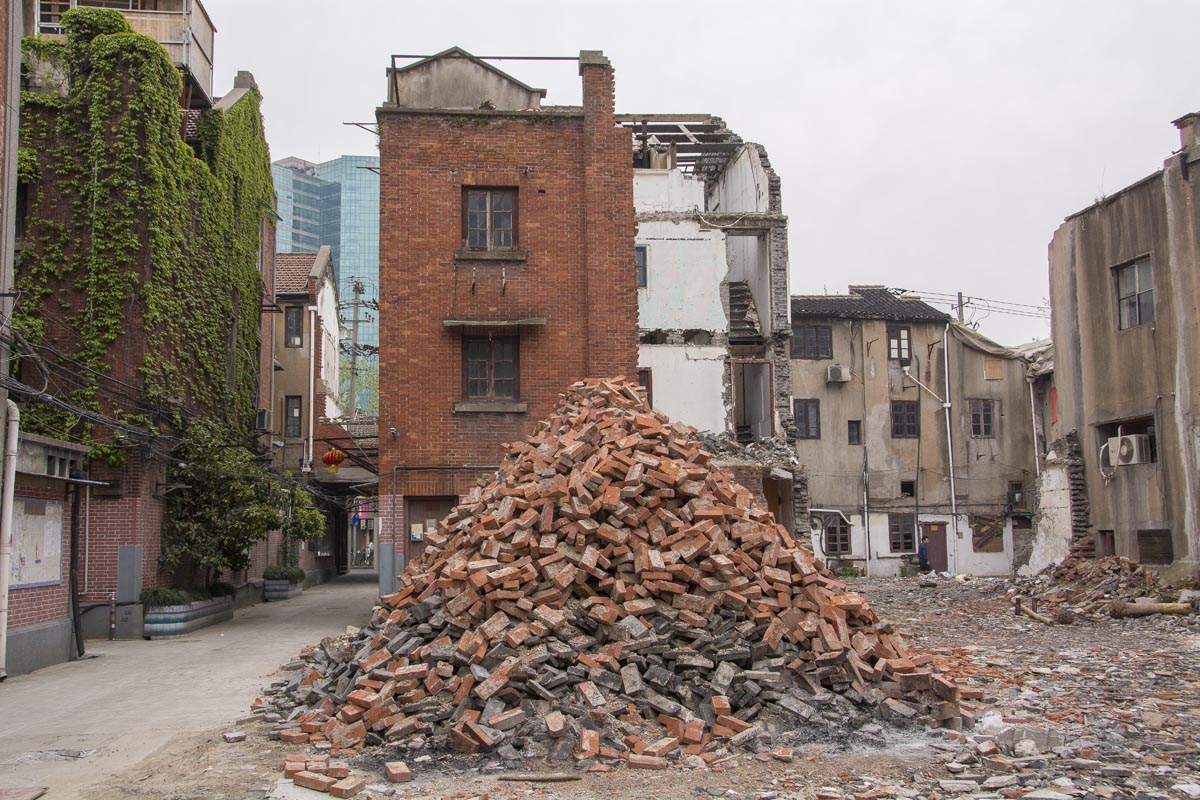
Now scavengers are busy in Laoximen itself. In a bitter irony, signs from the neighbouring streets can be found on the stalls, themselves slated to soon be swept away. As the still-ongoing demolition of Laoximen proceeded alley by alley, courtyard by courtyard, the bulldozers and demolition crews grew ever closer to the market itself, still open for business. Most recently, the houses that lined Dongtai street were smashed apart leaving only the street stalls remaining, surrounded by piles of rubble.
One stallholder explained, ‘We are moving very soon. We have meetings in a couple of days. At the end of the month we will know how much we are going to get compensated. I’m not sure where I am going. I am selling everything at a cheap rate.’ In one block, already long since flattened, people hold out in a last solitary building – their semi-demolished home – refusing to relocate, holding out for better compensation. Stallholder Mr Guo says, ‘They asked me to close before the end of March, but I protested. I need compensation you know – it’s normal. It’s reasonable if you stop my life source. The government sells the land for billions of money. We need our life.’
An indigenous woman who has been selling ethnic textiles for 30 years says she has no idea where she will move her stall to and she asks for suggestions. Mr Guo says he looked into another market option but the rents were high in comparison. Most stallholders say they will not be moving on, but instead will be closing their stalls for the last time the day the market ends. As a result many have reduced prices to clear their stock. ‘Now it’s a clearance sale, I can’t take everything home, my home is full of antiques already,’ says Mr Guo, and he explains that now he plans to travel the world. It presents a big life change: ‘I was born here and have been here all my life.’ A neighbouring stallholder says, ‘I’ve been here about 20 years. The street has finished its historical mission.’ For many inhabitants of ‘old’ Shanghai, that same sentiment applies to the city as a whole.
Commissioned by Geographical Magazine