A mine of information: improving communications around the Rio Tinto mine in Madagascar
A mine of information: improving communications around the Rio Tinto mine in Madagascar


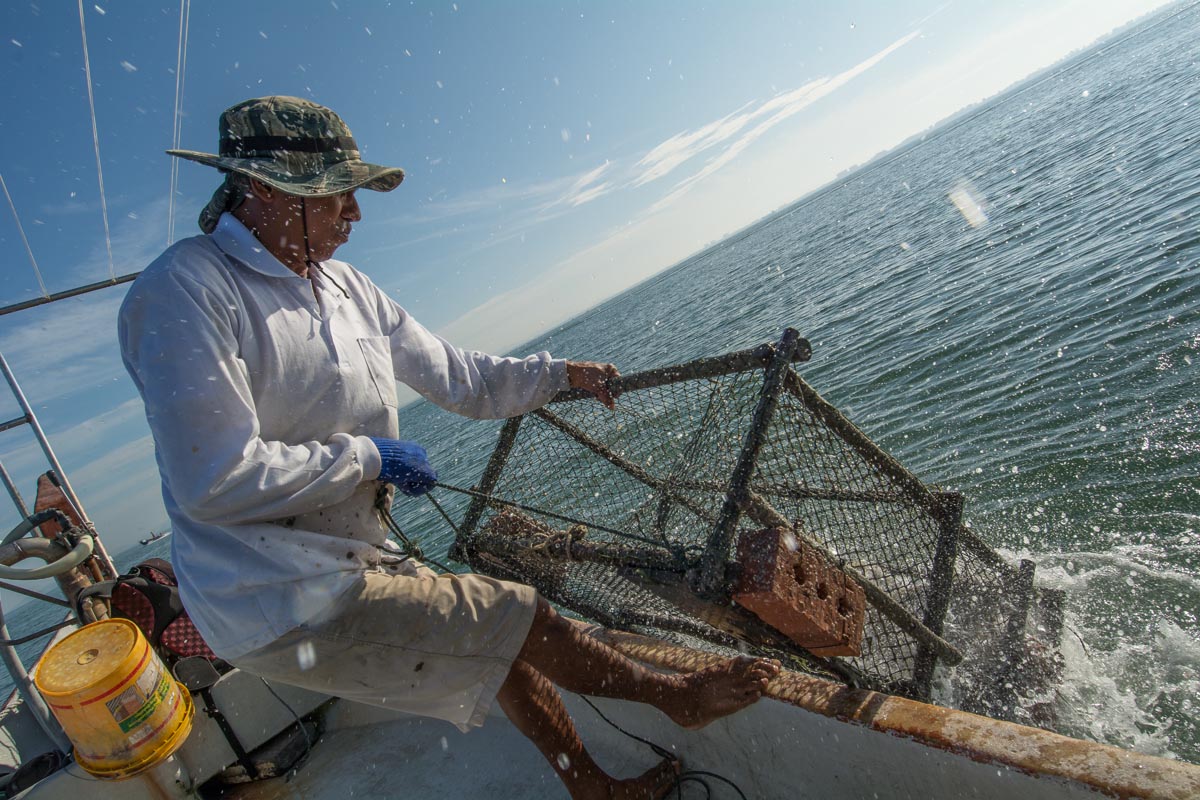
Using a method called triangulation, his keen eyes pinpointed natural markers on the shoreline and used these bearings to locate his traps with incredible accuracy. With an anchor thrown down, he snagged his trap and hauled it up. The deck was soon awash with flapping fish. These are grouper — prized in the restaurants of Penang and beyond, they fetch a premium price and can only be caught with hooks or traps, Liew explained. He said customers travel from as far as Hong Kong to buy these prized delicacies.
“Look at this mud in the traps,” Liew complained as just two of his four traps contained a catch worth keeping. Still, it was a good day under the circumstances. One phone call later and the 11 kilograms (24 pounds) of grouper were snapped up by a restaurant owner eager to purchase them for over 500 ringgit ($113). They were still alive when Liew delivered and weighed them while hungry customers looked on.
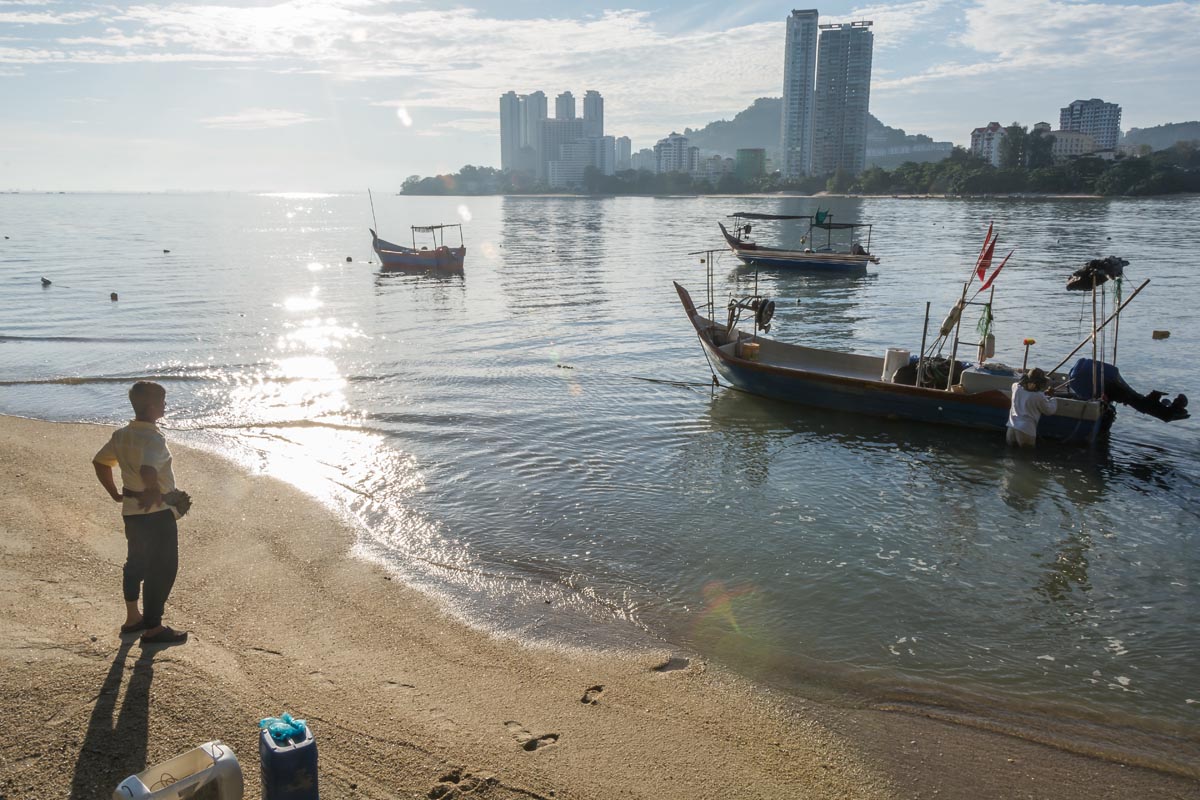
“I know this area very well because in my school days I followed one of the fishermen,” said Liew, from Tanjung Bungah a village North of Penang Island’s capital Georgetown. Now the days of his fishing grounds are numbered because of a land reclamation project by a local property developer.
“This area is very rich with mud crab, shrimp, snapper, and grouper, but soon it will all be gone,” said Liew.
The island of Penang, which lies off the west coast of peninsular Malaysia, is famed for the British colonial era architecture that won its capital, Georgetown, an inscription on the UNESCO World Heritage list. These days, though, soaring land prices mean most of the development is high-rise. Housing 2,372 people per square mile as of 2010, the island is the most densely populated place in Malaysia. With demand for real-estate high and land scarce, developers have ambitious plans to build out into the ocean by reclaiming coastal land and building islands made of sand — a drive supported by the Penang State government.
Reclamation projects have already been completed next to the second Penang bridge, which stretches 24 kilometers (15 miles) to the mainland from the island’s Southeast coast. Another reclamation scheme, known as the Seri Tanjung Pinang Project has also launched. Stage one, referred to as STP1, was completed in 2006: the 97-hectare (240-acre) extension to the shoreline northwest of Georgetown is filled with luxury housing and an upscale mall. The project’s second phase (STP2), which involves the construction of a new island as well as additional coastal reclamation, is currently underway. When STP2 is complete, it will bring the project’s total amount of reclaimed land up to 404 hectares (1,000 acres) of condominiums, shopping malls and leisure facilities. The project will also reclaim a 131-acre coastal strip for a government park.
Plans are also afoot for an even bigger reclamation project on the South of the island at Permatang Damar Laut.
All of these plans have been contested by environmentalists concerned about the impacts on dwindling mangroves, fisheries and birdlife – not only at the construction sites themselves, but also at the mine sites supplying vast amounts of rock and sand.
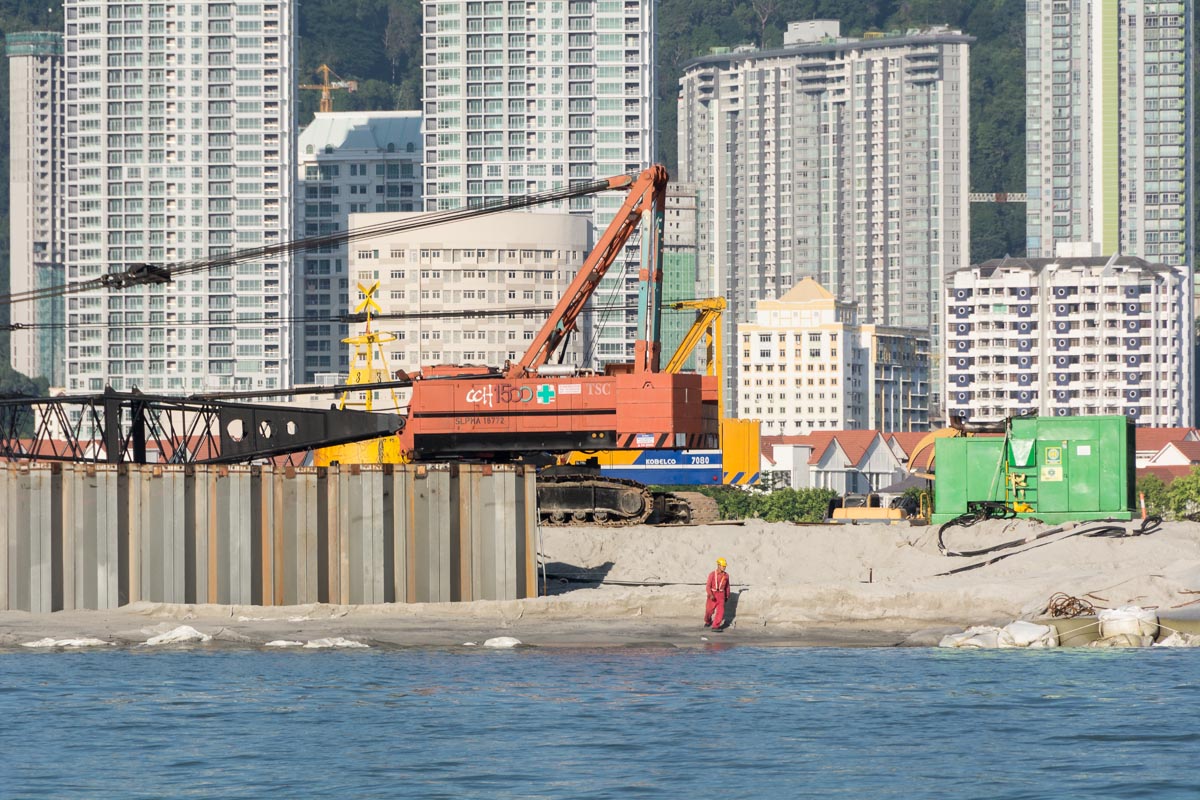
As Liew and I motored back to shore, we were escorted by a security launch. Guards on board shouted a warning for us to leave the construction area. On our port side, a rock bund wall was being filled in with sand by diggers, indicating the edge of the new reclamation island. On our starboard, out to sea, tug-boats, pontoons, dredge-ships and sand transport barges filled the sea with heavy construction traffic.
“That is Rat Island” said Liew, pointing to an outcrop of boulders and mangroves that houses a cemetery. A pair of white-bellied sea eagles (Haliaeetus leucogaster) took off from the rocks as we approached, one carrying a fish in its talons. According to the Environmental Impact Assessment (EIA) for the second phase of Seri Tanjung Pinang, these eagles are one of ten bird species that are “Totally protected” under Malaysia’s 2010 Protection of Wildlife Act, among a total of 73 bird species found to be inhabiting the project area.
“Those are the only mangroves left,” said Liew pointing to a few isolated trees. Because they provide essential habitat as fish spawning grounds, Liew is especially concerned about their loss, explaining that mangroves used to line the coast all the way to Georgetown six kilometers away. These will disappear with the planned coastal expansion under STP2.
“We have another 760 acres to go,” said Jonathan Yeoh, manager of group corporate strategy with Eastern and Oriental, the development company whose colonial-era flagship hotel graces the waterfront of Georgetown. It will retain its waterfront view, said Yeoh, but many other buildings will overlook the new island, known as STP2, to be connected by two bridges. E&O subsidiary Tanjung Pinang Development is coordinating construction of the project.
Mageswari Sangaralingam, a research officer for Friends of the Earth Malaysia in Penang questioned whether this style of development is appropriate for Penang: “There is almost like a glut of residential condos with many lying empty. What we need is low cost: medium-low cost housing projects which are affordable for the people. But then they are building these luxury condominiums which are not affordable. Most are vacant because they are owned by foreigners.”
Yeoh said his company could not comment on the master plan, which remains confidential. However, he was keen to stress that the island developers will set aside “30 percent” to cater for low-cost local housing.
A Chinese contractor, China Communications Construction Company Ltd is undertaking the works, via its wholly owned Malaysian subsidiary. The company, which claims to be the “world’s largest dredging company,” has considerable experience. As well as working on the 24-kilometer long Penang bridge, it was also involved in construction projects at the Hong Kong and Macao airports. A representative told Mongabay that while it was overseeing the works, it also employed local workers.
The reclamation works entail removing existing mud from the seabed. This dredge waste is dumped at a designated site about 40 kilometers to the North of Penang Island. Two million tons of rock plus steel piles will create the outline perimeter of the island. This is being filled with 33.1 million cubic meters of sand to eventually create the island and raise the level high enough above the water level to weather high tides and storms. The EIA says that shipping this quantity of sand will be done by 10,000 cubic meter barges requiring 3,820 trips over five years, each one of 171 kilometers.
The sand is being shipped from the Malaysian state of Perak, where it is being dredged from the seabed about 40 kilometers offshore. The Perak state government expressed alarm at the plans on March 12, citing potential environmental implications for its pristine islands such as Pangkor and the Sembilan cluster of nine islands. Perak First Minister Zambry Abd Kadir told the New Straits Times the state government “was in the dark over the matter.” Although the central government makes decisions concerning matters in coastal waters over three miles offshore, the minister complained that the State government should have been informed.
Questions remain about whether the authorization to mine sand in the area has been renewed. “The EIA was approved in 17 Sept., 2007. We got a response from the Department of Environment Perak. They said approval has lapsed and that if they want to carry out the mining activity they will have to submit a new EIA. We will write to the Government again to see if it was submitted or not,” said Friends of the Earth’s Sangaralingam.
Another development on the drawing board is the Penang Southern Reclamation (PSR) project, which is being developed by the Penang State government as a way to raise funds for an ambitious transport infrastructure program. The project would see three reclaimed islands, covering a total of 1,659 hectares, being constructed off the coast at Permatang Damar Laut.
This project, set to begin in 2018, has yet to receive final approval. Natural Resources and Environment Minister Wan Junaidi Tuanku Jaafar on Dec. 28, 2016 requested that all reclamation projects in Penang be put on hold. He cited concerns about the extent of the projects. He also said that it would be preferable to follow new national environmental survey methods for Environmental Impact Assessments, currently being finalized.
With reclamation projects to north, east and proposed in the south, expert assessments indicate that the entire physical structure of the island could be affected, explained Sangaralingam. “The whole geomorphology of the island will change. The flow of the currents will also change. There will be impacts to fisheries,” she said.
Fisherman Mohd-Ishak Bin Abdul Rahman was among a thousand fishers who took to the sea on January 13 to protest the effects of land reclamation projects on their livelihoods. “We are not asking for compensation,” said Mohd-Ishak who is Chairman of the Northern Fishing Community Group of Tanjung Tokong where the flotilla of around 450 fishing boats displaying protest banners set sail. “We are asking the company [Eastern and Oriental company] to pay 200,000 ringgit for new fishing equipment to enable us to continue fishing,” he said.
The decline in fish stocks has hit fishers’ incomes, and all complained they now catch fewer fish than before the reclamation began. Mohd-Ishak says that where they can no longer fill demand, buyers are looking to Thai fishers eager to oblige.
“The last six months our catch really dropped very much,” said Mohd-Ishak “Before, let’s say last year, we could catch around 100-200 ringgit. Now we go out and we are lucky to catch 40-50 ringgit.”
Inshore fishers from the community say that their fishing grounds were a short distance away until the project started. Now they have to motor much further out to sea, crossing a treacherously busy shipping lane in the process.
Unprotected by the shore, the fishers encounter higher waves that can only be navigated with bigger boats and more powerful engines, Mohd-Ishak explained. Deeper waters require deeper, heavier nets — all of which require considerable investments for which bank loans are not easily available. “Now we must go further out and use a big engine and a big winch. We need a winch to pull the nets. We cannot pull by hand. We are asking for these things but up to now they never give any answer,” said Mohd-Ishak.
Last year, Malaysia’s Fisheries Development Authority (LKIM) gave each licensed fisher 15,000 ringgit. “It was not compensation, we call it consolation,” said Mohd-Ishak echoing widespread discontent over the payment amount.
“There was no agreement, no nothing attached to the 15,000. Now we fight. We say we never asked for 15,000. We don’t know who accepted this figure.” he said.
When Mongabay questioned E&O’s Yeoh about the fishers’ grievance he said, “I think we have to be very up front and very frank that there will be a loss of marine life.”
“The Ex-gratia payment is determined by the LKIM, which is the fishery department and also the fishery commission as well, so we work very closely with them, and also seek their direction in terms of this ex-gratia payment,” Yeoh explained. Fishers need to bring their grievances to the LKIM who set the payments, he said. “We pay whatever they identify.”
Asked if E&O would be ready to pay more to resolve the situation Yeoh said: “We would have to go back to the drawing board and discuss what is reasonable.”
“The fishers are not happy with the consultation,” Mohd-Ishak said, arguing that fishers have been ignored and agreements made at the original consultation have not been honored: “It was agreed that there would be a discussion and agreement between the fishers, the developers and the government, but the developer and the state did not discuss with us about how to deal with these things, but came up with this sum of 15,000 ringgit given to us.”
Mohd-Ishak says he has, “Written letters to all the agencies at the state and federal levels but there is no answer. No nothing. I also wrote to the LKIM, the federal body.” Mongabay contacted the LKIM about Mohd-Ishak’s complaint but did not receive a response.
The coastline has already been transformed beyond all recognition from the first reclamation project. Now, the beach where the fishing community of Tanjung Tokong lives and keeps its boats is the last natural stretch of beach remaining in the area. Mohd-Ishak lives in a basic compound in a rudimentary brick bungalow that he built himself behind the beach, which is now surrounded by luxury high-rise condominiums towering over the beach community.
One of the main complaints fishers have is that the building works have led to a decline in fish stocks, which they mainly attribute to increased turbidity due to the reclamation dredging.
Kamaruddin, 70, is fixing his net. He points to a large net cage explaining, “Until five years ago I put that in the sea to keep my live crabs in, but then they started dying from the silt if I left them inside overnight.” He showed Mongabay two concrete tanks he now uses instead.
“Hopefully Penang will become the new Singapore,” said taxi driver Loh Hock Seng, who is excited about all the development taking place. As fisher Mohd-Ishak points out, Singapore no longer has a domestic inshore fishing fleet, relying instead on aquaculture and imports from neighbors such as Malaysia.
Published on Mongabay.com
Development re-cast? Assessment of the Rio Tinto ilminite mine in Port Dauphine, Madagascar.
Improving communication around the Rio Tinto ilmenite mine in Madagascar.


Sand-dredging is big business, especially in Asia, where demand has sky-rocketed thanks to the booming construction industry.
The sleepy fishing village of Koh Sralao, situated on a small island in a mangrove- lined estuary, is in the frontline of the resistance against rampant sand-dredging.
‘Sweetheart Island is the only place we can fish for crab now. Many islands have been lost to the sand-dredging already,’ said fisher Lim Lon. With its houses on stilts strung out over the water, the isolated village of Koh Sralao in Cambodia’s southwest Koh Kong Province is far from the tranquil backwater that it might appear at first sight. It is at the forefront of a movement to halt the sand-dredging which, since 2007, has blighted this and many other communities along Cambodia’s rivers and coastline.
As our fishing boat sailed upriver through an abandoned dredging site, the mangroves lay fallen and dying where the river bank had collapsed. A farmer complained that his riverside fields had receded 20 metres from erosion since the arrival of the dredgers.
‘Before the dredging, the water was only two metres [deep] or less, and in some places there were sand banks, but now the water is at least five metres and some places eight,’ explained another fisher, Phen Sophany. ‘When the water reaches five to seven metres, there are only a few male crabs. Crabs need shallower waters for breeding.’ Even when the dredgers have moved on, the crabs don’t return.
Studies have demonstrated that if sand extraction is greater than the rate at which it is naturally replaced by sedimentary deposits, then erosion will take place, not just at the dredging site, but upriver and downstream too, largely because the greater river capacity increases the speed of the flow, exacerbating erosion and increasing the potential for flooding.
Despite a seeming abundance of sand, and its low cost relative to other mined commodities, rapidly escalating global demand has led to pressure on supplies, and salt-free river sand is particularly prized for use in construction work.
‘It still impacts us when the dredgers are working upstream, because all the muddy water flows downstream – and crabs can’t live in muddy water,’ explained Sophany.
By 2015, dredging was hitting the community hard. Catches were down, and many families had taken out high-interest loans from loan sharks to stay in business. Others ‘collected water snails in the mangroves, but now there are no snail stocks’. Some quit crab fishing altogether to seek work in the new economic zone factories in Koh Kong city, a two-hour boat ride away.
Asia’s development boom is a key global driver of global sand demand – with Singapore by far the biggest importer. In 2012 academic Pascal Peduzzi estimated that ‘the world’s use of aggregates for concrete can be estimated at 25.9 billion to 29.6 billion tonnes a year – enough to build a wall 27 metres high by 27 metres wide around the equator.’ He estimates that between 47 and 59 billion tonnes of aggregate and sand is mined every year.
Satisfying Singapore’s hunger for sand led neighbours Indonesia and Malaysia to experience dramatic environmental impacts at home – including, in Indonesia’s case, the disappearance of entire islands. One by one, neighbouring countries stopped exporting to Singapore, leaving regional countries such as the Philippines, Vietnam, Burma and Cambodia to replace supplies. In a bid to open up a new supply front, in March a Singaporean company reportedly held talks with the government of Bangladesh to explore a nationwide sand-dredging deal.
In April 2015, when activists from NGO Mother Nature offered to help stop the sand-dredging works, many in Koh Sralao were only too keen to form a partnership. Together, they went from one sand-dredging barge to the next, demanding that they leave. To their surprise, the sand-miners complied. It was later discovered that, with no licence to dredge in the area, companies feared being exposed.
Mother Nature then started receiving calls about large-scale dredging operations from communities further west on the Andeung Teuk River. When activists arrived, they found more than 60 sand barges owned by the Direct Access sand-mining company.
The people who have benefited from all this, who have pocketed all this dirty money, are at the highest levels of government. ‘More than 100 people protested,’ says activist Sim Samnang, describing the flotilla of fisherfolk and activists who surrounded and boarded the barges. ‘We warned them away from the area, from our river.’ Each barge was carrying 10,000 cubic metres of sand to be transported out to sea and loaded onto giant cargo ships bound for Singapore.
The sand-dredging business is controlled by senior members of Cambodia’s ruling elite, notably Senator Ly Yong Phat, according to a report, ‘Shifting Sand’, by British NGO Global Witness. Ly Yong Phat is well known in Koh Kong Province, where he is known as the ‘King of Koh Kong’ for his widespread business dealings there.
In December 2016, five community fishers, activists (including this author) and a journalist were illegally detained by security guards from the Udum Seima Peanich Industry and Mine Co while visiting its dredging site on the Tatai River. Two of Prime Minister Hun Sen’s daughters, Hun Maly and Hun Mala, are listed as shareholders of the company.
Activists Sim Samnang, Try Sovikea and San Mala were imprisoned as a result of their efforts at the Andeung Teuk. ‘The government arrested us and left us in jail without trial for 10 months and 15 days,’ Sim told me in January from a secret location outside Cambodia, where the three were awaiting the outcome of their court appeal. Sim wasn’t hopeful: ‘The appeal court has summoned us to trial again in Phnom Penh, but we don’t trust them. Usually the Cambodian court is working under government power. It’s not independent, we cannot trust them. That’s why we came out of the country.’
At the appeal hearing their original sentence was upheld, and although they will avoid a further prison spell for now, they remain liable to pay $25,000 compensation to Direct Access, which brought the compensation case.5 Being in no position to pay the large sum, their situation remains precarious.
‘The people who have benefited from all this, who have pocketed all this dirty money, [are] at the highest levels of government, and [in] some of the companies – which are more like mafia cartels,’ says Alejandro Gonzalez-Davidson, founding director of Mother Nature Cambodia. He was deported in February 2015, for opposing construction of Cambodia’s proposed Areng dam.
He explains how in October 2016 he uncovered a scandal involving millions of tons of illegally exported sand to Singapore. By investigating sand import and export trade figures available on the UN Commodity Trade Statistics Database, Mother Nature identified a large discrepancy in quantities of sand exported by Cambodia to Singapore. The discrepancy was valued at around $750 million.6 So where had the missing sand gone?‘Hundreds of millions of dollars have been stolen from the Cambodian people,’ says Gonzalez-Davidson.
The Ministry of Mines and Energy have repeatedly dismissed the discrepancy, with spokesperson Dith Tina saying there was no ‘concrete proof’ and that re-import and export of the sand through third-party countries might be responsible. The response of the Cambodian government to the scandal was temporarily to halt sand exports to look into the matter.
In December 2016, the Cambodian Parliament’s anti-corruption commission called on mines and energy minister SE Suy Sem to explain the discrepancy, but in a letter to the Singapore Ambassador on 7 March 2017, the Commission said that it ‘did not find the explanation satisfying’.
The letter went on to request that the Singapore government share full details and documentation of all its sand imports: ‘Failure to effectively allay these suspicions and to collaborate with us might tarnish the reputation of Singapore, a country regarded as being one of Asia’s most transparent and least corrupt.’
A farmer complained that his riverside fields had receded 20 metres from erosion since the arrival of the sand-dredgers
At the beginning of April, opposition parliamentarian and Commission member Son Chhay said that he had met with officials from the Singapore embassy, who had declined to provide the information requested. The Cambodia Daily reported Chhay as saying: ‘I think that the Singapore side is trying to hide something. They are not honest with us.’
The controversy remains unresolved. Meanwhile, in April Mother Nature’s activists discovered that construction of a sand-washing facility was under way deep inside a national protected area. They suspect dredging operations will restart at any time. ‘It’s quite evident that sand is too valuable, too much money has been made by a lot of people, dirty money, and they’re just trying to make sure that this resumes eventually,’ explains Gonzalez-Davidson.
‘Fish have returned and dolphins have been spotted too,’ enthuses Mot Sopha. At Koh Sralao, things are looking up since the halt on sand-dredging. ‘We have money to repay our debts from buying fishing nets and boat equipment,’ her husband Sophany adds.
The community remains concerned, however, because some of the dredging boats have not left the area. Sophany remains undeterred. ‘Now we have changed our behaviour. We feel stronger than before. We will go and complain if they start dredging again,’ he concludes.
Sources
IOSR Journal of Pharmacy, Vol. 2, Issue 4 (July 2012), pp. 1-6
Environmental Development, 2014, vol. 11, p. 208-218
According to Commerce Ministry records.
Phoebe Seers ‘Singapore’s overdue response to Cambodian Sand trade data misses the point’, 17 January 2017 mlex.com
Published in New Internationalist Magazine