


A recent social media posting by a government spokesman indicates that the Sambor Dam is a priority project for the Cambodian government, to be completed by 2027 with an output of 1,800 megawatts.
The developer that originally planned to build the dam, China Southern Power Grid, pulled out of the project after villagers protested the dam’s potential impact on fisheries. Studies indicate the dam could reduce yields of fish and aquatic animals by as much as 30 percent.
China Southern Power Grid’s feasibility studies also indicated that 19,000 people would have to be relocated for the dam.
In 2013, the Cambodian government hired the US-based National Heritage Institute to review options for the project. The report prepared by NHI has not been made public, which has drawn criticism from civil society groups.
KRATIE PROVINCE, Cambodia — “If the dam is built, it will be like before, in the time of the Khmer Rouge when we all had to move,” said Plau Saret, 44, of Domrae Village on the Mekong River island of Koh Tnaot, right next to the proposed Sambor Dam site. In 2011, she and her husband built a new house. Then, a few years ago, she saw Chinese surveyors digging in the river.
The Sambor Dam is one of Cambodia’s priority energy projects, according to the country’s “Master plan for the development of energy generation.” This plan was a well-kept secret until two pages from it appeared Feb. 17 in a snapshot posted on the Facebook page of Phay Siphan, a government spokesman.
The plan posted by Siphan states the Sambor Dam will be completed in three stages from 2025-2027, with a total power output of 1,800 megawatts. Attempts by Mongabay to get government comments on the plan were not answered and few details are yet known about the proposed scheme.
The dam, in Kratie province, is the biggest of Cambodia’s two proposed mainstream Mekong dams. It has been on the drawing board for over a decade, but final plans do not yet appear to be in place. Last month, the Cambodia Daily reported that in October 2016 the cabinet greenlighted feasibility studies for the Sambor and two other proposed dams, but as yet there has been no confirmation that the Ministry of Mines and Energy has signed on.
It’s unclear who will undertake construction work, but Cambodian business tycoon Kith Meng, chairman of The Royal Group, was in February announced as the Cambodian partner. According to rights group Global Witness, Meng is, “known for involvement in land grabbing and illegal logging.” Global Witness also found that the Prime Minister’s daughter, Hun Mana “is a director and shareholder in Royal Group Investment Company.”
The cost of the dam
Back in 2008, dam builder China Southern Power Grid released the original feasibility study for the Sambor Dam. It put forward three different dam options with differing locations, electricity outputs and reservoir sizes. The favored option, they said, “would have an installed capacity of 2,600 MW, and a dam over 18 km long and 56 m high.” China Southern Power Grid’s original cost estimate for project exceeded US$5 billion.
Along with the inundation of the riverbank, four inhabited islands in the mainstream would be submerged. This would force the relocation of over 19,000 people making it by far the greatest displacement of people of any Cambodian dam – either constructed or planned.
In 2011, China Southern Power Grid withdrew from the project after protests from villagers who feared their fisheries would be destroyed. “CSG is a responsible company,” a spokesman told reporters.
Suong, a commune head on Tnaot Island, fled the Khmer Rouge genocide to the island in 1979 to seek protection from the invading Vietnamese forces. His commune had made a collective decision to flee and found the island, one of four in the river, uninhabited.
Now 64, Suong said it was tough work clearing the dense tropical forest to barter wood for rice, and that in the early days many contracted malaria. He recounted tales of the extraordinarily rich biodiversity, with tiger and deer sightings on the island and the clear, flowing river teeming with fish.
They fished for crocodile catfish (Bagarius suchus) with their bare hands, pulling them out of the water, he recalled. Not the only ones to plunder this bounty, they shared the river with Irrawaddy dolphin (Orcaella brevirostris) and Siamese crocodiles (Crocodylus siamensis).
Suong told folk-tales laden with animist superstition which highlighted the reverence, fear and respect that people then had for the natural world. He also described how people still revere the dolphin, regarding it as a lucky omen.
Now multiple pressures from population growth, modern technology and pollution are placing strains on the local ecosystem.
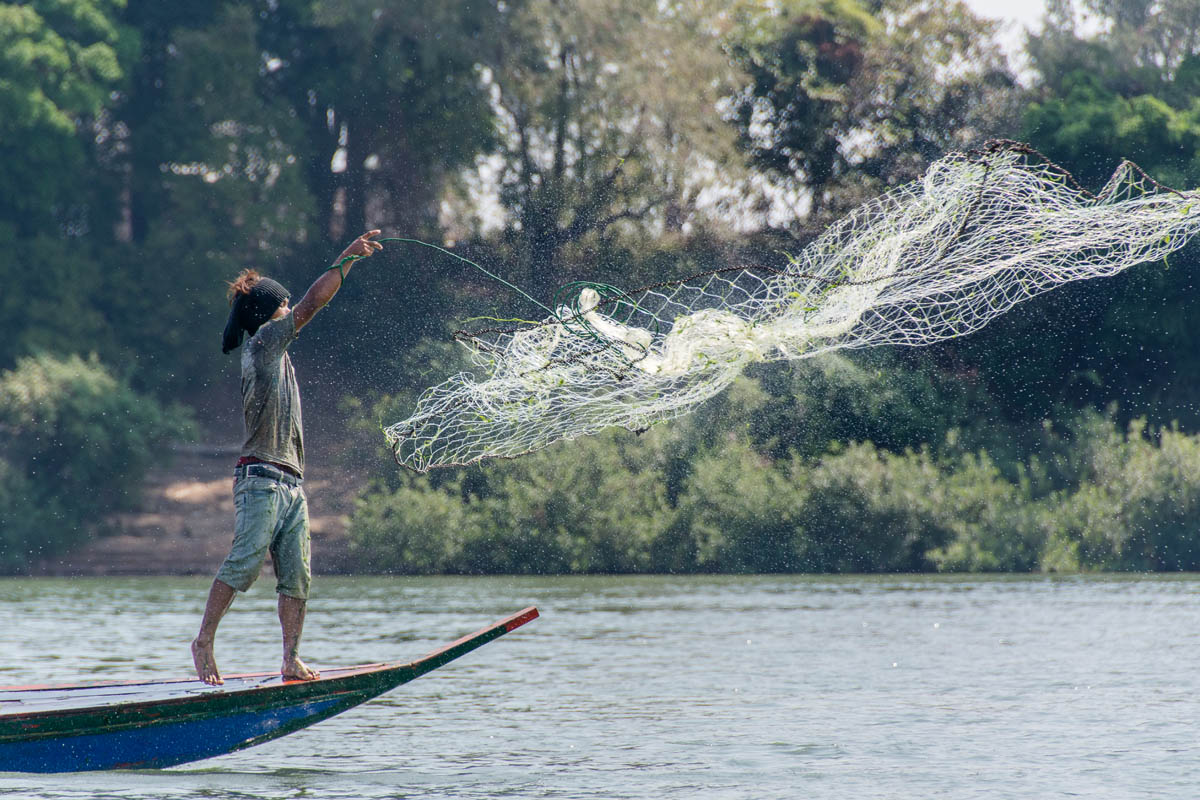
Fishers like Nous Sokaum said their catches have plummeted over the past three years. Sokaum said his typical daily catch used to be 100-200 kilograms per day. “Now I am lucky to catch five kilograms in two or three hours,” he said. Although their explanations differed there were common themes, especially illegal fishing and, in particular, the use high-voltage electrodes to stun and kill fish.
Villagers speculated that the decline in fish stocks could also be due to the impacts of dams already constructed upstream in Laos and China, which appear to be affecting the river. Kaeng Khin of Kampong Rote village on Rongeav island explained that, “everyone expected water levels to rise in the rainy season, but not in the dry season,” as she had experienced several times.
Experts are in agreement that a much bigger threat is on the horizon if the Sambor Dam goes ahead. According to a 2015 study by WorldFish and CGIAR, the Mekong is home to 781 fish species, making it one of the world’s most biodiverse rivers and an essential source of food security for the river basin. It also found that many of the river’s 165 migratory fish species would be impacted by the dams, causing fish yields to collapse.
According to the Cambodian Fisheries Administration, the Sambor Dam alone is predicted to reduce yields of fish and other aquatic animals by 16 percent to 30 percent.
The proposed dam site is also home to nine of around 90 Irrawaddy dolphins still estimated by WWF to live in the Mekong. These dolphins are already threatened by illegal fishing equipment like gill nets, said WWF Country Director Chhith Sam Ath. “Last year six dolphins died, but this was a reduction compared with 2015 when there were nine deaths,” he said. If the dam is built, Sam Ath thinks it is unlikely the remaining dolphins would survive.
Changes to the river’s ecology won’t just affect local aquatic life. The Mekong provides nutrients for fish all the way down the river and even feeds sea fish as the sediment plumes beyond the Vietnamese delta.
The sediment feeds the land, too
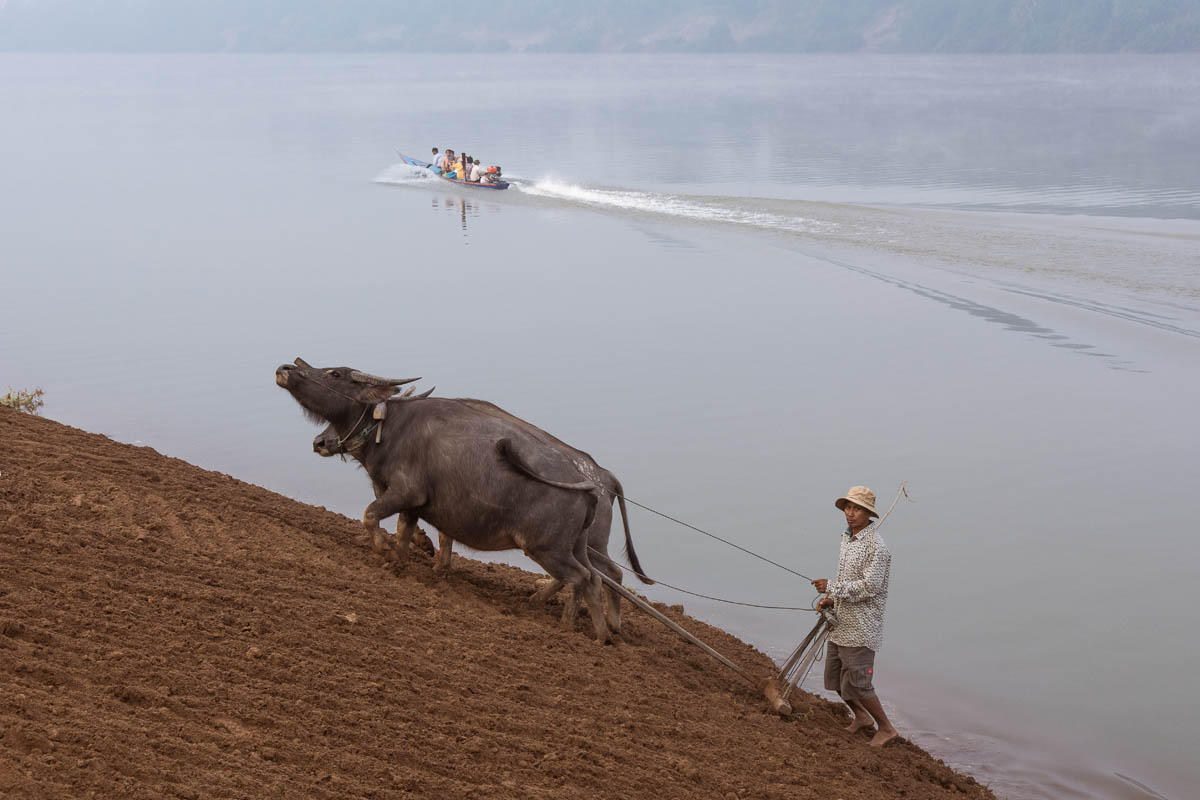
Plau Saret, 44, described how during the rainy season the river rises, flooding large parts of Tnaot island. “My rice fields get flooded,” she said. The silt deposited on her fields renewed the nutrients and led to a better rice crop, she explained, while her husband, Leurn Sittar, was tilling his vegetable gardens on the banks of the river both to make use of the rich alluvial sediment left behind in the soil. These precious sediment deposits are stopped by dams, instead settling in dam reservoirs.
Nous Sokaum, 66, is a member of the village council on the Island of Koh Real. Around ten years ago, he said, Chinese surveyors placed a concrete marker near his house to mark the dam site. Despite the apparent threat to his property, he remains positive about development in general. He said he agreed with fellow party members from the governing CPP who told him the dam “would be a good thing because it would provide a bridge across the river.”
Forest campaigners find this bridge a worrying prospect. On the west side of the river is the Prey Long forest, the most biologically important lowland forest remaining in Cambodia. According to forestry consultant Marcus Hardtke, previous dam projects unleashed a stampede of government-sanctioned logging to clear reservoir sites and usually this extended far beyond the reservoir boundary.
Civil society kept in the dark
In 2013, the Cambodian Government hired the San Francisco-based Natural Heritage Institute (NHI) to review hydropower generation options for the Sambor project. “NHI has assessed 10 alternative sites, designs, scales and operations including the originally proposed 2600 MW,” the institute’s CEO Gregory Thomas said by email. “[Five] ministries and many departments of the [Royal Cambodian Government] were briefed on the results of the assessment in December. The narrative report is forthcoming,” Thomas added.
“We heard of them [NHI], but they haven’t contacted us yet,” said WWF’s Chhith Sam Ath. He questions the assessment’s legitimacy: “If NHI is not going to do a consultation, in a participatory manner with stakeholders, then it’s wrong. It’s not actually representing the voice of people, or civil society, or community people in this area.”
With feasibility studies routinely withheld by the Government, civil society is keen that the NHI assessment is shared publically. However, Thomas explained that for now, “we are honoring the request of the RGC [Royal Cambodian Government] to limit distribution of the results of this assessment.”
According to Thomas, “The reticence of the RGC officials is based on their fear that critiques from the NGOs will be neither technically competent nor constructive. Is that well-founded? We have already seen some of them propagating uninformed speculation in lieu of facts.”
Founding Director of Mother Nature Cambodia Alejandro Gonzalez-Davidson criticized the NHI for its involvement in the Sambor project at a time when the Ministry of Mines and Energy is being questioned regarding a multi-million dollar corruption scandal, and governments and NGOs give the country poor marks for corruption.
“I find it extremely alarming that an organization that is funded by taxpayers money from the US is shaking hands with the Ministry of Mines and Energy,” Gonzalez-Davidson said. “This should not be a conversation about energy and electricity generation, it should be a conversation about how not to allow these gangsters [in the government] to go ahead with this new scheme – and destroy one of Cambodia’s most vital assets, the Mekong River.”
He is concerned that by engaging with the Government the NHI is lending legitimacy to the project. “This is something that the MME really wants. It’s all about green-washing their project,” he said.
Meanwhile, lack of information is a common complaint from villagers on islands that would be submerged if the original dam site is chosen. Most people had heard of the dam, often through NGO activities, but they were less certain about what the impacts would be: whether their land would be submerged, or even whether they would have to move out the way. If so, they did not know where they would have to go and whether they would receive compensation.
“There are four communes on Koh Tnaot island but only this one seems to care about the dam,” said Dung Sofu Eun, headman of Kampong Rote said. “I went to talk to other communes but the authorities were not really open. Even in commune meetings they don’t speak about the dam. I’m very concerned that we don’t have enough information.”
On Rongeav Island, Kaeng Khin said that when she ventured to a gathering in Phnom Penh to advocate for sustainable energy, her sister got a visit from eight policemen asking what Khin was up to. Khin said that her sister felt intimidated so paid them a considerable bribe to go away and leave her family alone — money that Khin repaid and for which she says she is now in debt. Khin reported the incident to human rights groups, but Mongabay was not able to independently verify her claim.
Gonzalez-Davidson — who in 2015 was deported for campaigning against the Areng dam – regards intimidation tactics as a familiar state ploy to push through infrastructure schemes: “Every single relevant state agency will lobby on behalf of the dam and most shockingly, they will try to stymie all efforts by activists, communities, and NGOs who are trying to stop the dam.”
Exploring alternative solutions
NGOs believe that some of the options being explored by NHI include dams which only partially block the river to supposedly allow sediment flow and migration. But Maureen Harris, Southeast Asia Program Director at International Rivers had misgivings: “We are not aware of evidence that these serious impacts can be effectively mitigated and these concerns have been expressed again and again including in the MRCs strategic assessment.”
The weight of evidence against the dam has led NHI to look into other alternatives. Thomas from NHI confirmed that a floating solar array on the Lower Sesan 2 reservoir is being explored as one of the “no dam” options that are part of their comparative assessment, which “will be completed by the end of 2017,” Thomas said. Floating array technology has attracted attention as a way of increasing reservoir efficiency because the floating solar panels deflect heat, so reducing evaporation.
“We have measured our land and registered it with the commune head,” said Plau Sareth. She explained that it might help to prove the extent of their land if they ever need to claim compensation. She plans to complain about the dam. “I am not sure if we will win and people don’t have a lot of knowledge or confidence that they will win against the government,” she said, but many of the Mekong islanders who Mongabay spoke to said that they are against the dam and will try to stop it.
Citations:
- China Southern Power Grid and Guangxi electric power industry (2008) The Kingdom of Cambodia feasibility study report of Sambor hydropower station. Nanning, China.
- ICEM, (2010) MRC Strategic Environmental Assessment (SEA) of hydropower on the Mekong mainstream, Hanoi, Viet Nam.
- Baran E., Guerin E., Nasielski J. (2015) Fish, sediment and dams in the Mekong. Penang,Malaysia: WorldFish, and CGIAR Research Program on Water, Land and Ecosystems (WLE).
- IFReDI, with inputs from R. Johnstone, E. Baran (WorldFish), Chheng P., Touch B.T., So N. and H.E. Nao Thuok. (2013) Food and nutrition security vulnerability to mainstream hydropower dam development in Cambodia. Synthesis report of the FiA/Danida/WWF/Oxfam project “Food and nutrition security vulnerability to mainstream hydropower dam development in Cambodia”. Inland Fisheries Research and Development Institute, Fisheries Administration, Phnom Penh, Cambodia.
- Global Witness (2016) Hostile Takeover – the corporate empire of Cambodia’s ruling family. Global Witness, London, UK.
First published on Mongabay.com


